IT Transformation & Modernization
Delivering IT Transformation End-to-End: From Strategy and Migration to Operations
Digital technologies and disruptive technology trends are reshaping business models, markets, and value chains at unprecedented speed. As a result, many organizations face significant pressure to transform their IT: legacy environments, fragmented IT organizations, and growing complexity often hinder innovation and scalability.
IT Transformation & Modernization addresses these challenges directly. Through structured transformation programs, clearly defined target-state architectures, and targeted IT infrastructure modernization, organizations can align their IT capabilities with the demands of a digital business environment – creating measurable, manageable, and future-ready outcomes.
Unlike isolated projects, IT transformation programs combine multiple initiatives under a shared strategic objective. This enables organizations to actively manage dependencies, migrations, and priorities while creating the transparency required for informed management decisions.
What Is IT Transformation & IT Modernization?
IT transformation refers to the comprehensive evolution of technology, IT organizations, and IT governance across the enterprise. The focus is on systematically advancing system landscapes, architectures, and operating models.
IT modernization represents the technology-focused component of this evolution. Existing applications, data structures, platforms, infrastructure environments, and cloud ecosystems are modernized, consolidated, optimized, or replaced to support future business requirements.
IT Transformation vs. Digital Transformation
The terms IT transformation and digital transformation are often used interchangeably, yet they address different levels of change:
- IT transformation focuses on advancing enterprise IT capabilities, including technology landscapes, architectures, and operating models.
- Digital transformation goes beyond IT and encompasses the broader transformation of business models, processes, and value creation through digital technologies.
In short: IT transformation impacts the IT organization, while digital transformation impacts the entire enterprise. IT transformation is therefore a critical enabler of digital transformation, but not the same thing.
What Typically Falls Under IT Transformation?
IT transformation and modernization extend far beyond infrastructure upgrades. They encompass the holistic evolution of enterprise IT—from technology and processes to organizational structures and governance.
A successful IT transformation program typically includes the following dimensions:
- Technology & Architecture: Modernization of applications, data structures, platforms, and IT infrastructure (including cloud, multi-cloud, and hybrid-cloud environments), as well as the definition of future-state architectures.
- Applications & Processes: Enhancement and consolidation of IT systems alongside the optimization and standardization of business processes to reduce complexity.
- Organization & Operating Model: Adjustment of roles, responsibilities, processes, and collaboration models within the IT organization and between IT and business functions.
- Governance & Control: Implementation of architecture standards, portfolio and demand management capabilities, as well as transparent KPI and reporting structures to guide transformation efforts.
- Transformation Execution & Migration: Planning and managing migration and transformation initiatives, including dependency management, prioritization, and transitioning into stable operations.
- Change, Skills & Culture: Developing required capabilities, adapting ways of working, and actively supporting organizational change to ensure successful adoption.
Core Technologies of IT Transformation
Technology selection depends on business requirements and the existing IT environment. Typical building blocks include:
- Cloud (including Multi-Cloud & Hybrid Cloud): Flexible scaling of IT resources, greater agility, and reduced infrastructure dependencies.
- Virtualization & Containerization: Efficient infrastructure utilization and the foundation for scalable, modern applications.
- DevOps & Modern Delivery Models: Closer integration between development and operations, enabling faster application delivery.
- Artificial Intelligence & Data Analytics: Leveraging data to drive automation, support decision-making, and optimize processes.
- Cybersecurity Solutions: Protecting systems, data, and infrastructure against an increasingly complex threat landscape.
- Automation & Orchestration: Reducing manual effort, increasing operational efficiency, and ensuring stable service delivery.
Building a Future-Ready IT Organization
Organizations must continuously adapt their IT capabilities to evolving market conditions, emerging technologies, and growing business demands. As a result, strategic IT development has become increasingly important – not only to ensure operational stability, but also to support long-term business objectives.
Goals and Drivers of IT Transformation in Companies
Organizations pursue IT transformation initiatives to adapt and advance their IT capabilities in response to changing requirements. At the same time, these programs are often driven by specific structural challenges within the IT landscape:
- Reducing complexity and operating costs by modernizing or replacing legacy systems
- Creating more consistent and manageable structures through greater system, process, and platform harmonization
- Increasing scalability and flexibility to support future business and technology requirements
- Enabling the fast and structured integration or separation of IT environments during M&A and post-merger integrations
- Ensuring business continuity throughout transformation and migration programs
- Strengthening cybersecurity, data protection, and resilience against growing cyber threats
- Modernizing IT systems and infrastructure through cloud, multi-cloud, and hybrid-cloud approaches
- Positioning IT as a strategic enabler of long-term innovation
AI as a Driver of IT Transformation
Generative and agentic AI are redefining what future-ready IT organizations must deliver. AI is no longer a downstream use case – it is increasingly becoming an architectural decision when deployed at enterprise scale.
Organizations require AI-ready data foundations, including data quality management, retrieval-augmented generation (RAG) architectures, vector databases, and knowledge repositories. They must make deliberate choices about where intelligence resides – on-premises, cloud-based, or hybrid – and establish orchestration layers to manage AI services and autonomous agents.
For regulated and IP-sensitive industries such as automotive and manufacturing, digital sovereignty becomes a critical success factor. Data residency, intellectual property protection, and compliance with regulations such as the EU AI Act are no longer afterthoughts—they are core architecture and governance requirements.
EFS Consulting helps organizations move AI from pilot initiatives into scalable, controlled production environments, establishing clear guidelines for model selection (open-source vs. proprietary), data governance, and cost management, including FinOps capabilities for AI workloads.
Key Steps in IT Transformation & IT Modernization
Organizations typically implement IT transformation initiatives through a structured approach:
- Define Vision & Strategy: Establish future-state IT objectives and priorities aligned with business strategy.
- Assess the Current IT Landscape: Create transparency regarding systems, processes, and infrastructure as the basis for decision-making.
- Develop a Transformation Roadmap: Define initiatives, priorities, milestones, and dependencies.
- Execute Modernization & Migration: Transform IT environments incrementally, including cloud platforms, infrastructure, and applications.
- Establish Governance & Control: Implement PMO structures, clear accountability, KPIs, and reporting mechanisms.
- Adapt the Organization & Operating Model: Evolve the IT organization toward service-oriented and process-driven structures.
- Develop Skills & Enable Change: Equip employees with new capabilities and embed new ways of working.
- Ensure Security & Stability: Maintain cybersecurity, data protection, and business continuity throughout the transformation.
Opportunities and Challenges of IT Transformation
IT transformation enables organizations to systematically evolve their IT capabilities while responding to changing business demands. At the same time, complexity and execution challenges increase.
Opportunities for Companies
- Modernizing the IT Landscape: Replacing outdated architectures with scalable, future-ready platforms.
- Greater Flexibility and Scalability: Responding faster to market developments and emerging technologies.
- Reduced Complexity: Eliminating data silos and improving integration across systems and processes.
- Enabling Innovation: Accelerating the adoption of new technologies and the execution of strategic initiatives.
Key Challenges in the Implementation
- Integrating New Technologies into Existing Environments: Managing the complexity of migrating and connecting heterogeneous systems.
- Resistance to Change: Overcoming limited acceptance of new technologies, processes, and ways of working.
- Security and Compliance Requirements: Meeting growing demands for cybersecurity, privacy, and regulatory compliance.
- Limited Resources and Budgets: Balancing ambitious transformation goals with finite capacity and funding.
- Technology Selection and Alignment: Identifying solutions that fit both business requirements and the existing IT landscape.
EFS Consulting Service Portfolio in the Context of IT Transformation & IT Modernization
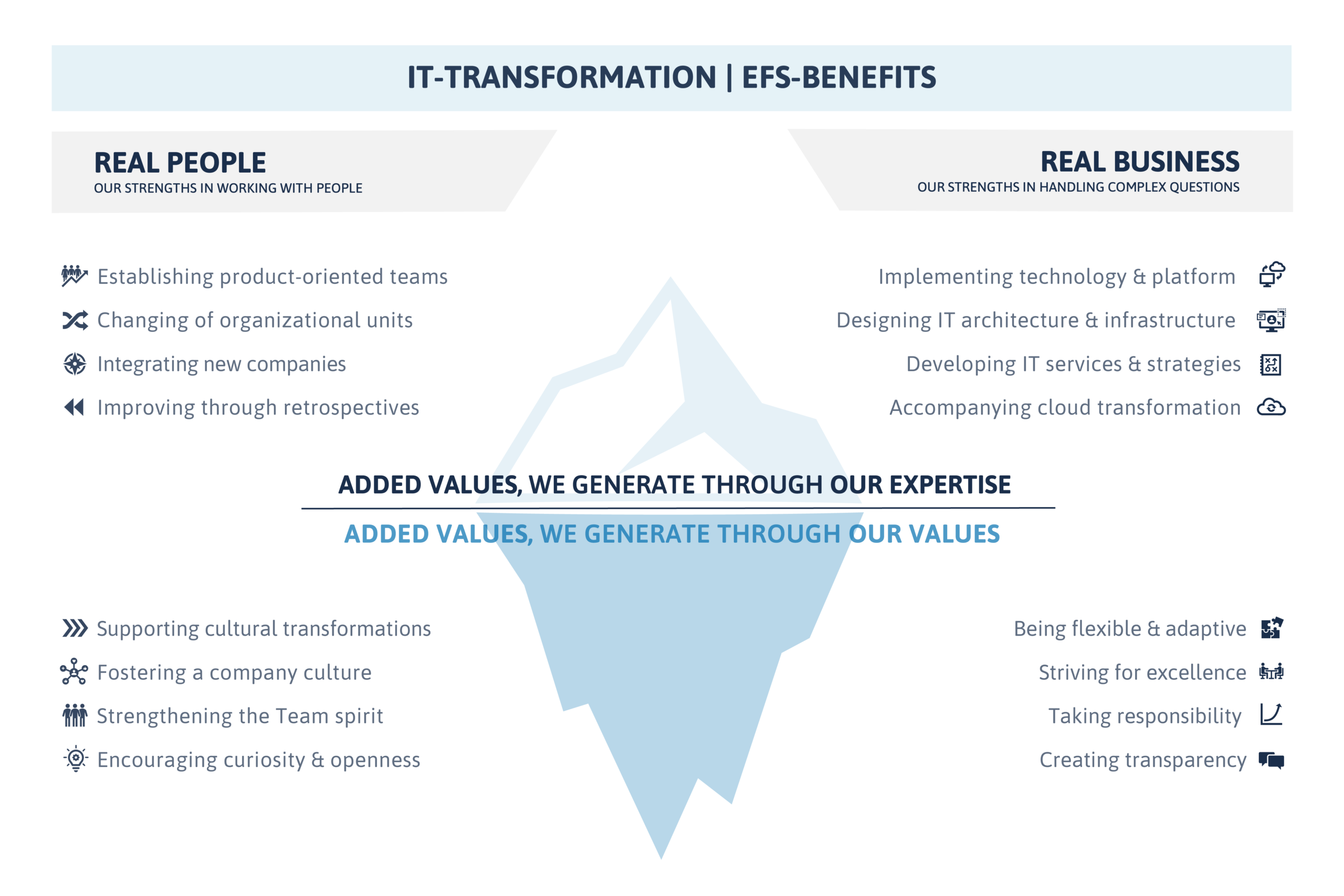
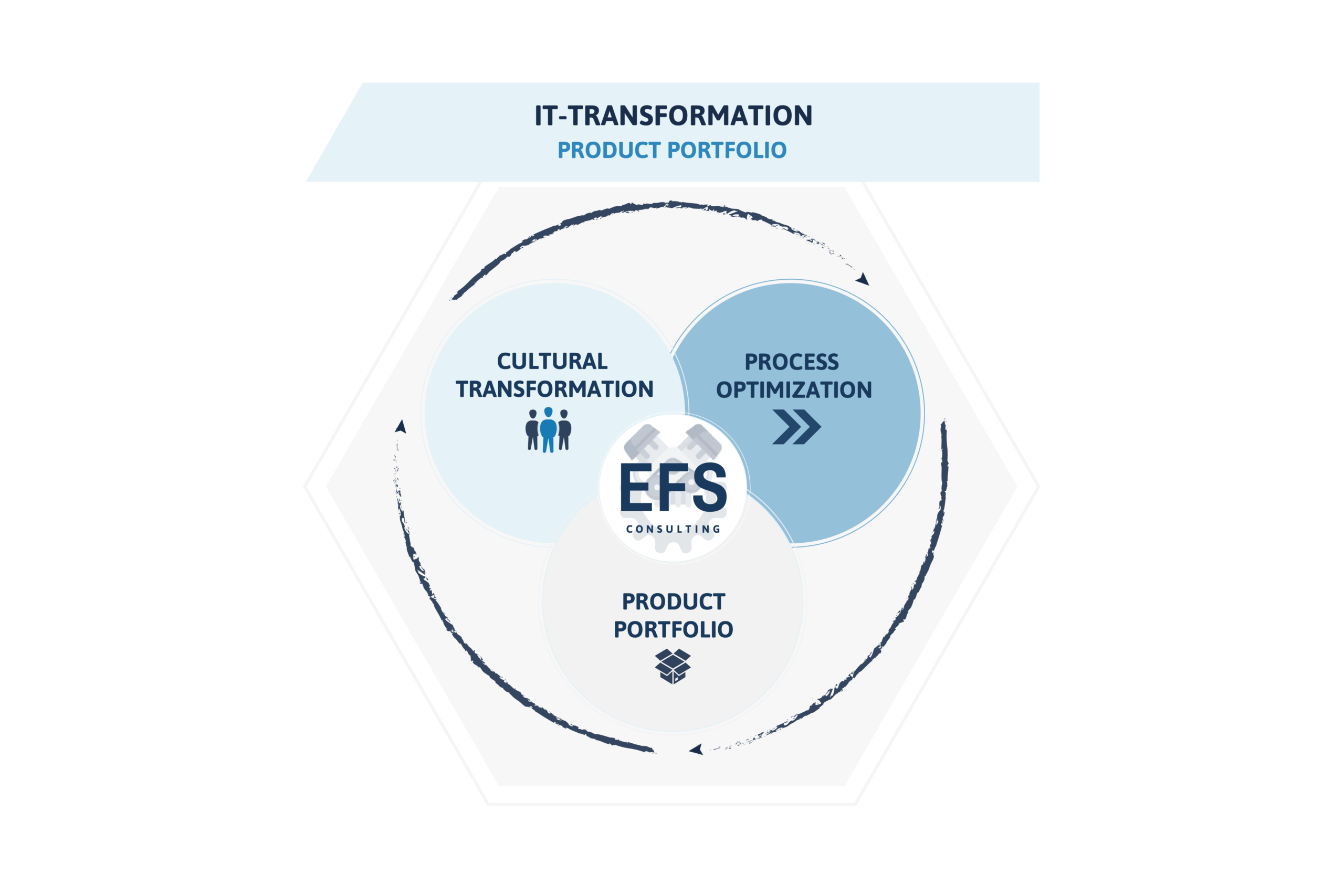
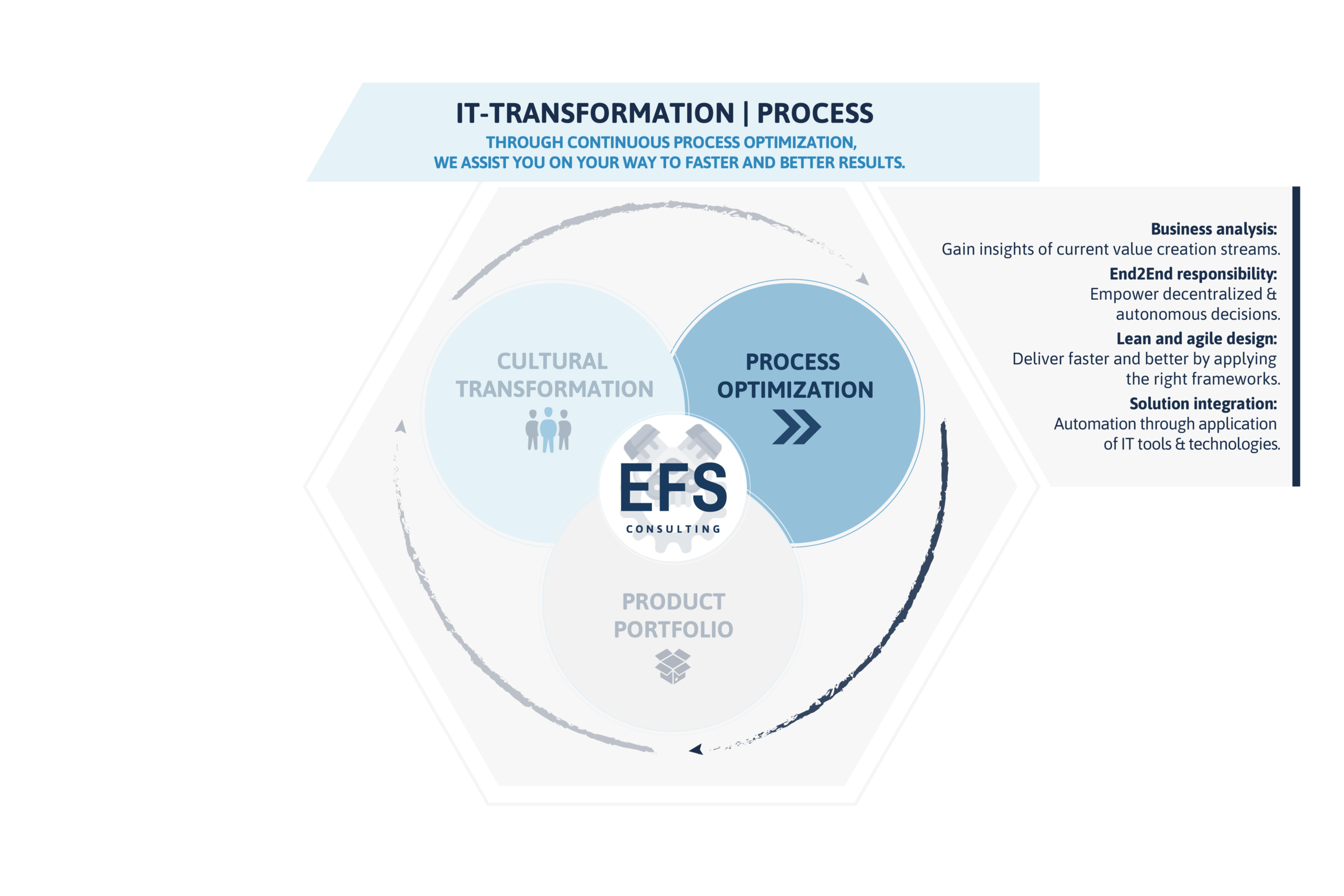
The EFS Consulting service portfolio for IT Transformation & IT Modernization is designed to establish and manage IT transformation programs where strategy, architecture, execution, and organizational change work together in a structured, controllable, and results-oriented manner.

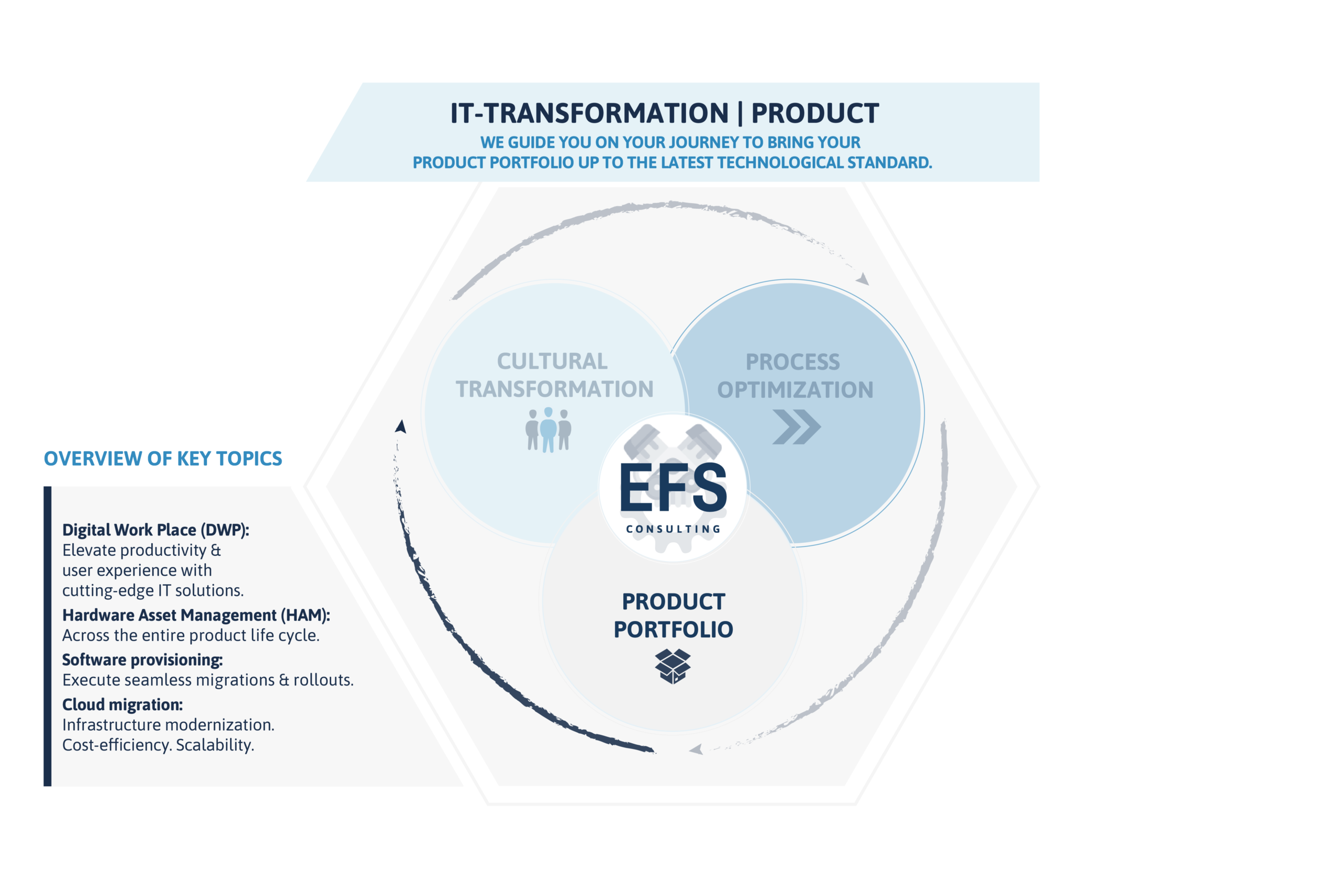
The Following Areas are Covered by EFS
The following service offerings illustrate how EFS Consulting enables organizations to execute IT transformations with confidence, reduce complexity, and establish a resilient foundation for growth and innovation:
- IT Transformation Programs & PMO
- Legacy Transformation & IT Modernization
- IT Harmonization
- IT Integration Following Acquisitions
- IT Transition Management
- Testing, Rollout & Deployment Management
- IT Organizational Change Management
1. IT Transformation Programs & PMO
We manage complex IT transformation programs through structured governance and full transparency across initiatives, workstreams, and dependencies.
EFS Consulting Services:
- Management of complex IT transformation programs
- Design and operation of PMO, governance, and reporting structures
- Coordination of parallel workstreams and dependencies
- Management of risks, budgets, resources, and progress
- Support for hybrid and agile delivery models
2. Legacy Transformation & IT Modernization
We modernize legacy IT environments and support the transition from outdated systems to scalable target-state architectures.
EFS Consulting Services:
- Modernization of IT and application landscapes
- Legacy system transformation and replacement
- Mainframe modernization and re-platforming
- Re-architecting existing system landscapes
- Data migration and data cleansing initiatives
- Definition of target and transition architectures
3. IT Harmonization
Fragmented systems, processes, and platforms increase complexity and operational costs. EFS Consulting helps organizations harmonize their IT environments, establish standards, and create a consistent technology foundation.
EFS Consulting Services:
- Harmonization of IT systems and platforms
- Consolidation of applications and services
- Standardization of processes and service models
- Definition of technology standards and architectural principles
- Reduction of complexity and system interfaces
4. IT Integration Following Acquisitions
In the context of Mergers & Acquisitions (M&A) and Post-Merger Integration (PMI), IT plays a critical role in ensuring operational stability, business continuity, and the realization of synergies. EFS Consulting supports organizations in the integration or separation of complex IT landscapes, helping them navigate technological, organizational, and operational challenges throughout the transition process.
EFS Consulting Services:
- IT integration during mergers and acquisitions
- Post-merger integration of IT organizations and platforms
- Planning and execution of IT carve-outs
- Day-1 readiness management
- Harmonization of services, governance, and operating models
- Coordination of integration and separation activities
5. IT Transition Management
The transition from a defined target state to stable operations requires structured planning, clear accountability, and controlled execution. EFS Consulting helps organizations successfully transition new systems, services, and operating models into day-to-day operations while minimizing risk and ensuring business continuity.
EFS Consulting Services:
- Transition planning and wave planning
- ITIL-oriented service transition management
- Management of critical transition phases
- Stabilization of hybrid operating models
- Business continuity management during transformation
- Operational handover and hypercare management
6. Testing, Rollout & Deployment Management
Successfully introducing new systems and processes requires structured testing, controlled rollouts, and reliable deployment processes. EFS Consulting helps organizations minimize implementation risks and ensure a smooth transition into production by managing testing, deployment, and go-live activities in a structured and controlled manner.
EFS Consulting Services:
- Deployment and rollout management, including international programs
- Test management and quality assurance
- Coordination of production go-lives
7. IT Organizational Change Management
The success of IT transformations depends largely on adoption, effective communication, and sustainable organizational integration. EFS Consulting helps organizations embed change systematically into their structures, collaboration models, and ways of working- ensuring that transformation is embraced, understood, and successfully anchored across the organization.
EFS Consulting Services:
- Enterprise IT change management
- Support for organizational transformation
- Stakeholder and communications management
- Evolution of roles and collaboration models
- Implementation of new ways of working and operating models
- Enablement and organizational adoption of new processes
The Typical IT Transformation Dilemma: A Clear Vision – but No Path Forward
Many organizations know exactly where they want their IT organization to go: modern architectures, cloud-based platforms, scalable systems, and increased innovation.
Yet transformation efforts often stall – not because the strategy is unclear and not because technology is unavailable, but because execution proves far more complex than expected.
Legacy systems, fragmented environments, and years of accumulated complexity create significant barriers. Systems are disconnected, processes are inconsistent, and dependencies lack transparency, turning every change initiative into a major undertaking. At the same time, multiple initiatives compete for attention and resources—modernization programs, migrations, new platforms, and M&A integrations.
Perhaps most importantly, transformation must occur while day-to-day operations continue uninterrupted. Organizations must maintain business continuity while implementing new target-state architectures, responding to cyber threats, meeting compliance requirements, and accelerating innovation.
The result: the destination is clear, but the structure required to reach it is missing.
This is where EFS Consulting comes in: Through a structured and pragmatic approach, we help organizations reduce complexity, manage dependencies, and establish transformation programs that deliver measurable and sustainable progress.
Why EFS Consulting?
Successful IT transformation requires more than technology projects. It requires structure, governance, and execution capabilities that work within complex enterprise environments. At EFS Consulting, we understand a fundamental truth: technology, processes, and tools are only as effective as the people who use them. Most transformation initiatives do not fail because of technology- they fail because people are not fully engaged.
We engage those affected by change, turn stakeholders into active participants, and shape the transformation together:
- Structured governance instead of project fragmentation through clear governance models, prioritized roadmaps, and active dependency management
- A holistic transformation approach integrating technology, operating models, organizational change, migration, and governance
- Pragmatic execution that translates target-state visions into realistic, operationally viable implementation plans
- Experience in complex transformation environments, including international programs, decentralized organizations, and M&A scenarios
- Business continuity throughout change, ensuring operational stability while transformation progresses
- Transparency for informed decision-making through clear KPIs, reporting structures, and governance mechanisms
- A focus on sustainable simplification, reducing complexity across IT landscapes and processes
Clients benefit from extensive experience and deep industry expertise gained through large-scale IT programs at automotive OEMs and suppliers—from PLM implementations and post-merger integrations to carve-outs and the development of complex enterprise system landscapes.