SAP Business Transformation Management: Managing Transformation Holistically
Transformation is about more than modernizing systems: strategy, processes, data, technology and people need to evolve together. Without a clear target state, existing complexity and dependencies risk being carried over into the new landscape.
SAP Business Transformation Management (SAP BTM) connects process and system architecture and creates transparency across the current state, target state and necessary changes. In this insight, you will learn how SAP BTM and Transformation Architecture work together and how SAP Signavio, SAP LeanIX, WalkMe and SAP BTP support the journey from the current state to sustainable transformation.
Table of contents
Key Takeaways
- SAP Business Transformation Management (SAP BTM) is a holistic approach to planning, managing and governing enterprise transformation across processes, Enterprise Architecture and Digital Adoption.
- SAP Signavio, SAP LeanIX and WalkMe support process optimization, Enterprise Architecture Management and the adoption of new technologies in day-to-day work.
- Transformation Architecture connects strategy, processes and IT in a shared target state and provides the foundation for a prioritized Transformation Roadmap.
- SAP BTP complements transformation from a technology perspective by supporting integration, extensions and automation.
- The goal is sustainable transformation capability: Transformation is not viewed as a one-time migration, but as the continuous improvement of business and IT.
- From strategy to architecture. From architecture to transformation. From transformation to measurable business value.
Why SAP Transformation is More Than an IT Transformation
Focusing only on systems does not go far enough in an SAP transformation. SAP S/4HANA, cloud adoption, Clean Core and emerging technologies simultaneously affect processes, data, roles and the entire application landscape. Without a shared target state, existing complexity and dependencies risk simply being transferred into the new system landscape.
This is why business and IT need to be aligned around a common future state. This is where Business Transformation Management and Transformation Architecture come together.
What Is SAP Business Transformation Management (SAP BTM)?
SAP Business Transformation Management, or SAP BTM, is a holistic approach to planning, executing and managing enterprise-wide transformation. It considers strategy, processes, technology and the people within the organization together. SAP describes Business Transformation Management as an approach that helps organizations plan, execute and govern enterprise-wide transformation initiatives.
It is neither another ERP system nor a single software product. Instead, it brings together specialized solutions that provide transparency and control across different dimensions of transformation.
The SAP BTM portfolio currently focuses primarily on three areas:
- Process Intelligence
- Enterprise Architecture
- Digital Adoption
SAP brings together SAP Signavio, SAP LeanIX and WalkMe to address these areas.
The underlying logic is essential for successful transformation: Understand how the organization works today. Define how it should operate in the future. Implement change in a structured way and ensure that it is successfully adopted in day-to-day operations.
This shifts the focus from isolated technology projects to integrated transformation management.
From Individual Transformation Projects to Holistic Transformation Management
Traditional transformation programs are often organized around individual projects: implementing a new ERP system, harmonizing processes or replacing an existing application.
Each initiative may make sense on its own. Complexity arises when multiple initiatives affect the same processes, Business Capabilities, data or applications.
Holistic Business Transformation Management therefore looks beyond individual projects and considers the dependencies between the strategic target state and operational implementation.
At its core, several layers need to be connected:
Strategy and Business Objectives
↓
Business Capabilities
↓
Business Processes
↓
Enterprise & Application Architecture
↓
Data and Technology
↓
Transformation Initiatives
↓
Adoption and Organizational Anchoring
SAP follows a comparable integrated perspective with its BTM portfolio: SAP LeanIX addresses Enterprise Architecture, SAP Signavio focuses on business processes and WalkMe supports Digital Adoption.
For organizations, this creates an essential foundation: transparency about what needs to change, why the change is necessary, what the optimal target state looks like and which dependencies need to be considered during implementation.
The Core Components of SAP Business Transformation Management
Successful Business Transformation affects multiple layers of an organization at the same time. This is why SAP combines specialized solutions within its BTM portfolio as part of a transformation toolchain rather than addressing every requirement through a single system.
SAP Signavio: Understanding and Transforming Processes
SAP Signavio addresses the process dimension of transformation. The solution helps organizations create transparency across existing business processes, analyze how they actually operate using live data, identify optimization potential and implement improvements.
This perspective is essential for transformation. Before moving processes into a new system landscape, organizations should understand which processes create real value, where standardization makes sense and which legacy structures should not simply be carried over into the target architecture.
SAP LeanIX: Enterprise Architecture as a Foundation for Better Decisions
SAP LeanIX complements the process perspective with Enterprise Architecture Management (EAM). Its focus is on enterprise and IT architecture, particularly existing applications and the relationships between them.
SAP describes LeanIX as a solution that helps organizations create transparency across their system landscape, manage complexity and plan future transformations using connected Enterprise Architecture data.
This is particularly relevant for large-scale transformations. Historically grown application landscapes often contain overlaps, dependencies and technological complexity. A structured architecture perspective helps organizations move beyond documenting the current state and use those insights to make decisions about the future landscape.
Which applications will still be needed? Which can be consolidated or replaced? Which systems support which Business Capabilities? And what dependencies need to be considered during transformation?
These questions directly connect Enterprise Architecture with the Transformation Roadmap.
WalkMe: Embedding Transformation in Day-to-Day Work
A technically successful implementation does not automatically mean that transformation has been successfully embedded in the organization. New processes and systems only deliver sustainable value when people understand and use them in their daily work.
This is where WalkMe comes in, with its focus on Digital Adoption and digital change. WalkMe supports users within digital workflows and helps organizations guide the adoption of new technologies.
WalkMe therefore adds a crucial dimension to the architecture and process perspectives: people within the transformation.
The logic is straightforward: an optimized target architecture and harmonized processes only create business value when new solutions and ways of working are actually adopted and used, while organizational governance and compliance requirements continue to be respected.
SAP BTP: The Technology Foundation Within the SAP Ecosystem
The SAP Business Technology Platform (BTP) needs to be distinguished from the three core BTM solutions. It does not address the same management dimension as SAP Signavio, SAP LeanIX or WalkMe. Instead, within the broader SAP portfolio, it provides a platform for integration, extensions and automation and represents another part of the digital toolchain.
This technology layer is highly relevant for holistic transformation. While Business Transformation Management provides transparency across processes, architecture and adoption, the resulting target architecture still needs to be implemented technologically and existing and new applications need to be connected.
The two perspectives can therefore be clearly distinguished:
- SAP BTM helps create transparency and manage transformation holistically.
- SAP BTP provides the technological foundation for integration, extensions and automation within the SAP landscape.
This distinction is important to avoid equating Transformation Architecture with technology architecture alone.
Transformation Architecture as the Foundation of Every Transformation
Digital transformation affects more than systems. It impacts processes, applications, data, organizational structures and ways of working. Transformation Architecture brings these dependencies together on a common layer and connects corporate strategy with concrete implementation.
The objective is to create clarity about where the organization stands today, what the future business and IT landscape should look like and which changes are required to get there.
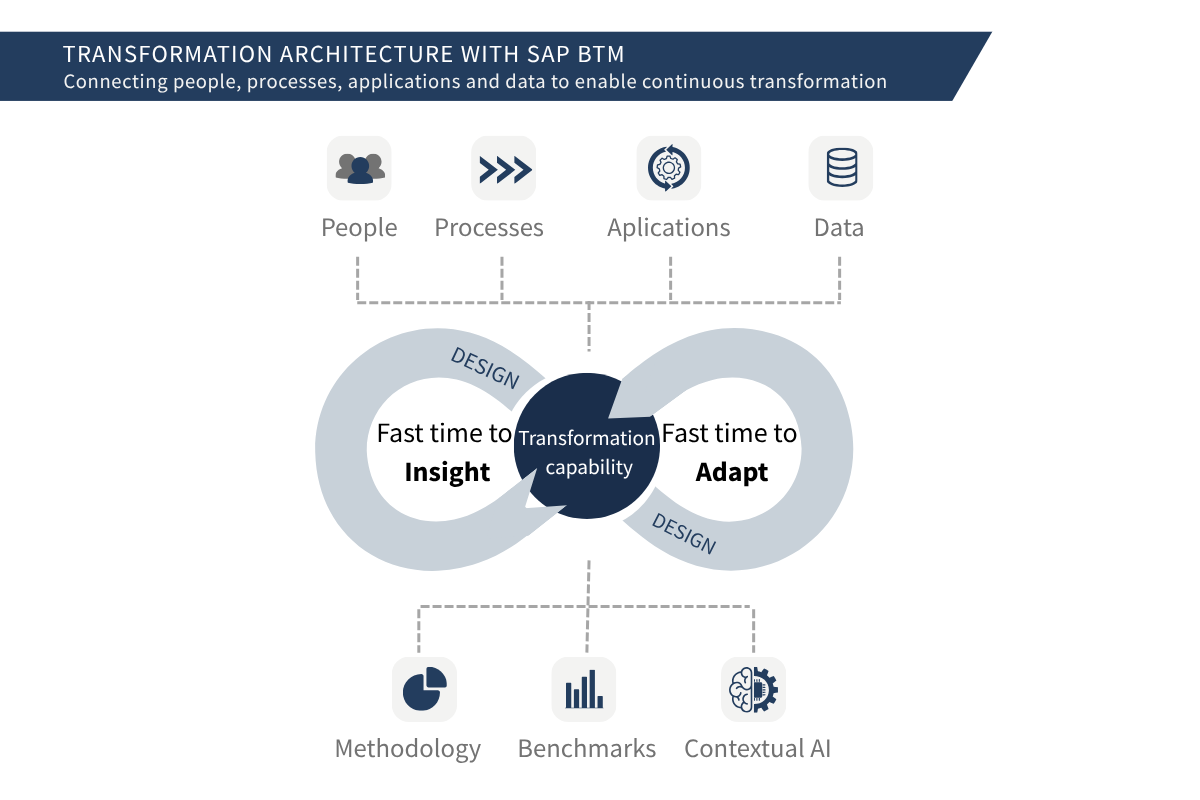
Transformation Architecture connects people, processes, applications and data, creating a foundation for continuous change. The cycle between “Fast Time to Insight” and “Fast Time to Adapt” illustrates the underlying idea: transformation means continuously turning insights into concrete improvements.
What Is Transformation Architecture?
Transformation Architecture describes the journey from the current state to a defined target state. While Enterprise Architecture creates transparency across existing structures and dependencies, Transformation Architecture focuses specifically on how these structures need to change.
Three simple questions guide the approach:
- Where are we today? What processes, applications and dependencies currently exist?
- Where do we want to go? Which Business Capabilities, processes and technologies will we need in the future? What is the optimal target architecture?
- How do we get there? Which changes are required and in what sequence should they be implemented?
Transformation Architecture is not another SAP tool. It is a methodological framework that aligns business, process and technology decisions with a shared transformation objective.
From the Current State to the Target Architecture
Successful transformation does not begin with selecting a technology. It begins with a clear understanding of the current state and the desired target state.
The underlying logic:
Business Strategy
↓
Business Capabilities
↓
Processes & Organization
↓
Data & Applications
↓
Technology & Integration
↓
Target Architecture
↓
Transformation Roadmap
This creates an end-to-end connection between strategic transformation needs and concrete implementation.
Business Capabilities as the Starting Point
The first question is: What does the organization need to be capable of in the future?
Business Capabilities describe the capabilities required to achieve strategic objectives, independently of individual systems. This makes it possible to identify which capabilities are strategically important, where development is required and which processes or applications are affected.
Technology decisions therefore follow business requirements, not the other way around.
Taking an End-to-End View of Processes
The next step is to critically assess existing processes. SAP Signavio helps create process transparency, analyze current performance and identify opportunities for improvement.
The essential question should not be: “How do we move our existing process into the new system?” but: “How should this process operate optimally within our future system architecture, and which architecture supports it best?”
This perspective helps prevent historically grown complexity from simply being transferred into a new system landscape.
Creating Transparency Across the Application and IT Landscape
At the same time, organizations need to understand which applications support their processes and Business Capabilities and what dependencies exist between them. SAP LeanIX complements the process perspective through Enterprise Architecture Management.
Relevant questions include:
- Which applications will still be needed in the future?
- Where do redundancies or critical dependencies exist?
- Which systems should be modernized, consolidated or replaced?
Enterprise Architecture thus evolves from a documentation exercise into a decision-making foundation for transformation.
Target Architecture: Defining the Future State
The Target Architecture defines how business and IT should work together in the future. It brings business objectives, processes, organization, data, applications and technology together in a shared target state.
The decision-making logic is:
Strategy → Capability → Process → Architecture → Technology
This makes it clear why a particular change is required and how it contributes to the overall transformation objective.
From Target Architecture to Transformation Roadmap
A target state alone is not enough. It needs to be translated into concrete and prioritized transformation steps.
Not every change can happen at the same time. Process harmonization may be a prerequisite for system consolidation, new architectures may create additional integration requirements, and organizational changes may in turn enable new processes.
The Transformation Roadmap therefore answers one essential question:
What do we need to change, and when, to reach the optimal target state step by step?
This turns Target Architecture into an actionable Transformation Roadmap that considers business and technology together.
SAP BTM and S/4HANA: Transformation Instead of Pure System Migration
An SAP S/4HANA transformation provides an opportunity to renew more than technology alone. If existing processes, extensions and dependencies are transferred unchanged, the complexity of the legacy landscape may remain.
Holistic transformation therefore starts earlier, with the future business model, required Business Capabilities, End-to-End Processes and the desired Target Architecture. SAP also positions ERP transformation with an integrated toolchain as a BTM use case.
Challenging Existing Structures
Before implementation begins, organizations should determine what belongs in the future landscape and what should consciously be changed. This includes:
- process variants and custom extensions
- redundant applications
- complex interfaces
- dependencies between SAP and non-SAP systems
- organization-specific workarounds
The key question is not: “How do we transfer our current landscape?” but: “Which processes and structures will we need in the future, and what should the optimal future landscape look like?”
This turns S/4HANA from a pure migration project into part of a broader Business Transformation.
What Organizations Can Achieve with SAP Business Transformation Management
SAP BTM provides a foundation for viewing processes, architecture and adoption as interconnected dimensions rather than isolated areas. SAP itself emphasizes transparency across the current state and alignment between business, IT and operations.
Create Transparency
What needs to change, and which areas will be affected?
Connecting process and architecture data makes dependencies visible and helps identify relevant areas for action.
Align Business and IT Around a Shared Target State
Business objectives and technology decisions should follow the same logic:
Business Objective → Capability → Process → Architecture → Transformation Initiative
This creates transparency around which business need each technological change is designed to address.
Identify Transformation Risks Early
Complex transformations involve numerous dependencies across processes, applications, data and organizational structures. Making these dependencies visible at an early stage allows them to be incorporated into the target architecture and Transformation Roadmap.
Enable Continuous Transformation
Transformation does not end at go-live. Markets, technologies and processes continue to evolve. Transformation management therefore needs to support continuous change as well.
SAP also positions BTM as a foundation for continuous transformation and increasingly connects its portfolio with an agent-led toolchain.
From an Integrated Toolchain to Agent-Led Transformation
AI Agents are adding another dimension to Business Transformation. SAP positions its BTM portfolio as part of an agent-led toolchain designed to support transformation, cloud migration and modernization.
As a result, the connection between processes, Enterprise Architecture and governance becomes even more important. Organizations need to understand not only their existing systems and processes, but also where AI Agents should be integrated into the enterprise landscape and how they should be governed.
At the same time, AI Agents need the right context to identify the relevant workflows and access the appropriate data sources. This requires transparency across processes, applications and data in the first place.
From a Transformation Architecture perspective, this expands the future target state: alongside applications, data and integrations, AI Agents and their governance increasingly need to be considered as part of the architecture.
Success Factors for SAP Business Transformation Management
Technology alone does not make transformation successful. What matters is consistently connecting business objectives, processes, architecture and implementation.
Target State Before Technology
The available tool should not determine where the organization is heading. The starting point should be strategic objectives, required Business Capabilities and future End-to-End Processes. Technology requirements should then be derived from these needs.
Connect Business, Processes and Architecture
Transformation does not work in silos. Business requirements need to be connected with processes, applications, data and technological dependencies.
Transformation Architecture provides the shared decision-making foundation for this.
Balance Standardization and Differentiation
Not every existing process variant or custom extension needs to remain part of the future landscape. At the same time, maximum standardization is not always the right answer.
The key question is:
Where does standardization reduce unnecessary complexity, and where does differentiation create genuine business value?
Especially in an S/4HANA transformation, this perspective helps organizations actively challenge legacy structures instead of simply modernizing them technologically.
EFS Consulting Expertise: From SAP Transformation to Sustainable Business Transformation
Successful transformation does not end with a Target Architecture or Transformation Roadmap. The key is to translate strategic decisions into concrete change, embed that change within the organization and make its business value measurable.
In the long term, the objective is therefore not only to complete an individual SAP transformation successfully, but to establish transformation as an ongoing organizational capability.
This requires a continuous cycle:
1. Understand
Create transparency across processes, Business Capabilities, applications, data and dependencies.
2. Transform
Develop a target state, prioritize change and bring the required initiatives together in an actionable Transformation Roadmap.
3. Evolve
Embed new processes and technologies, monitor their impact and continuously evolve the architecture in line with changing requirements.
This changes the central question from: “How do we successfully complete this transformation?” to: “How do we build the capability to continuously transform our organization in a structured way and create genuine operational agility?”
This is where the long-term value of holistic Business Transformation Management lies.
Conclusion: SAP Transformation Requires a Shared Target State
SAP Business Transformation Management connects processes, Enterprise Architecture and Digital Adoption. A clear Transformation Architecture brings these perspectives together in a shared target state and provides the foundation for manageable and sustainable transformation.
Understand. Design. Transform. Measure. Continuously improve. This is Transformation Architecture with SAP Signavio × SAP LeanIX.
EFS Consulting helps organizations align business, processes and technology holistically and translate them into clear Transformation Architectures and actionable roadmaps. Looking to make your transformations more strategic and sustainable? Talk to our experts.
FAQs
What is SAP Business Transformation Management?
Which solutions are part of SAP Business Transformation Management?
Key SAP BTM solutions include SAP Signavio for processes, SAP LeanIX for Enterprise Architecture and WalkMe for Digital Adoption.
What is the difference between SAP BTM and SAP BTP?
SAP BTM focuses on the holistic management of transformation. SAP BTP provides the technology platform for integration, extensions and automation.
What is the difference between Enterprise Architecture and Transformation Architecture?
Enterprise Architecture creates transparency across business and IT structures. Transformation Architecture focuses on their structured evolution from the current state to the target architecture.
What role does SAP LeanIX play in Business Transformation Management?
SAP LeanIX supports Enterprise Architecture Management and creates transparency across applications, dependencies and the future IT landscape.
What role does SAP Signavio play in Business Transformation Management?
SAP Signavio helps organizations analyze, model and systematically optimize business processes.
What role does WalkMe play in an SAP transformation?
WalkMe supports Digital Adoption and helps embed new systems, processes and digital ways of working into day-to-day operations.
How does SAP BTM support an S/4HANA transformation?
SAP BTM connects process, architecture and adoption perspectives, allowing an S/4HANA transformation to go beyond pure technical migration. This creates a foundation for continuous improvement, cost optimization and new value creation, while building the process and architecture transparency required for future AI Agents.
How does EFS Consulting support organizations with SAP transformation?
EFS Consulting connects business, processes, organization and IT to translate strategic objectives into a consistent transformation target and an actionable roadmap.
Does EFS Consulting support the development of an SAP Transformation Roadmap?
Yes. The target state, transformation requirements, dependencies and priorities are structured and translated into concrete transformation steps.
Does EFS Consulting only consider SAP systems?
No. Holistic transformation considers relevant SAP and non-SAP systems as well as the dependencies between them.
How does a holistic SAP transformation with EFS Consulting start?
The starting point is a clear understanding of the transformation ambition, current state and target state. From there, relevant areas for action, dependencies and a Transformation Roadmap can be derived.

Authors