What is Enterprise Architecture Management (EAM)?
Companies today face the challenge of managing increasingly complex IT landscapes effectively, while also handling digital transformation, regulatory requirements and technological innovation. Enterprise Architecture Management (EAM) acts as a business enabler in this context, helping organizations to navigate complex structures, connect business and IT, and ensure that technological decisions measurably contribute to corporate strategy. This article explains how modern EAM works, the elements it comprises, and its importance for future-ready organizations.
Table of contents
Key Takeaways
- Enterprise architecture management (EAM) is a strategic management instrument that holistically designs and evolves enterprise architecture.
- The four domains of EAM architecture are (1) business architecture, (2) data architecture, (3) application architecture and (4) technology architecture.
- 70 % of EFS Consulting clients lack sufficient transparency regarding applications, costs and risks at the start of projects.
- Organizations can benefit from EAM through increased transparency, standardization, cost reduction, compliance, faster transformation and better decision-making.
Fundamentals: What is Enterprise Architecture Management (EAM)?
Enterprise Architecture Management (EAM) is an approach to managing the holistic design and governance of enterprise architecture. EAM ensures that a company’s strategy, business processes, data, applications, and technologies are aligned. A central component of EAM is the transparent representation of the organizational structure and IT architecture, which makes dependencies understandable. The goal of EAM is to create transparency, reduce redundancies, ensure compliance, and provide a stable foundation for digital transformation and innovation.
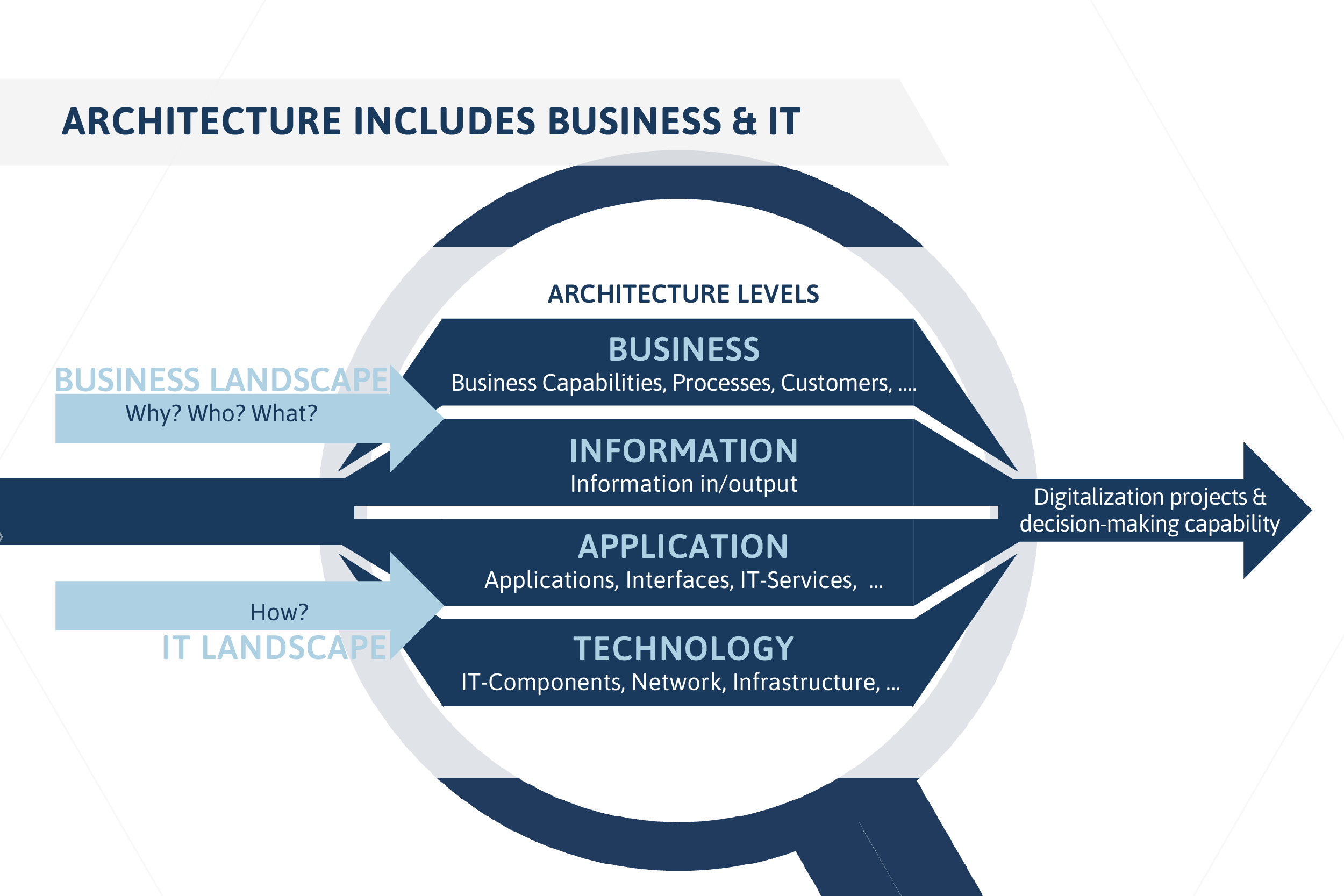
The 4 Architectural Levels (Domains) of EAM
The four architectural domains are central components of every EAM practice.
1. Business Architecture
Business architecture describes a company’s core business processes and their relationships with organizational structures, capabilities, and information flows. It provides a business perspective on value creation and defines the data requirements of the business units as the basis for processes and decisions.
2. Data Architecture
Data architecture describes the structure, availability, and use of data within an organization. It encompasses data models and information objects, as well as their relationships to one another, and ensures that relevant data is consistent, accessible, and usable for business processes and applications.
3. Application Architecture
Application architecture describes the entirety of the applications in use and how they interact within the IT landscape. It maps out how data is processed, exchanged, used, and modified across various systems within the application landscape.
4. Technology Architecture
The technology architecture describes the underlying technological infrastructure that enables the operation of applications and the processing of data. It encompasses platforms, systems, and technical components that ensure the storage, processing, and secure transmission of data, and forms the basis for a scalable and stable IT environment.
A coordinated architectural metamodel encompasses artifacts at all levels: “Everybody needs an architect.”
Strategic Key Elements in Modern EAM
Effective enterprise architecture management relies not only on a consistent architecture model, but also on the right methodological, technological and organizational building blocks.
Frameworks and Modeling Languages: An Overview of the Most Important EAM Approaches
Effective Enterprise Architecture Management is based on the interplay between EAM frameworks and modeling languages. While frameworks provide the methodological and organizational framework for designing and managing the enterprise architecture, modeling languages enable its structured and comprehensible representation. A modern EAM approach typically draws on elements from various EAM approaches and combines them as needed.
Among the most important frameworks are:
- TOGAF (The Open Group Architecture Framework), with its ADM (Architecture Development Method), primarily provides a method for planning, governing, and developing enterprise architecture.
- The Zachman Framework provides a classification scheme for architecture artifacts and offers an overview of perspectives and levels of abstraction.
- COBIT is a framework for the governance and management of enterprise IT that defines processes and control objectives to align IT with business goals. It encompasses EA services such as target architectures, roadmaps, and governance mechanisms.
- CMMI (Capability Maturity Model Integration) is a reference model for assessing and continuously improving processes. It helps organizations increase their performance through defined maturity levels.
The most important modeling languages include:
- ArchiMate is a modeling language that represents business processes, applications, and technologies in a consistent visual format and is often used in conjunction with TOGAF.
- BPMN (Business Process Model and Notation) is a standard for the graphical modeling and visualization of business processes, which allows workflows to be presented in a way that is understandable across the organization and systematically analyzed.
- EDGY is an open, easily accessible enterprise design language that provides common concepts, relationships, and visual symbols so that people from different disciplines can collaboratively design the EA.
Furthermore, EAM is closely linked to agile frameworks such as SAFe, particularly in the context of “SAFe for Architects.” Enterprise architects use this framework to define the technical vision, architectural principles, and roadmaps, and to ensure the continuous and business-oriented evolution of the architecture in collaboration with agile teams.
EAM-Tooling: Software Instead of Excel Graveyards
Manual lists, Excel files, or scattered storage systems reach their limits as soon as an architecture becomes more complex. EAM requires a central architecture tool in which core information such as capability maps, process models, the application landscape, data flows, technology standards, integration points, and architecture decisions (ADRs) are maintained.
Modern tools including LeanIX, Bizzdesign, Software AG Alfabet, Ardoq, and ADOIT offer automated synchronization with CMDBs, CI/CD pipelines, and cloud portals. This creates an up-to-date and reliable view of the architecture, which serves as the foundation for strategic decisions. It becomes clear that effective EAM is only possible with reliable data, and this reliability cannot be guaranteed without automation.
EFS Consulting Partner Certifications
EFS Consulting is Austria’s first certified LeanIX-Partner. Together, we offer our clients both expert consulting and practical support in implementing LeanIX. We help structure the IT landscape, identify dependencies, and derive concrete transformation roadmaps, as well as establish LeanIX as the central data repository within the organization.
With our Bizzdesign Partner certification, we help our clients consistently align strategy, business processes, and the IT landscape; conduct well-founded impact analyses; and derive robust transformation roadmaps.
As a certified SAP Signavio partner, we support our clients in establishing transparent end-to-end process models, identifying opportunities for optimization, and linking processes to architectural decisions and transformation initiatives.
Despite our numerous certifications, we are tool-agnostic and work with the tools provided by our clients. In doing so, we adapt flexibily to their specifications.
Governance: Roles, Responsibilities, and Structures
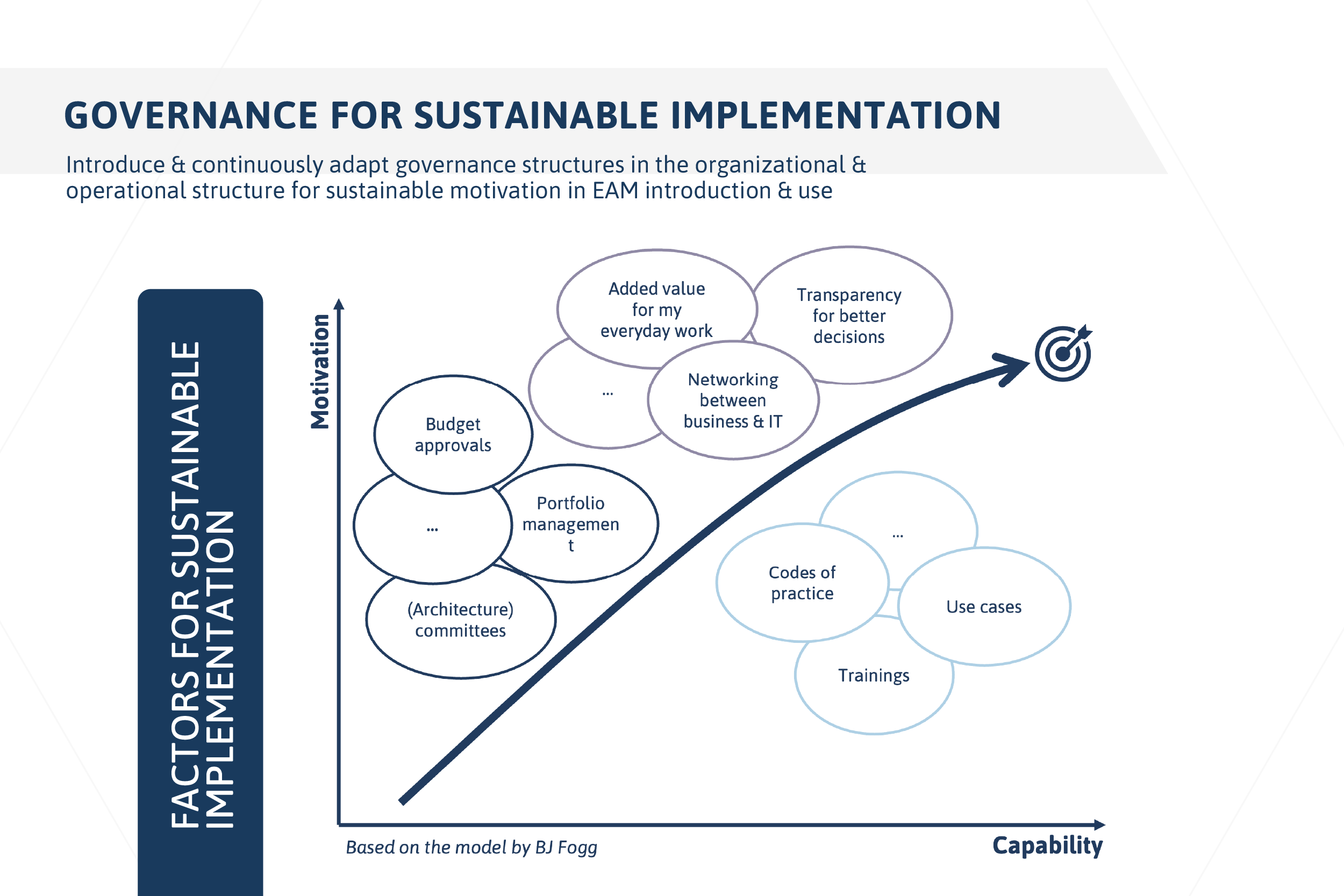
An effective EAM requires clearly defined roles and responsibilities. Responsibilities must be clearly defined so that architectural decisions can be made consistently, strategic goals can be supported, and IT and business requirements can be effectively aligned. Enterprise architects design the overarching target architecture and standards, while domain architects, solution architects, and business units collaborate on operational implementation. Architecture boards and steering committees are governance structures that create transparency, promote high-quality decision-making, and ensure long-term adherence to architectural principles.
In addition to clear roles and responsibilities, an effective EAM requires a governance structure. This structure establishes the organizational framework for successful architecture implementation and management. The combination of motivation and capability among the roles involved – from business units to product teams to management – is crucial. Establishing an architecture committee or integrating the architecture into existing committee structures enables transparent management and well-informed decisions. In addition, sustainable processes for data maintenance, ownership, and quality assurance form the basis for consistent architectural information. Accessible knowledge sources, guidelines, and practical training also promote enablement and support the integration of EAM into day-to-day work based on specific use cases.
Benefits & Goals of EAM for Companies
Whether in day-to-day operations, digital transformation, reorganizations, mergers and acquisitions, or carve-outs, EAM provides transparency across IT systems, interfaces, and data flows, thereby creating a reliable foundation for informed decisions.
The Benefits of EAM for Digital Transformation
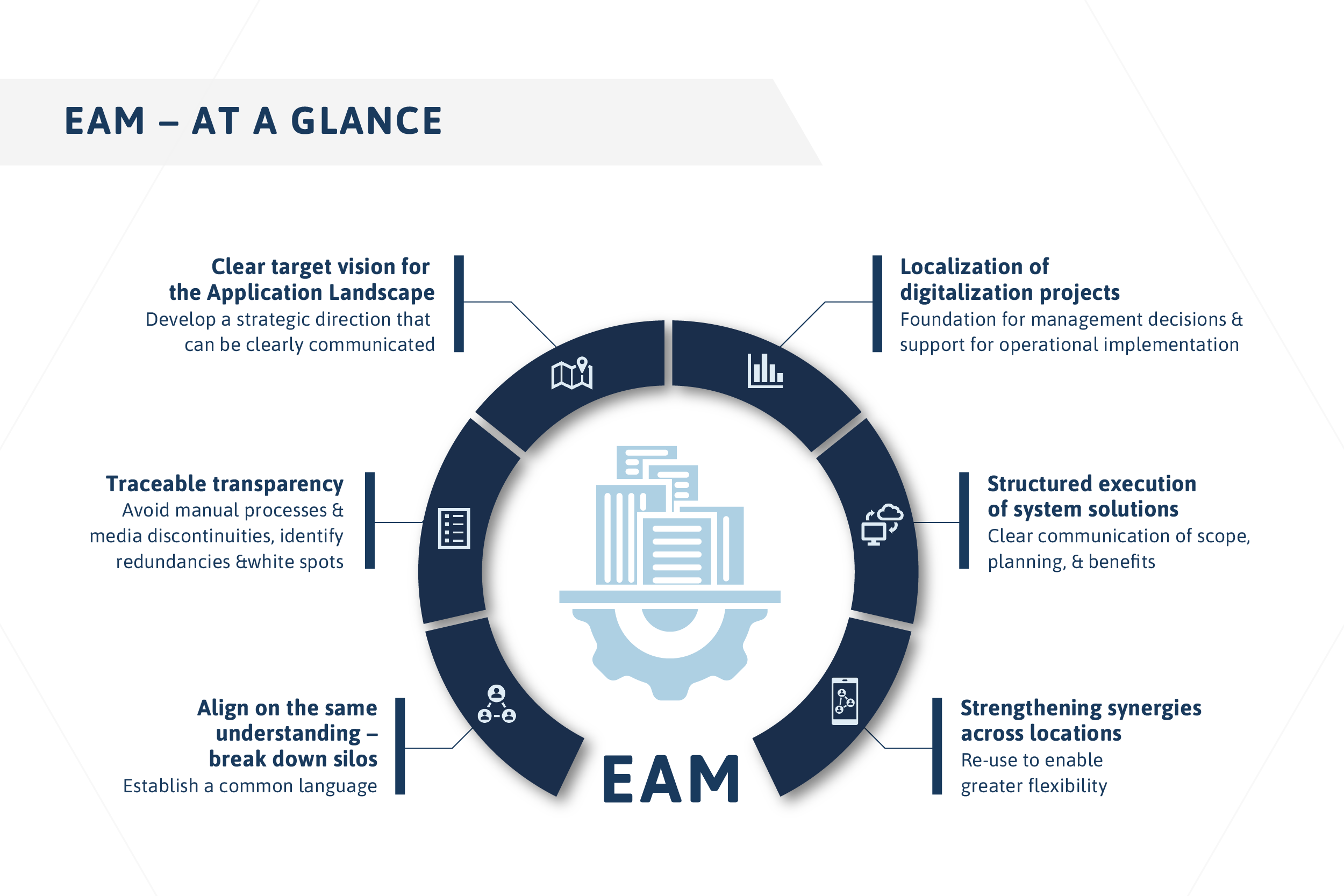
EAM provides a centralized, traceable view of the entire application and system landscape and makes dependencies transparent. This enables better management of digital transformation projects, leverages synergies, and facilitates informed decisions regarding system selection and further development. At the same time, it reduces redundancies and establishes a common language between business and IT.
Goals of EAM
EAM pursues clear goals that go beyond technical efficiency: It provides a holistic view of the enterprise architecture and ensures that IT decisions are always aligned with the corporate strategy. EAM reduces complexity, enhances agility, increases standardization, minimizes risks, and lays the foundation for future-proof data strategies and cloud strategies/architectures. Decisions are fact-based and transparent, transformations are accelerated, and resources are used efficiently.
Typical Challenges
Typical challenges in EAM arise primarily from a lack of transparency, differing perceptions of the existing IT landscape, and a lack of coordination between locations or departments. Without a clear vision, application landscapes are difficult to communicate. Manual processes and media discontinuities make it difficult to maintain an overview, and silos prevent a shared understanding. At the same time, companies struggle to properly prioritize digital transformation projects, plan system replacements in a structured manner, and leverage synergies across locations. This is precisely where EAM comes in: It creates transparency, defines target states, and provides a common language as well as a structured basis for decision-making.
EFS Consulting POV: Why EAM Is Business-Critical Today
EAM has evolved into a business-critical discipline. The reason is simple: Today, companies manage highly fragmented IT landscapes. Based on our project experience, approximately 70% of companies lack a sufficient overview of which applications are in use, how well these align with their business, or what costs and risks are actually incurred. At the same time, external pressure is mounting: data governance requirements, regulatory mandates such as DORA, DSGVO, KRITIS or the EU AI Act, as well as growing security risks and rising operating costs, make a robust architectural foundation indispensable.
Our clients’ key EAM challenges:
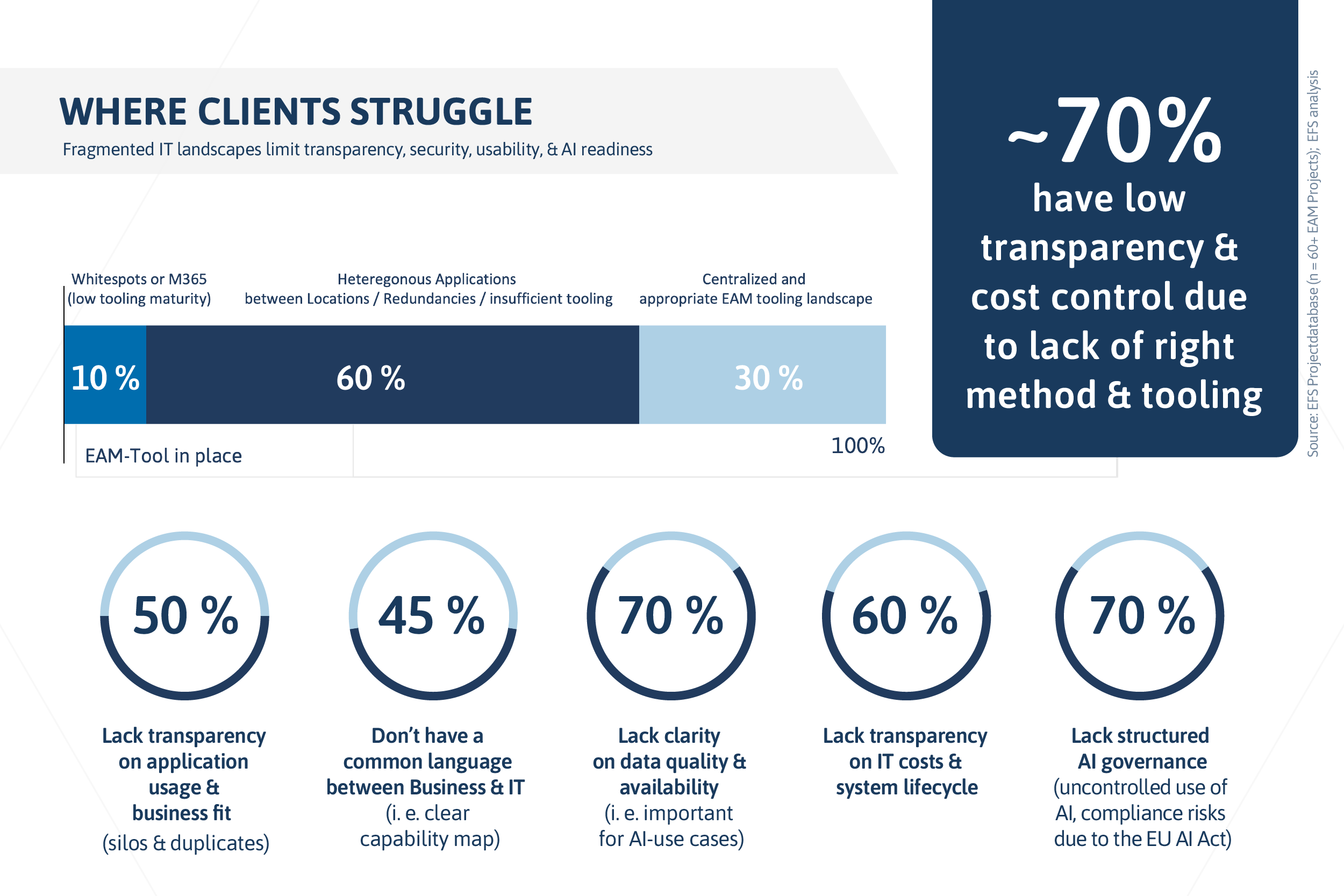
A professional, methodologically sound EAM approach creates added value precisely in this area. It makes structures visible, reduces complexity, enables decision-making, and lays the foundation for secure, scalable, and future-proof transformations. In short: EAM is the key to effectively managing organizations in an increasingly digital and regulated world. For example, experience from our client projects shows that by optimizing the application portfolio, we can reduce application costs by 15–25%. At the same time, the use of EAM tools can be increased by around 20%.
EFS Consulting Guide: Creating an EAM Transformation Roadmap in Three Steps with the EAM Health Check
With the EAM Health Check, we efficiently create transparency across all levels of the enterprise architecture and identify areas for action in three steps.
1. Create transparency and map the architecture
First, we define the business scope and systematically map the enterprise architecture. By modeling and visualizing processes, data, applications, and technologies, we create a transparent overall picture with clear responsibilities and dependencies.
2. Analyze andidentifypotential
Based on the assessment, we analyze silos, drivers of complexity, pain points, and redundancies. The identified potential is evaluated together with the business unit and IT and translated into clearly structured areas for action.
3. Derive Measures and Develop a Roadmap
The identified opportunities lead to prioritized project initiatives, which are consolidated into a transformation roadmap. The results are presented in a format suitable for management and provide a solid foundation for informed decisions and the next steps in the transformation.
Conclusion
EAM is an interplay of tools, methods, and culture that enables different architectural levels to be aligned with strategic goals and established within the organization. Today, EAM is a key success factor because it creates transparency in complex IT and process landscapes and empowers companies to identify innovation potential and manage transformations safely and efficiently.
EFS Consulting takes a holistic approach that ranges from analyzing the status quo, creating capability maps and meta-models, implementing tools, and establishing governance structures to embedding EAM sustainably in an organization’s processes and culture.
FAQs
What does Enterprise Architecture Management do?
EAM manages the enterprise architecture across processes, data, applications, and technologies, creates transparency, and aligns IT with business objectives.
What is an EAM strategy?
An EAM strategy defines roles, principles, methods, tools, and goals for systematically planning and developing enterprise architecture.
What does an Enterprise Architect do?
Enterprise Architects model the enterprise architecture, manage architecture decisions (ADRs), and design target states. In addition, they serve as bridge builders between business and IT.
What is EAM modeling?
EAM modeling refers to the structured representation of selected architectural components (e.g., processes, digital products, data flows, technologies) using modeling languages such as ArchiMate.

Authors