Stopping Shadow AI: How Companies Are Gaining Control Over Hidden AI Use
Employees use AI tools every day without IT or management knowing about it – welcome to the era of shadow AI. In this insight, you will learn why shadow AI is far more dangerous for companies than classic shadow IT, what regulatory and operational risks arise, and how you can regain control with a structured approach without nipping innovation in the bud. It is precisely this balancing act between innovation and control that we discuss in this Insight.
Table of contents
Key Takeaways
- Shadow AI refers to the uncontrolled, unsanctioned use of AI tools by employees – without the knowledge and approval of the IT or compliance department.
- The risks go far beyond classic shadow IT: Prompt leakage, data leakage, data breaches, and compliance exposure can have significant legal and financial consequences.
- The EU AI Act and GDPR create clear regulatory obligations that directly affect Shadow AI, because: Ignorance does not protect against liability.
- The key lies not in prohibition, but in structured AI governance: AI usage monitoring, clear AI guidelines and AI access control enable control while promoting innovation.
What is Shadow AI
The term shadow AI describes a phenomenon that has spread rapidly over the past two years: employees are using generative AI tools, large language models (LLMs) and other AI systems without the knowledge of information technology, information security or compliance teams, and even more so without formal approval. What starts as a harmless gain in efficiency can quickly develop into a serious business risk.
Shadow AI vs. Shadow IT: The Crucial Difference
At first glance, Shadow AI appears to be a natural evolution of the well-known phenomenon Shadow IT. But the comparison falls short. While shadow IT typically includes tools like Dropbox or Trello, shadow AI is about systems that actively interact with, process, and interpret business-critical data. This is fundamentally changing the risk landscape.
With classic shadow IT, a document stored in an unapproved cloud remains a document. With shadow AI, on the other hand, sensitive information – customer data, financial reports, internal strategy papers – can flow as prompts to external LLMs, where it can be used to improve the model, stored or viewed by third parties. The data outflow does not happen through a hacker attack, but through well-intentioned everyday use.
| Criterion | Shadow IT | Shadow AI |
| Core definition | Unapproved software/services | Unsanctioned AI tools and LLM applications |
| Data processing | Data Storage & Transfer | Active Processing, Interpretation & Output Generation |
| Risk type | Data loss, license risks | Prompt leakage, data breaches, hallucinations, compliance exposure |
| Regulation | GDPR (partial) | GDPR, EU AI Act, Information Security Standards |
| Visibility | Often recognizable by network logs | Barely visible without AI usage monitoring |
| Innovation potential | Low | High, increases complexity of management |
| Typical tools | Dropbox, WhatsApp, Trello | ChatGPT, Claude, Gemini, Midjourney, Copilot (privat) |
Why Shadow AI is Emerging in Companies
Shadow AI is rarely created with malicious intent. Rather, it is a symptom of structural and cultural gaps in organizations. The drivers can be divided into two categories:
Organizational Drivers
- Lack of AI governance and unclear AI guidelines: If companies do not communicate a clear AI policy, employees fill the vacuum with their own solutions.
- Slow approval processes: Bureaucratic approval processes are frustrating – the next AI system is just a click away.
- Lack of officially provided AI tools: If the company does not provide generative AI (Gen AI), employees search for them themselves.
- Insufficient risk and compliance communication: If you don’t know why certain AI systems are problematic, you see no reason to avoid them.
- No central AI strategy: Without strategic guardrails, decentralized, uncontrolled initiatives emerge in every department.
Human and Operational Drivers
- Desire to increase efficiency: Employees experience every day how AI tools make their work easier – the incentive is real and understandable.
- Pressure to innovate and experiment: In an environment where AI expertise is becoming a career factor, employees don’t want to fall behind.
- Low barriers to access to GenAI tools: Free or low-cost access to powerful LLMs makes it trivial to get started.
- Rapid problem solving in everyday work: Formulating emails, debugging code, structuring concepts – AI shadow tools deliver immediate results.
- “Just a harmless test”: The danger of data leaks and security gaps is not intuitively felt by many users.
The Regulatory Framework: Why Shadow AI is Becoming a Compliance Issue
Shadow AI is no longer a purely technical problem. It directly affects several regulatory frameworks that are binding on European companies. The combination of these sets of rules makes uncontrolled AI use a serious compliance risk with potentially significant sanctions.
Shadow AI and the EU AI Act
The EU AI Act is the world’s first comprehensive AI regulation and applies to all companies that deploy or provide AI systems in the EU. Shadow AI creates a direct problem here: Companies can only meet their obligation to classify, document and assess conformity if they know which AI systems are actually in use. Unapproved, arbitrarily used AI systems make this transparency impossible.
More on this in the free EFS Consulting whitepaper Guide to the Artificial Intelligence Act, which shows risk categorizations, impact and concrete preparation measures for companies in a practical way.
Shadow AI and GDPR
The GDPR stipulates that Personal data may only be processed in secure, contractually regulated systems. When employees enter personal data – such as customer contact details, application documents or personnel data – into external AI systems, they violate: often unknowingly, against these basic principles. Data breaches caused by prompt leakage or data leakage can result in fines of up to 4% of annual global sales. Particularly problematic: many popular GenAI tools operate their servers outside the EU.
Shadow AI and Information Security
From the perspective of AI risk management and data security, Shadow AI represents a systemic security vulnerability. Without AI Access Control and AI Usage Monitoring, companies cannot ensure what data has left the organization. Compliance frameworks such as ISO 27001 or SOC 2 require complete traceability of data access – a standard that by definition cannot be met if AI shadow tools are used uncontrollably.
Who bears responsibility: liability and responsibility
A common misconception: “If an employee uses an AI tool on their own responsibility, the liability lies with them.” This is legally wrong!
The company, as a controller within the meaning of the GDPR and as an operator within the meaning of the EU AI Act, remains liable for all AI-related data loss and compliance violations – regardless of whether the tool was officially sanctioned. A lack of AI governance does not protect against liability – it reinforces it.
The Invisible Escalation: Why Shadow AI is Becoming a Business Risk
The real danger of shadow AI is its invisibility. Unlike data loss due to a hacker attack, Shadow AI often leaves no immediate traces. The escalation from a harmless experiment to a serious corporate risk takes place insidiously and is often only noticed when the damage has already occurred.
The Silent Data Outflow
The most critical risk vector of shadow AI is prompt leakage: sensitive information entered into an external LLM as part of a prompt. The scenarios are diverse:
- Sales reps insert customer data into AI tools to formulate proposals.
- HR teams upload resumes with personal data.
- Developers pass proprietary code to external models.
In each of these cases, sensitive information leaves the company without a log entry, without a security warning, without an IT team noticing. The problem is exacerbated as many GenAI vendors use user data to train their models. Data loss of this kind can hardly be reversed.
Privacy and Compliance Risks
Any unauthorized use of an external AI tool may constitute a data breach within the meaning of the GDPR. Companies without AI Policy and AI Usage Monitoring cannot prove that they have taken reasonable measures to prevent data breaches in an emergency. In addition, there are industry-specific regulations: the Health Insurance Portability and Accountability Act (HIPAA) in healthcare, the Payment Card Industry Data Security Standard (PCI-DSS) in finance, and NIS2 for critical infrastructure – all areas where shadow AI can have particularly serious consequences.
These risks are particularly palpable in the regulated financial sector – more on this in the EFS Consulting whitepaper The Role of AI in Banking, which shows why clear governance frameworks are becoming mandatory there.
Reputational Risks
If employees use AI-generated content externally without review, for example in customer communications, marketing materials or public statements, companies risk considerable damage to their reputation. Hallucinations of LLMs can lead to factually false statements. Bias in models can produce discriminatory content. And when such incidents become public, the argument that nothing was known about the internal use of AI does not protect against the loss of trust among customers, partners and the public.
Operational Risks
In addition to regulatory and reputational risks, uncontrolled shadow AI also causes direct operational damage:
- Hallucinations: LLMs generate inaccurate but convincing-sounding outputs, a dangerous basis for business decisions.
- Bias: Structural biases in models can lead to discriminatory processes, for example in the HR or lending process.
- Lack of quality assurance: Because Responsible AI principles are not applied to shadow AI by definition, there is no control over outputs.
The Governance Gap
The overarching problem is AI risk visibility: companies can only manage what they see. When AI usage grows faster than control over it, an AI governance gap is created that widens over time. Every new AI system that an employee uses without the organization knowing about it widens this gap. Without structured AI risk management and AI access control, the company’s risk profile grows exponentially, while those responsible are in the dark.
Where Shadow AI is Already Happening in the Company Today
Shadow AI is not a theoretical scenario. Today, it takes place in almost every area of the company, in some more than in others. The following is an exemplary insight into the areas in which shadow AI can typically occur and what risks can be associated with it.
Marketing & Communications
Marketing teams are one of the areas where shadow AI is often used. Copywriting, content planning, social media posts, press releases – generative AI enables enormous efficiency gains. The problem is that confidential campaign strategies, market research data and unpublished product information often flow into external models. Image generation tools such as Midjourney or DALL-E also raise questions about copyright and brand identity that remain unresolved without clear AI guidelines.
HR & Recruiting
HR departments use AI shadow tools for CV screening, interview preparation, and job advertisements. The risk is particularly high here, as applicant data is personal information that is particularly sensitive to protection. In addition, there is the risk of algorithmic bias in the pre-selection of candidates, which goes unnoticed by users without sufficient AI literacy.
Sales
Sales reps use shadow AI to create proposals, formulate customer communications, or generate market analysis. Customer-specific information, pricing structures and contract details are among the most sensitive business data of a company. If these are entered into external LLMs as context, they leave the company unchecked, with potentially serious consequences for competitive advantages and customer trust.
Software Development
Development teams are excited about AI-powered code generation, and rightly so. But if tools such as GitHub, Copilot or ChatGPT are used without the company’s own configuration, proprietary code, database structures and API keys can find their way into external models. Without AI access control and clear guidelines for handling code, the risk is difficult to quantify.
Knowledge Management
Internal research, summaries of long documents, extraction of information from reports, shadow AI has become a natural everyday tool for knowledge workers of all disciplines. The problem is subtle: Often, internal strategy papers or confidential reports are uploaded in their entirety to external AI systems without awareness of the consequences for data management and data security.
EFS Consulting Shadow-AI-Readiness-Check
1. How Companies Recognize Shadow AI
The first step to controlling shadow AI is to make it visible. AI Risk Visibility begins with an honest inventory: What do our employees really use? As part of an EFS Shadow AI Readiness Check, this typically takes place over several days, during which business departments, IT and compliance work together to develop a clear picture of the actual use of AI:
- Analyze usage patterns: Network logs, browser histories (with legal review), and IT security tools provide initial indications of the use of external AI systems.
- Conduct AI discovery assessments: Structured surveys and workshops with specialist departments reveal the actual use of AI – often surprisingly broadly.
- Interviews & departmental analyses: Direct conversations with team leads bring to light concrete usage scenarios that are not visible in logs.
- Map tool landscapes: A systematic inventory of all AI shadow tools used, sorted by risk class, creates the basis for targeted measures.
- Make shadow AI visible: Only what is visible can be regulated. The result is a consolidated AI risk map as a basis for the next steps.
2. How Companies Control Shadow AI Without Slowing Down Innovation
The intuitive reaction of many companies to Shadow AI is the ban: all unauthorized AI tools are blocked, access to external LLMs is blocked. This strategy is not only ineffective, it is counterproductive. Employees find ways around barriers, the pressure moves underground, and the company loses touch with technological progress.
The far more effective approach is governance instead of blockade – creating a structured framework that enables AI use and at the same time makes it controllable. At EFS Consulting, this approach is made up of several interlocking building blocks:
- Create secure AI sandboxes: Company-owned, privacy-compliant AI environments where employees can experiment without putting sensitive data at risk.
- Define clear AI usage policies: AI guidelines must be understandable, practical and communicated – not as a bureaucratic document, but as a guide in everyday work.
- Promoting AI literacy: The EFS AI Training service area AI trainings prepares employees specifically for AI-supported work processes – in addition, the EFS Consulting Insight on AI Literacy & AI Competence shows: What companies need to know now and how to do this in a structured way.
- Enablement instead of restriction: If you provide officially approved and secure AI tools, you take away the incentive for employees to switch to shadow alternatives.
- Implement AI Access Control: Role-based access concepts ensure that AI tools are only used in the contexts for which they have been released – flanked by AI compliance service area, which ensures the safe, ethical and legally compliant use of AI.
3. The EFS Consulting Brief Assessment: Where Does Your Company Stand Today?
Companies are typically in one of four stages of maturity on the path to a mature approach to shadow AI:
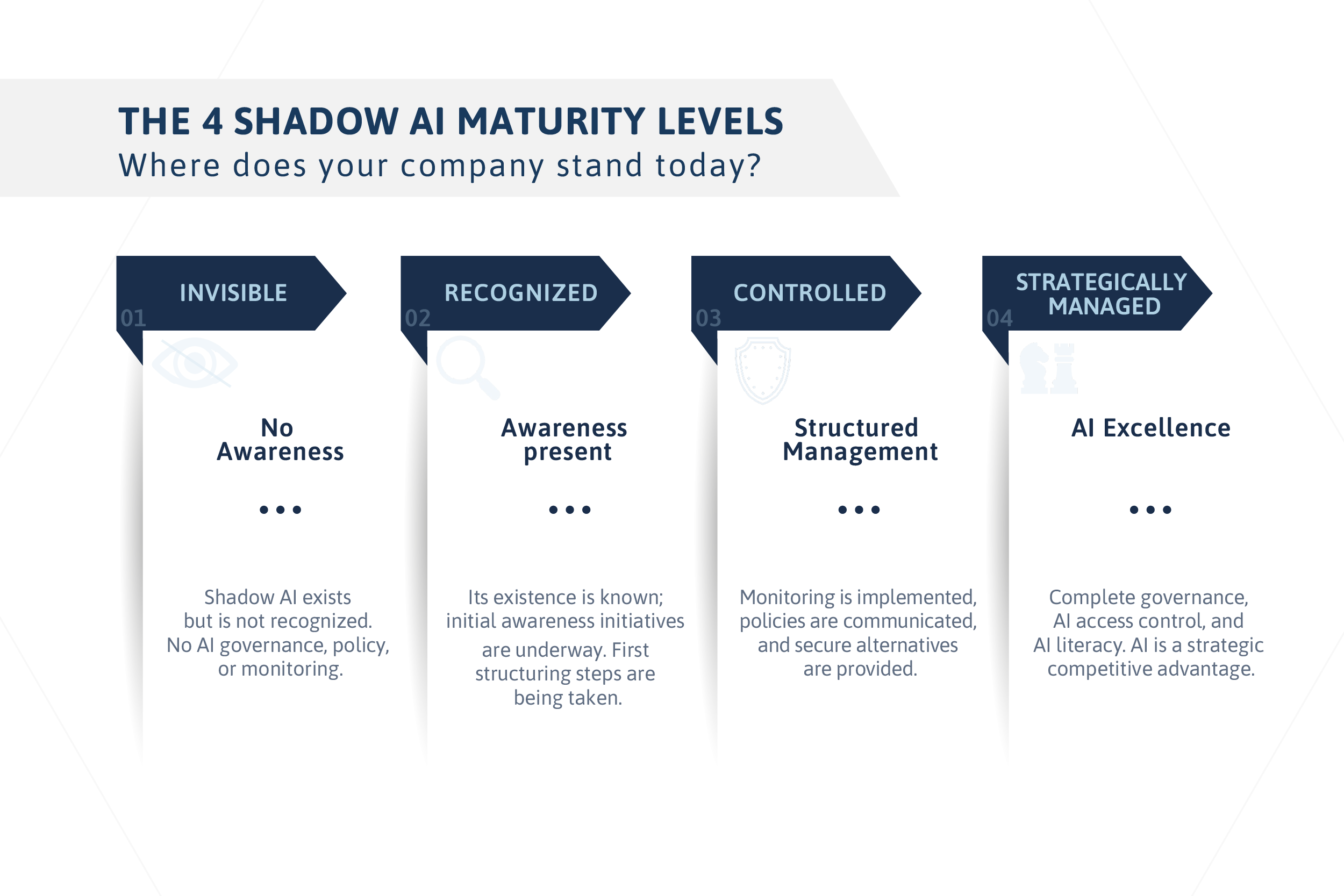
- Invisible: Shadow AI exists, but is not noticed. No AI governance, no AI policy, no monitoring. The risk profile is growing uncontrollably.
- Recognized: The company knows that shadow AI exists, but has not yet taken any structured measures. The first awareness initiatives are being launched.
- Controlled: AI Usage Monitoring has been implemented, the first AI guidelines have been communicated, and secure alternatives are being provided. AI risk management is taking effect.
- Strategically controlled: Complete AI governance with a clear AI strategy, AI access control, continuous monitoring and a culture of AI literacy. Shadow AI is no longer a blind spot.
The good news is that the path from the first to the second level of maturity is shorter than many companies think. The EFS Consulting Brief Assessment builds on the proven AI portfolio – starting with an AI awareness workshop, through the identification of relevant use cases, to the derivation of a prioritized AI roadmap. The kick-off takes place in a non-binding initial meeting, from which the concrete scope for your company can be derived.
EFS Consulting AI Program Lead Ralph Zlabinger: Why Shadow AI is a Top Priority
“When I think of shadow AI, my most important advice for companies is: don’t start with bans. I’ve seen too many times how managers punish their people for wanting to be efficient. And in the end, they lose two things at the same time: control (because the use simply goes underground) and the trust of their own employees. The real question is not whether AI is used in the company. That happens anyway. The question is whether you as a company create the framework so that this happens safely, in accordance with the rules and with a strategy. AI governance is not a brake block for me. It’s more like crash barriers on the highway: you don’t drive slower, you just arrive safer.
What I take away from our projects at EFS Consulting is that the companies that invest in clear AI guidelines early on are not only more secure in the end, they are also simply faster. They dare more because they know what they have gotten themselves into. My conclusion after countless conversations with customers: If you invest in governance today, you will buy competitiveness tomorrow. If you want to read more about how to really build AI competence in the company, I recommend our insight AI Literacy & AI Competence: What Companies Need to Know Now.”
Conclusion
Shadow AI is no longer a marginal phenomenon, it has long been a reality in most companies. The combination of a lack of AI governance, low barriers to access to powerful GenAI tools, and growing pressure to innovate creates a dynamic that leads to significant data security, compliance, and operational risks without structured countermeasures. The good news is that if you recognize the problem and address it in a structured way, you can not only control shadow AI, but turn it into a source of real competitive advantage.
EFS Consulting supports companies in making Shadow AI visible, evaluating and translating it into a strategically driven AI use, from the initial AI use to the development of customized AI policies and AI governance frameworks to the implementation of AI usage monitoring and training programs for AI literacy. An overview of our consulting approach can be found on the AI Governance page. Contact us if you would like to know where your company is today – and what steps make sense next.
FAQs
What is Shadow AI?
Shadow AI refers to the use of AI tools and LLMs by employees without the knowledge or approval of IT, compliance or management, usually on their own initiative to work more efficiently.
How is Shadow AI different from Shadow IT?
Shadow IT generally means unauthorized software use. Shadow AI is the riskier variant: AI systems actively process and interpret company data and generate outputs independently, with a higher risk of prompt leakage and compliance violations, but significantly lower visibility for IT.
Why is Shadow AI dangerous?
Three risks: data leaks due to uncontrolled entry of sensitive data into external tools, compliance violations under the GDPR and EU AI Act with possible fines, and operational risks due to hallucinations and bias without quality assurance. In short, what is not visible cannot be managed.
How can companies detect shadow AI?
Through a combination of technology and organization: monitoring of network traffic and SaaS usage (e.g. CASB tools), evaluation of expense and license data, anonymous employee surveys and regular IT audits. An open corporate culture in which AI use is disclosed without fear of sanctions is also crucial.
How does EFS Consulting specifically support Shadow AI?
EFS Consulting accompanies companies from the Shadow AI Risk Assessment to the development of AI governance frameworks and release processes to employee training and change management, with the aim of making AI use visible, secure and compliant.

Authors