Different Leadership Styles of the Agile Leader
Agile teams and entire organizations undergo development. Understanding different models to grasp this development is a useful tool for agile leaders.
Table of contents
Reality is always more complex and multifaceted than the models. However, these models provide a good guide for selecting appropriate methods and defining the next steps.
Agile Leader: Different Agile Leadership Styles According to Team Phase
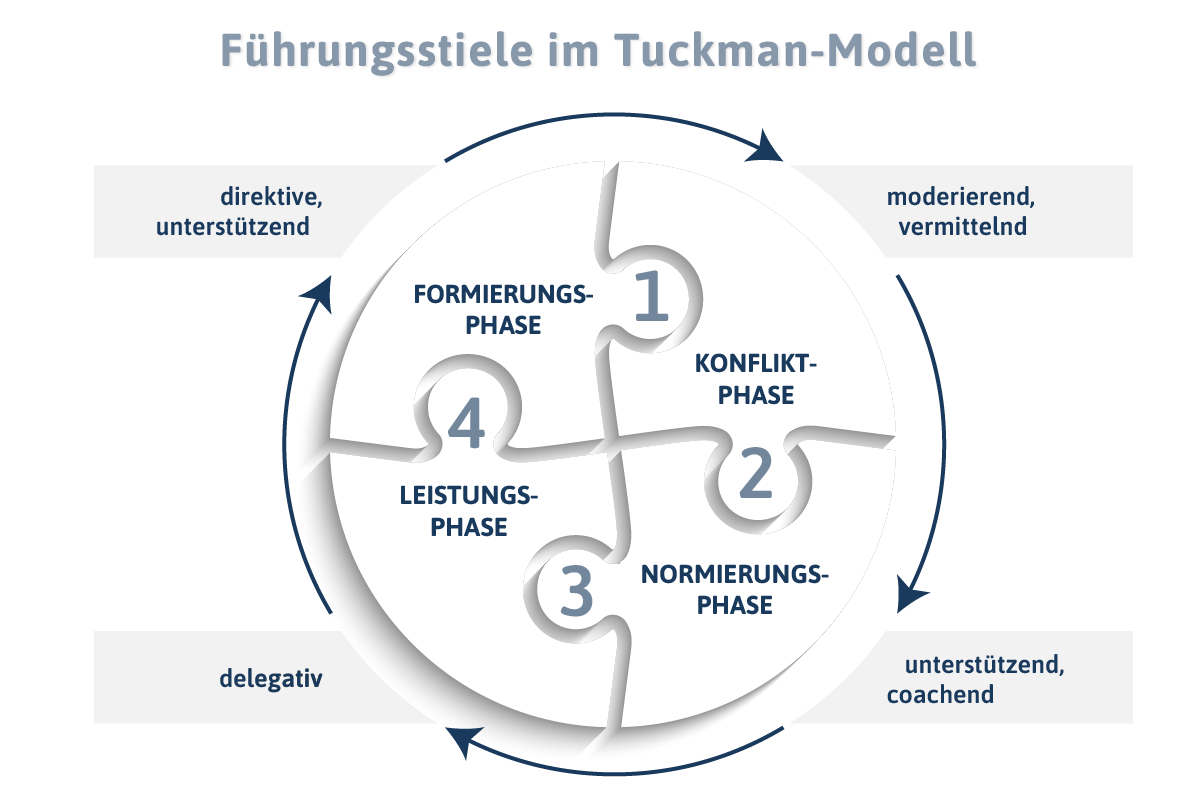
According to Tuckman, a team goes through four phases after initial forming and after each change in composition: Forming, Storming, Norming, Performing. These team phases are also known as the team clock. Each of these phases requires different leadership styles to effectively support and guide the team.
Forming (Politeness Phase)
In the forming phase, also known as the “politeness phase,” the team comes together for the first time in its new composition. Members seek orientation and clear structures. They hold back and often lack the trust to speak openly.
An agile leader in the forming phase:
- Clearly presents the vision and goals of the product.
- Ensures training and adequate empowerment for the tasks.
- Clarifies agile principles and values with the team and how they will apply them in the specific environment.
- Fosters an environment of trust and openness by actively listening and encouraging team members to express their ideas and concerns.
- Supports the team in working self-organized by creating frameworks and defining initial roles and responsibilities.
Training in the agile frameworks creates a shared understanding and a common point of reference, which are essential for the subsequent phases..
Storming (Conflict Phase)
During the storming phase, tensions among team members become visible. Different opinions, views, and preferences clash. This indicates that team members have found enough trust to show their needs and preferences. The leader encourages team members to express their needs and creates conditions to channel them constructively.
An agile leader in the storming phase:
- Moderates conflicts constructively and promotes open communication to resolve misunderstandings and tensions.
- Encourages collaboration and emphasizes common goals to unite the team.
- Remains flexible and adjusts processes and structures to improve team dynamics.
- Sharpens the common understanding of how agile values and principles can be lived concretely in the given context.
Agile values and cultural work, along with specific methods like Nonviolent Communication or Liberating Structures, are particularly helpful here.
Norming (Normalization Phase)
In the norming phase, the team develops common norms and standards. Team members begin to work better together and build mutual trust.
An agile leader in the norming phase:
- Promotes self-organization by supporting the team in developing its own working methods and taking initiative.
- Strengthens mutual trust through regular feedback and positive reinforcement.
- Encourages continuous improvement through regular retrospectives and feedback loops.
Approaches like solution-oriented coaching, team-building measures, and celebrating successes can further strengthen the team and lead it into the performing phase.
Performing (Performance Phase)
In the performing phase, the team works efficiently and purposefully together. The members are well-coordinated and focused on the common goal.
An agile leader in the performing phase:
- Encourages the team to be creative and develop innovative solutions.
- Remains available as a resource and supporter to remove obstacles and assist the team as needed.
- Takes care of obstacles that are beyond the team’s direct influence.
- Encourages the team to celebrate successes and protects it from overworking.
In this phase, self-assessments or holistic agility checks can provide insights into how the team can further develop in a targeted manner.
The Bottom Line
The phases often transition smoothly into one another and can be reinitiated even in stable teams by new conditions. An agile leader is characterized in every phase by promoting self-organization, trust, continuous improvement, and team support. By adapting their leadership style to the respective phase of team development, they can effectively support the team and maximize its performance.

Authors