Product Lifecycle Management (PLM): Basics, Added Value & Implementation
Products are growing more complex, markets are accelerating, and customer demands are becoming increasingly individual — yet somewhere in between, data silos, change orders, and approval loops keep multiplying. What still works in small teams quickly becomes a real burden as product complexity rises and organizations scale: for development, for production, for service. Product Lifecycle Management brings structure — not through more bureaucracy, but through end-to-end processes, a shared data foundation, and connected systems. This insight shows how PLM is becoming an enabler for digitalization, sustainability, and innovation.
Key Takeaways
- Product Lifecycle Management (PLM) connects product data, processes, and systems across the entire lifecycle — from initial concept to decommissioning.
- Companies that consistently leverage PLM develop faster, manufacture more reliably, and respond more flexibly to market changes.
- PLM never stands alone: it operates within a dynamic ecosystem of adjacent systems, emerging technologies, and evolving regulatory requirements. Ignoring this environment means missing PLM’s decisive value — the end-to-end digital thread across the entire product lifecycle.
- Introducing PLM comes with predictable challenges — from data migration to interface complexity to change management. The good news: most pitfalls are well understood and avoidable with the right approach.
Introduction & Definition of PLM
The idea of managing product information in a structured way across the entire lifecycle is not new — but its importance and complexity have grown considerably. With the spread of CAD systems in the 1980s, the need arose to centrally manage technical drawings and product data. Product Data Management (PDM) was the first step.
Globalization, growing product complexity, and increasing pressure on time-to-market drove further evolution in the 1990s — PDM matured into a company-wide PLM approach.
Since then, the landscape has changed fundamentally. Products are becoming more software-intensive, supply chains more global, and regulatory requirements more extensive — making an end-to-end PLM approach increasingly strategic.
What is Product Lifecycle Management?
Product Lifecycle Management (PLM) is a holistic approach to managing the entire product lifecycle — from initial idea through development, production, and service to end-of-life. At its core is the end-to-end integration of product data, processes, and systems along the entire value chain.
Companies that consistently implement PLM shorten decision paths, reduce the cost of errors, and bring innovations to market faster and more reliably. PLM is therefore far more than an IT project — it is a strategic approach to securing long-term competitiveness.
Why PLM matters more than ever
Increasing product complexity, shorter innovation cycles, and globally distributed value chains make structured PLM a decisive competitive factor. Companies must manage product processes across departmental and site boundaries — while simultaneously meeting regulatory, environmental, and economic requirements.
A holistic PLM approach creates the necessary transparency: development, production, quality assurance, sales, and aftersales all work from a shared data foundation. Decisions become faster, better informed, and more traceable. Moreover, a consistent, quality-assured product data landscape is the prerequisite for modern technologies such as AI, machine learning, and automation to deliver their full potential.
Taxonomy: PLM / ERP / Digital Factory / MES / ALM / CRM
PLM, ERP, Digital Factory, MES, ALM, and CRM address different dimensions of enterprise value creation — they are complementary, not competing.
- PLM owns the product-centric view: product structure, change management, configuration management, and the complete product history.
- ERP (Enterprise Resource Planning) governs commercial and logistical processes — the bill of materials (BoM) is the classic link between both worlds (see more about Feature Based Documentation).
- The digital factory connects production planning with the product model from PLM — from factory layout to the simulation and validation of manufacturing processes.
- MES (Manufacturing Execution System) bridges planning and production in real time — PLM-MES integration creates a controlled data flow between engineering and the shop floor.
- ALM (Application Lifecycle Management) covers the software lifecycle — in products with a growing share of embedded software, this interface is becoming increasingly business-critical.
- CRM (Customer Relationship Management) brings market and customer intelligence into play — essential for requirements management and aftersales processes.
Only the consistent interaction of all system worlds enables a seamless digital thread – and thus a fully integrated digital enterprise architecture.
“Digital Twin” & “Digital Thread”
Two concepts fundamentally shape modern PLM strategies: (1) the Digital Thread and (2) the Digital Twin — and only their interaction unlocks the full strategic value.
- The Digital Thread is a continuous strand of information connecting all relevant data and processes across development, production, use, and service into a consistent, traceable information model.
- The Digital Twin represents the physical product, its components, its creation, and its behavior in a virtual model — current, precise, and maintained throughout the entire lifecycle.
Together, both concepts enable closed-loop feedback across the entire product lifecycle: usage, operational, and sensor data from the field flow directly back into development and design — allowing product performance, reliability, and maintenance strategies to be continuously optimized. PLM serves as the central integration platform that brings together data from all systems and enables data-driven decisions across every lifecycle phase.
Normen & Standards im PLM
The procedural framework of PLM rests on a broad set of norms and standards — regardless of the system in use.
- ISO 10303 (STEP) governs vendor-neutral product data exchange between CAD and PLM systems.
- ISO 10007 provides the normative foundation for configuration management
- IEC 81346 establishes the basis for consistent product structures through structured designation and classification of technical systems
With the growing importance of systems engineering — driven by increasingly software-intensive and interdisciplinary products — three further standards for lifecycle management are gaining relevance:
- ISO/IEC/IEEE 15288 defines lifecycle processes for systems
- ISO/IEC/IEEE 12207 standardizes the software lifecycle, bridging the gap between PLM and ALM
- ISO/IEC/IEEE 24748 frames both with overarching guidelines for consistent, organization-wide lifecycle management
These standards form an internationally recognized foundation — they define frameworks and principles but do not replace individual design decisions: industry, corporate structure, and product complexity ultimately determine which standards apply and to what extent.
Product Lifecycle Phases and the Role of PLM
Structured PLM only delivers its full value when it is consistently embedded across all phases of the product lifecycle — from ideation and concept development through design, production, and use to recycling and reuse. As a central backbone, PLM provides the methodological and technological foundation for each of these phases: standardized data models, integrated processes, and digital tools create transparency, traceability, and efficient collaboration.
The Role of PLM in the Product Lifecycle Phases
1. Ideation & Requirements Management
Every product begins with an idea and clear requirements. These are captured in a structured way and form the basis for all subsequent development decisions.
Role of PLM: PLM provides the structural foundation for centrally capturing requirements from diverse sources — customers, markets, standards — and managing them in a traceable manner. Changes to requirements are versioned and auditable at all times. Early linkage of requirements with product variants lays the groundwork for end-to-end variant and complexity management across all subsequent phases.
For efficient management of variants and complexity, specialized solutions such as the VariantPlanner, as well as algorithmic approaches like the MOPS algorithm, can be used to enable data-driven planning and optimization of variant portfolios.
2. Concept & Development
In the concept phase, initial drafts, designs, and product architectures take shape. Iterative development loops, simulations, and reviews refine the concept into a production-ready solution. End-to-end data management prevents version conflicts and ensures quality from the beginning.
Role of PLM: PLM connects CAD data, bills of materials, and development documents on a central platform — accessible across departments and in real time. Product variants and configurations are managed systematically, complexity is controlled proactively, and the reuse potential of existing assemblies is fully leveraged. Validation processes — from requirements verification to design approval — are consistently embedded in the system and fully documented.
3. Release & production preparation
Before series production begins, the product passes through defined release processes – technical, regulatory, and commercial. Bills of materials, production documents, and inspection plans are finalized and handed over to manufacturing and procurement. A complete and current change status is business-critical at this stage.
Role of PLM: PLM controls and documents all release and validation steps — technical, regulatory, and commercial — within an end-to-end workflow. Bills of materials, production documents, and inspection plans are transferred directly from the PLM system, variant-specific and at the current revision. Outdated or incorrect documents reaching the shop floor become a thing of the past.
4. Production & Quality Assurance
During manufacturing, product data must be consistent, current, and available to all stakeholders. Changes to the product must be incorporated into ongoing production in a controlled manner — without errors, delays, or quality losses. Manufacturing and quality assurance are tightly interwoven in this phase.
Role of PLM: The integration of PLM and MES enables product changes to flow into ongoing production in a controlled way — across variants and with clear configuration traceability. Validation results from quality testing are linked directly to the respective product status, and deviations are analyzed systematically. This accelerates root cause analysis and sustainably reduces scrap and rework costs.
5. Sales & Aftersales Service
The operational phase begins with market launch. Service, maintenance, and spare parts supply all require access to the exact product configuration of each individual unit in the field. A consistent product history is the foundation for efficient aftersales service.
Role of PLM: PLM ensures that service and sales have access to the exact configuration of every delivered product at all times — even across large numbers of variants. Spare parts management, maintenance records, and warranty processes are all based on consistent, current product data. This raises service quality and significantly reduces effort in managing highly variant-rich product portfolios.
More information on aftersales product documentation as a basis for efficient support.
6. End-of-life & retirement
Every product eventually reaches the end of its lifecycle — whether through discontinuation, successor products, or regulatory requirements. Orderly phase-out processes, long-term spare parts supply, and material recovery in the spirit of the circular economy are increasingly coming into focus. All relevant product information must remain available and traceable well beyond this phase.
Role of PLM: PLM accompanies the product through to orderly discontinuation — with complete documentation of all versions, variants, changes, and materials used. This data foundation is the basis for regulatory compliance obligations and validation documentation, while simultaneously supporting circular economy initiatives. PLM thus remains an indispensable instrument of control even at the very end of the product lifecycle.
PLM-Systems & Tools
Selecting “the right” PLM system and toolset is a key success factor for digitalizing product development. Depending on requirements, different platform approaches and operating models come into play — from established enterprise solutions to flexible cloud and open-source platform approaches.
Enterprise Platforms vs. Open Platform
The choice of the right PLM system depends largely on industry, company structure, and the existing IT landscape. Established enterprise platforms such as Siemens Teamcenter, PTC Windchill, and Dassault 3DEXPERIENCE dominate the market — with deeply integrated CAD and engineering environments and decades of implementation experience. Open, platform-oriented solutions such as Aras Innovator, by contrast, stand out through their flexibility, adaptability, and open interfaces.
Cloud & SaaS im PLM
Cloud and SaaS models are gaining traction across industries, offering scalability, reduced maintenance overhead, and faster deployment for globally distributed teams — while making PLM increasingly accessible to SMBs. The question is no longer whether to move to the cloud, but which model — public, private, or hybrid — best fits the organization.
3 pillars of successful PLM
Successful PLM is not a matter of chance — it results from the interplay of (1) a clear strategy, (2) well-designed integration, and (3) a structured implementation.
Focusing on just one of these dimensions means leaving PLM’s full potential untapped. Only the combination of all three creates the foundation for sustainable value creation across the entire product lifecycle.
1. PLM strategy: The basis for sustainable success
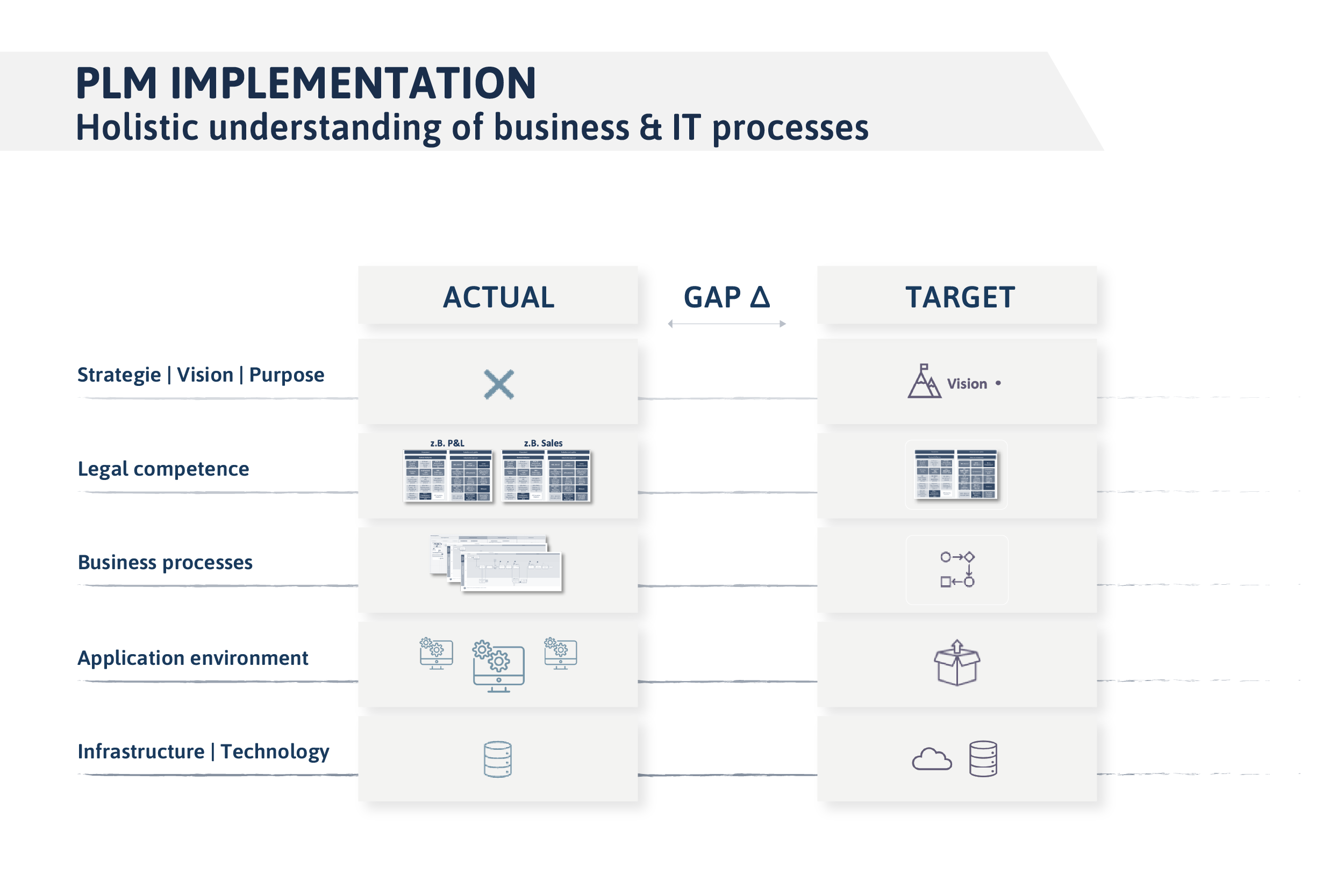
A viable PLM strategy is not created from an IT project – it starts with an honest assessment: Where do we stand? Where do we want to go? Which processes, systems and organizational structures need to change?
A clearly defined PLM strategy provides the foundation for targeted system selection, a realistic roadmap and measurable value – from the first rollout stage to a fully integrated PLM landscape.
2. PLM Integration: Bridging business and technology
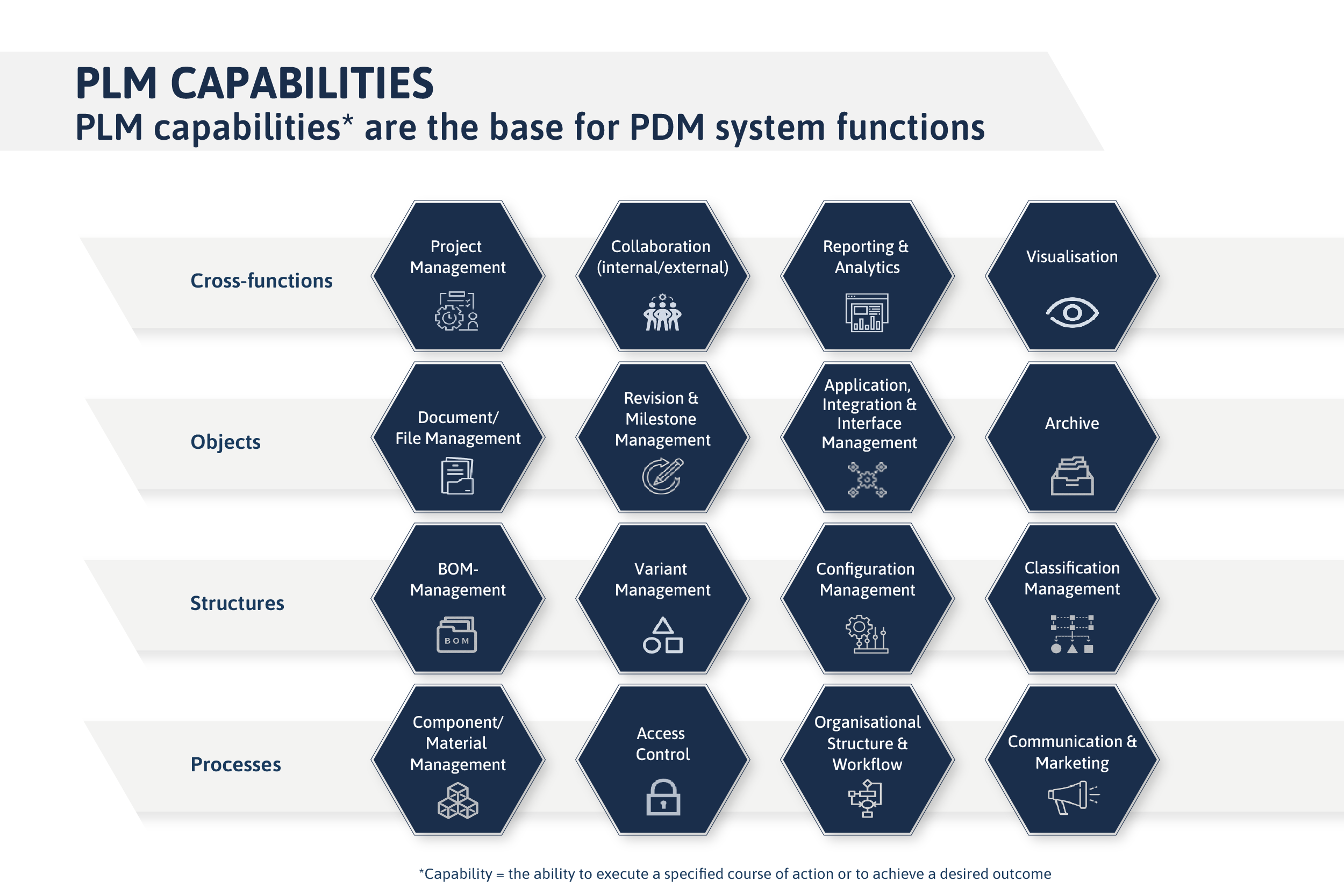
PLM only delivers its full value when seamlessly embedded in the existing system landscape. Integrating PLM with ERP, CAD, ALM, and adjacent systems creates the end-to-end digital thread — and with it, the data foundation for informed decisions across the entire product lifecycle. Successful PLM integration requires not only technical expertise but also a deep understanding of the underlying business processes.
3. PLM implementation: Partnership and process discipline
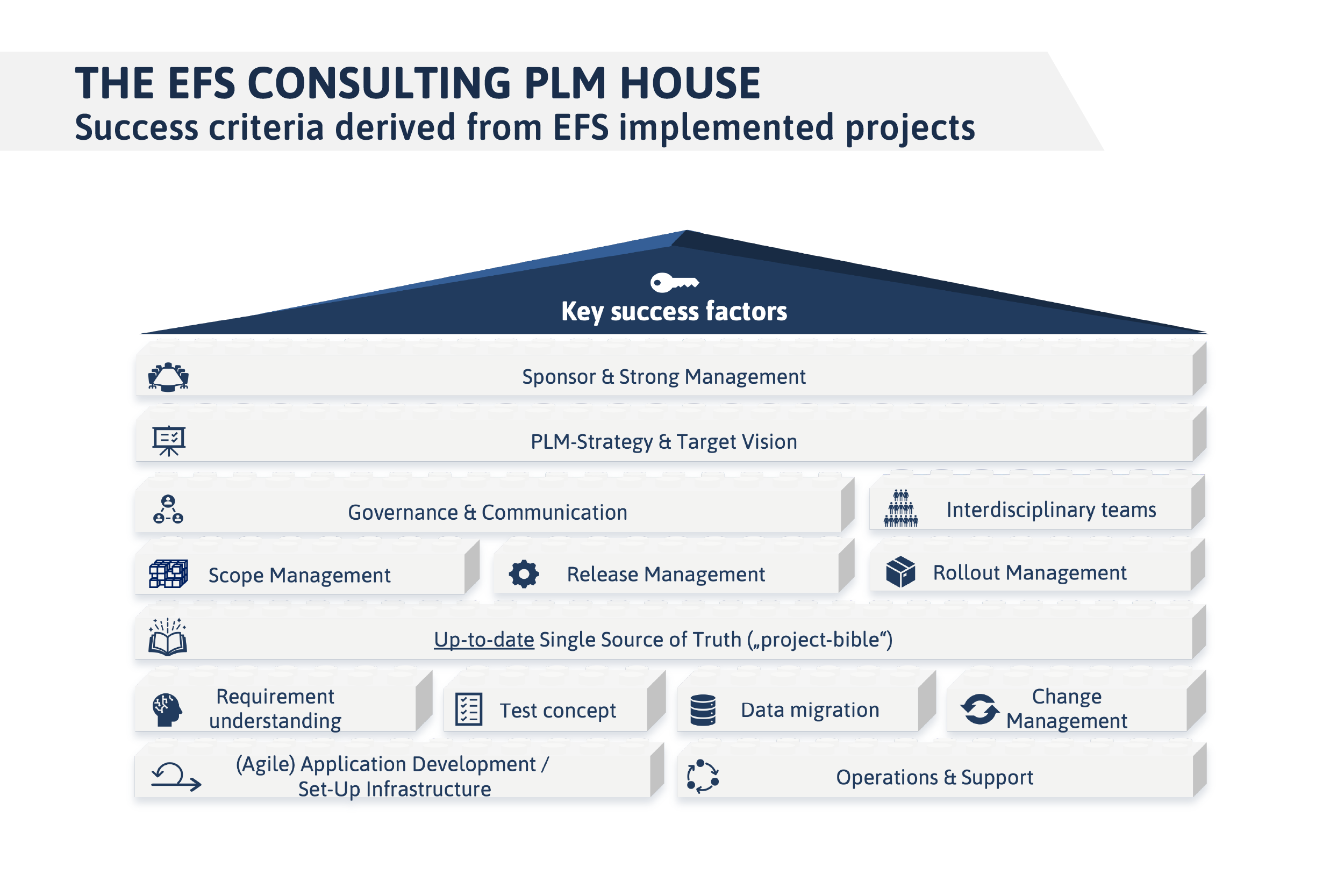
The best PLM strategy is only as good as its execution. A structured implementation – with clear milestones, early user involvement, and consistent change management – is the decisive factor for sustainable project success.
The EFS Consulting Approach in the context of PLM
Successful PLM is created through the interplay of a clear strategy, well-thought-out integration and structured implementation – and the conviction that PLM is not an IT project, but an integral part of the company’s processes.
As an experienced, technology-neutral consultancy, EFS Consulting accompanies companies throughout all project phases: with a deep understanding of product processes, IT architectures and PLM know-how – and the claim to consistently combine business departments, IT and PLM vendors. The goal is to secure the maximum benefit from your PLM investment – sustainable, strategic and process-oriented.
Conclusion
PLM is not a software decision — it is a strategic one. Companies that consistently connect product processes, centralize data, and treat PLM as an enterprise-wide program create the foundation for faster development cycles, higher product quality, and lasting competitiveness.
The complexity of PLM does not lie in the system — it lies in the question of how strategy, integration, and change come together in a specific corporate context. Those who master these three dimensions turn PLM into more than an IT project: a genuine lever for the digital transformation of product development and beyond.
Are you planning to introduce a PLM system or would you like to remodel your existing PLM landscape? EFS Consulting accompanies you in a technology-neutral, process-oriented manner and with transformation competence – from the initial assessment of the current situation to the sustainable anchoring in the company. Contact us for a non-binding initial consultation or an initial, structured PLM readiness analysis for your company!
FAQs
What is Product Lifecycle Management?
Product Lifecycle Management (PLM) connects all information and processes related to a product — from initial concept through design and production to end-of-life. Companies that consistently leverage PLM reduce design errors, accelerate time to market, and lay the foundation for digitalizing their entire product process.
What is the difference between PLM and PDM?
PDM organizes CAD data, bills of materials, and documents within the engineering environment. PLM goes further: it connects this data foundation with processes across procurement, manufacturing, and quality assurance. PDM helps to eliminate document chaos – but optimizing product processes across the enterprise requires holistic PLM.
What is a PLM system?
A PLM system centralizes product data, controls change processes and creates transparency across all product versions. Integration into the existing system landscape – ERP, CAD, ALM, etc. – is critical. The spectrum ranges from established enterprise platforms such as Siemens Teamcenter, PTC Windchill, and Dassault 3DEXPERIENCE to open, flexibly integrable solutions such as Aras Innovator. The right choice depends on company size, industry, and process maturity.