Shifting Retail Landscapes: How Price Consciousness & Discount Providers Are Redefining the Industry
The retail landscape is under massive pressure: global platforms are shifting market standards, new regulations are increasing process complexity, and price-conscious, digitally-savvy customers are challenging retailers strategically. Because brick-and-mortar stores can often no longer display the full variety of products, customers are increasingly migrating (back) online. Those who underestimate the need for action risk tangible margin losses and a sustainably weakened market position. In this Insight, you will learn how these dynamics of competition, changing consumer habits, and technological shifts jeopardize traditional retail models, and which core risks retailers and importers must keep in mind to secure their future.
Table of contents
Key Takeaways
- Global marketplaces (e.g., Amazon, Shein, Temu) are setting new baseline prices and increasing competitive pressure.
- Regulatory mandates like the GPSR are raising product safety requirements in the EU.
- Customers are shopping cross-channel and have become significantly more price-sensitive.
- Driven by extreme price sensitivity, the historical consumer trend of demanding ever-higher quality at lower prices has broken down.
- Cost structures remain high, putting heavy pressure on profit margins.
Retail Landscape Basics
The retail landscape is undergoing a profound transformation that challenges companies strategically and elevates risks. Global platform providers are intensifying competition and shifting market standards, while new regulatory requirements make processes more complex. At the same time, consumer behavior is shifting: high price sensitivity, declining brand loyalty, and high expectations for digital services. Customers are better informed thanks to online reviews and comparison platforms, which causes in-person consultation to lose its significance. Furthermore, physical retail stores cannot always have all products and models available in every single branch, which forces customers to fall back on e-commerce.
These developments create a challenging environment. Retailers and importers must make pivotal decisions to secure their competitiveness, operational stability, and the future of their business models. Anyone who underestimates the need for action risks margin losses, efficiency hits, and a long-term weakening of their market position. Core concepts and developments form the foundation for understanding the causes and impacts of this shift in the retail landscape.
What Is a “Retail Landscape”?
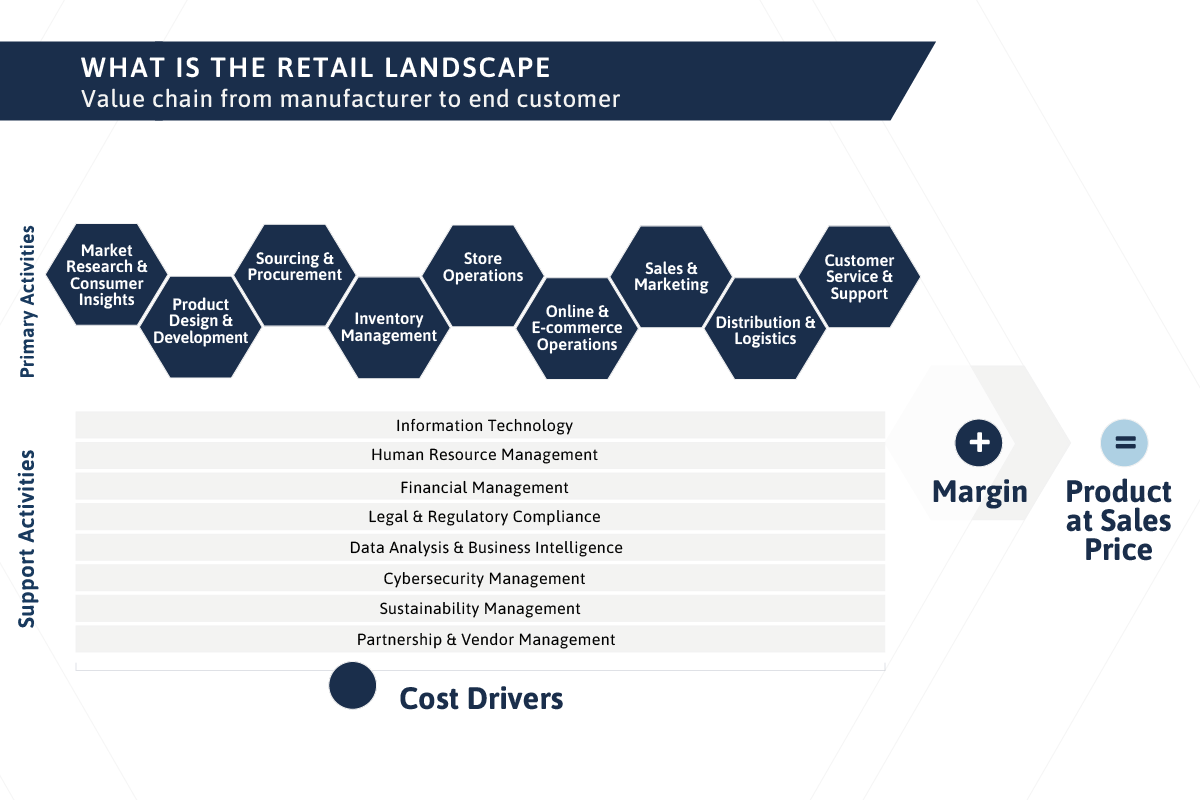
The term “retail landscape” refers to the overall organized structure, composition, and layout of the retail sector at any given time. It encompasses the entirety of all distribution channels and retail businesses (such as supermarkets, boutiques, and specialty stores), as well as their positioning and interconnectedness. This increasingly includes the digital channels used to offer goods.
The retail landscape shapes how goods are organized, distributed, and exchanged across the value chain among producers, retailers, and consumers.
Change vs. Disruption
Change refers to an incremental, gradual, and predictable adjustment where existing business models remain intact but are continuously modernized.
Disruption describes an abrupt, profound upheaval that displaces existing structures and fundamentally replaces them with new technologies, business models, or altered consumer behavior.
Evolution of Distribution Channels: From the Brick-and-Mortar Point of Sale to Digital Ecosystems
Instead of expansion, physical store networks are currently defined by downsizing and consolidation. Retailers are increasingly investing in new forms of physical presence (such as pop-up stores, showrooms, experiential spaces, and personalized consultation) to create relevance and tightly integrate digital and physical touchpoints. At the same time, consumers show a preference for broad generalists, particularly in fashion, jewelry, and sporting goods.
Furthermore, the traditional retail landscape faces intense competition from digital commerce. Online players scale faster, shape consumer behavior, and benefit from being able to ensure product availability even with low inventory volumes. Physical retail, by contrast, requires at least one item per store location. This creates new competitive structures, shifts power dynamics, and increasingly extends value-creation processes into the digital realm.
Today, customers move seamlessly between the online and offline worlds as a matter of course: they discover products on social media, compare prices online, and still visit brick-and-mortar stores—or continue comparing options directly on their smartphones while shopping. For retailers, this behavior highlights the critical importance of omnichannel retailing, as purchasing decisions are formed across multiple touchpoints. Visibility is achieved primarily by providers who consistently integrate both worlds.
Omnichannel strategies range from traditional retail approaches and personalized customer experiences to comprehensive ecosystems. A comparison of these approaches can be found in the following table:
| Aspect | Retail Strategy | Personalization Strategy | Ecosystem Strategy |
| Classification | Basic | Individualization | Advanced |
| Objective | Meet minimum requirements for omnichannel performance | Tailored, relevant customer engagement | Seamless, holistic service experience across the entire customer journey |
| Focus | Consistent shopping experience online & offline | Data-driven personalization & intelligent communication | Integration of all channels, experience, access to community |
| Customer Value | Convenience & freedom of channel choice | Individualized recommendations, relevant offers | Integration into lifestyles, platform utility, sense of community |
| Typical Elements | App, in-store returns of online orders | Targeted promotions, personalized push notifications | Content platforms, community features |
Traditional Retail vs. Platform Economy
The most significant differences between traditional retail and the platform economy lie in their fundamental operational mechanics. While traditional retailers purchase, stock, and display goods to subsequently sell them, platforms like Temu primarily broker goods, enabling them to offer a virtually limitless assortment.
Amazon can be described as a provider that follows a hybrid business model. Products with high demand and rapid turnover are, in part, sold directly by Amazon under its own name and on its own account, including private labels such as Amazon Basics. At the same time, the expansion and completion of the product assortment is achieved through Amazon’s marketplace structure, where third-party sellers offer their products. This model enables Amazon to provide an exceptionally broad product range while benefiting from reduced capital commitment and lower inventory holding requirements.
| Criterion | Traditional Retail | Platform Economy |
| Value Creation Logic | Retailer purchases goods and resells them | Platform intermediates between sellers and buyers |
| Assortment Scope | Limited, curated assortment | Virtually limitless, global assortment |
| Scalability | Growth through stores and physical square footage | Digital scaling without physical boundaries |
| Business Model | Margin on sold goods | Commissions, advertising, data services, optimized last-mile logistics |
| Cost Structure | High fixed costs (rent, personnel, warehousing) | Largely variable platform and tech costs |
| Competition | Local & regional | Global, highly price-sensitive & transparent |
| Customer Contact | Direct in-store contact | Customer relationship is managed by the platform |
| Logistics | Warehousing and store delivery | Direct shipping by sellers/manufacturers or fulfillment networks |
| Price Transparency | Limited, location-dependent | Maximum transparency, intense price comparison |
Which Factors Shape Today’s Retail Landscape?
The retail landscape and its ongoing transformations are shaped by a variety of factors. The most critical include the following:
- Economic Climate
- Price Levels
- Purchasing Power
- Consumer Behavior
- Competition
- Technology
- Regulation
The following sections explain in detail how these factors specifically impact the retail landscape.
The Economic Cycle Dictates the Rules of the Game in Retail
The overall economic climate has a substantial impact on the retail landscape. As illustrated in the chart below, the economic cycle can be divided into four phases: expansion, peak, contraction, and trough.
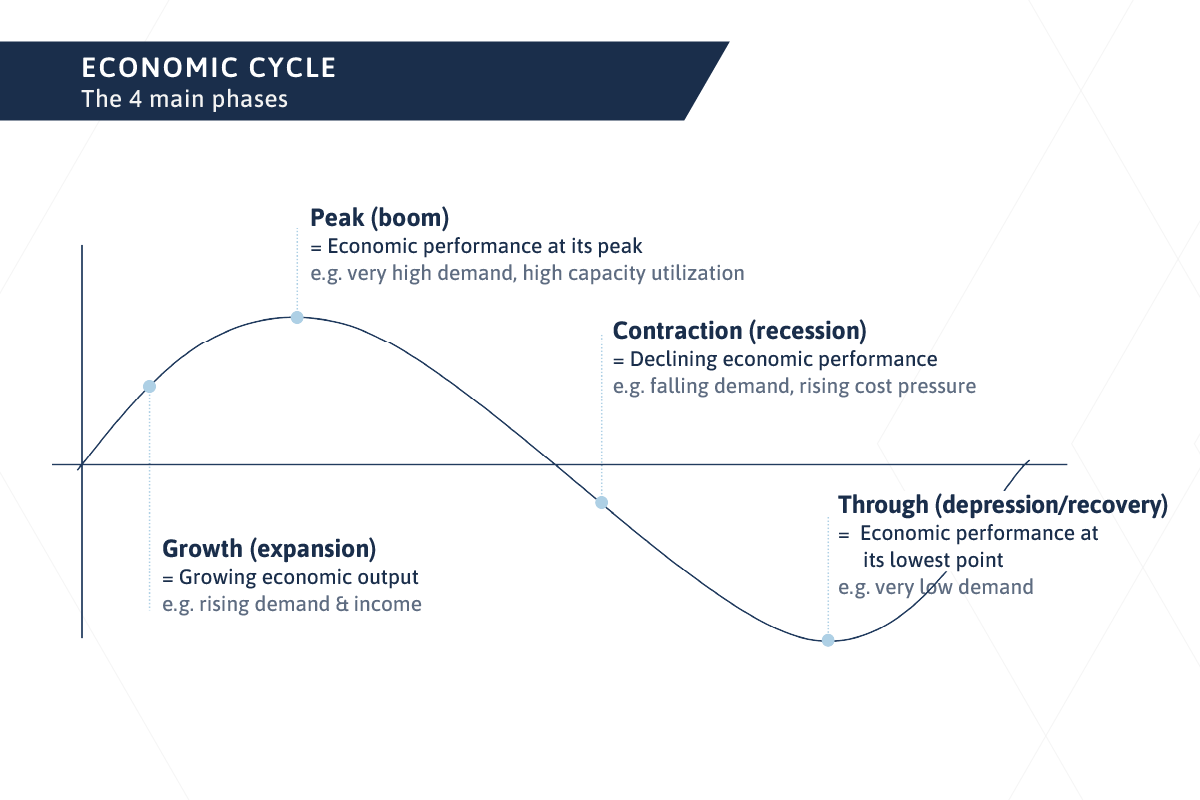
In a phase of economic recession, such as the one we are currently experiencing, consumers react with restraint, causing demand to drop. This puts further pressure on already thin retail margins. In such a situation, retailers must aggressively reduce their costs.
This cost pressure is currently further exacerbated by a unique macroeconomic phenomenon: stagflation. In this scenario, rising prices collide with virtually stagnant economic growth, further narrowing companies’ strategic room for maneuver.
Given sluggish macroeconomic growth and rising prices, the question arises as to which factors companies can actually actively influence.
The largest and most directly controllable lever for corporate profitability lies in the optimization of overhead structures. Overhead costs include, for example, rent, energy, and personnel expenses. They constitute a substantial portion of the cost structure and offer the greatest potential for cost reduction. Instruments such as zero-based budgeting help to consistently challenge existing cost structures and plan budgets from scratch based entirely on actual needs.
Price as a Strategic Management Factor in Retail
In retail, price serves as a central strategic management factor. The most critical concepts in this context are:
- Price Level: Defines positioning ranging from discount to premium.
- Price Sensitivity: Indicates how strongly customers subjectively react to price changes (e.g., in e-commerce).
- Price Elasticity: Quantifies how sharply demand reacts to a $\pm 1\%$ change in price.
- Price Perception: Describes the psychological effects of pricing structures that influence purchasing decisions (e.g., charm pricing/ending digits, reference prices, promotional offers).
Why Today’s Customers Make Different Choices
The prolonged economic downturn is depressing real purchasing power and significantly altering shopping behavior. Many consumers are abandoning established brand loyalty in favor of lower-priced private labels. This weakens the brand equity of many manufacturers, as perceived brand value increasingly takes a backseat to price advantages. At the same time, acceptance of low-cost alternatives is rising—even if these products do not always meet the same quality or sustainability standards.
High price sensitivity means that prices are compared more consciously and promotional offers are scrutinized more heavily. Comparison platforms reinforce a behavior shaped by “smart shopping,” which places additional pressure on retailers.
Furthermore, consumers today discover brands via international online shops and social platforms. As a result, convenience and cross-border shopping are gaining importance, while expectations for inspiring shopping experiences are simultaneously rising.
Global Cutthroat Competition
Today, retailers compete across formats and channels. Private labels are gaining market share, D2C (Direct-to-Consumer) brands are bypassing traditional retail, and models like subscription commerce or omnichannel services are expanding the competitive landscape. Driven by globalization, online marketplaces such as Temu, AliExpress, and Shein have scaled rapidly, while brick-and-mortar discounters like Action and Tedi exert additional pressure on physical retail. Digital platforms, in particular, are reshaping the market framework: they set new price benchmarks, offer vast assortments, provide rapid shipping models, and enable manufacturers to market directly to end consumers.
This dynamic creates new price anchors that destabilize traditional pricing structures. Consumers are becoming accustomed to extremely low prices, flexible delivery options, and a virtually unlimited product selection.
These forces amplify a clear polarization in the market: while some providers focus on premium positioning and brand strength, price competition is intensifying at the lower end of the spectrum—driven by global low-cost providers.
The shift in the retail landscape is also evident in the emergence of relatively new Asian players in the European market, which are continuously expanding their market share. According to a survey, 29 percent of Germans shopped at the online retailer Temu (3rd place) over the past year, and 18 percent of respondents shopped at Shein. For comparison, market leader Amazon stood at 75 percent, with eBay in second place at 33 percent (As of November 2025—Statista).
Technology as an Enabler
In addition to the trend toward the platform economy and omnichannel strategies, technology is increasingly becoming a core enabler that supports key retail functions through data-driven insights. Dynamic pricing utilizes algorithmic models and machine learning to flexibly adjust prices to demand and competition, while electronic shelf labels (ESLs) enable rapid implementation. At the same time, AI is deployed particularly in forecasting and inventory management, which increases demand accuracy, optimizes stock levels, and reduces out-of-stock scenarios. Additionally, AI and predictive analytics help align product assortments with real-time demand. AI personalization, AR/VR, and automation create new differentiation factors while simultaneously raising the pressure on retailers to keep pace with innovation.
Regulatory Guardrails: GPSR and Product Introducer Liability
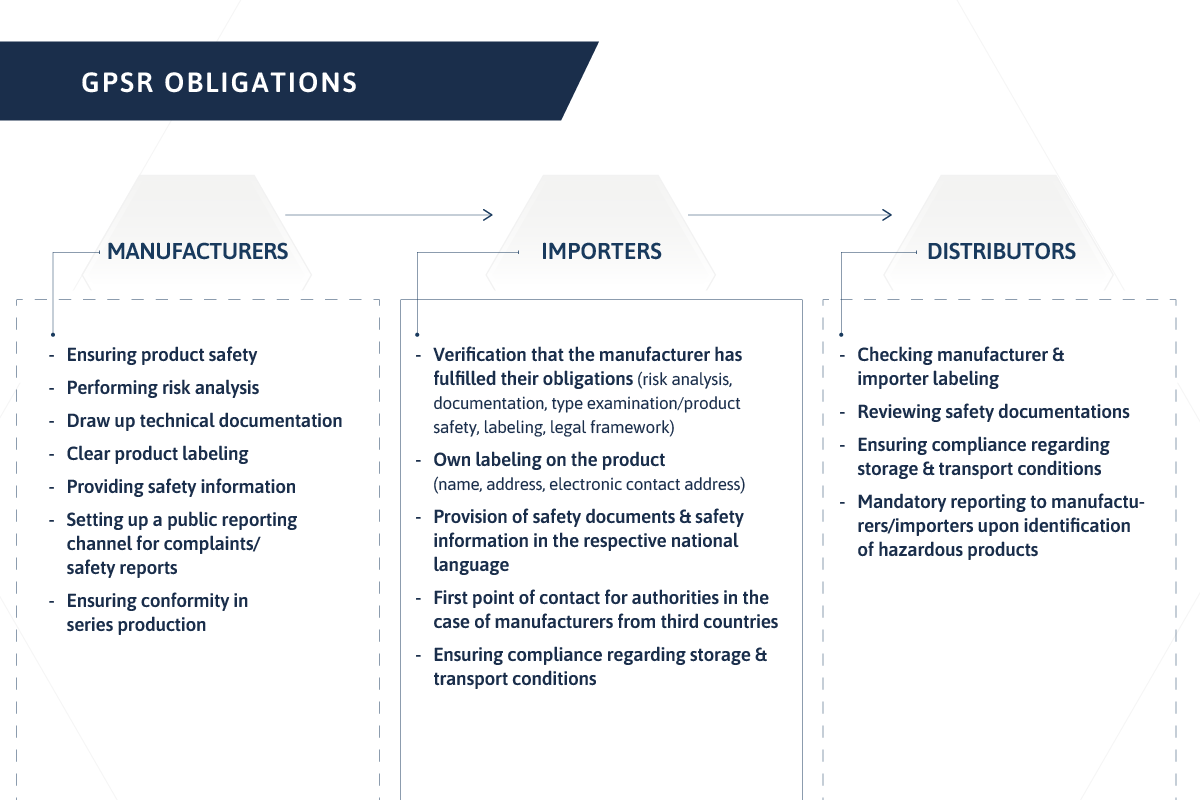
With the General Product Safety Regulation (GPSR) in effect since December 2024, alongside other frameworks such as the Supply Chain Act, the CSRD, and the DPP (Digital Product Passport), the EU aims to ensure a high level of safety for consumers in the European market and increase transparency across the value chain. The GPSR applies to all consumer products and tightens the obligations of global marketplaces and fulfillment service providers. Unsafe products must be removed from circulation more quickly, responsibilities must be assigned more clearly, and authorities must be supported more actively, which significantly increases the risk for the party introducing the goods to the market (Inverkehrbringer-Risiko). Specifically, the three most relevant stakeholders have the following obligations:
Key business, legal, and operational terms (such as product compliance, overhead costs, spend cube, and marketability) have been carefully translated to maintain the analytical, whitepaper-style tone of EFS Consulting.
In practice, many low-cost providers fail to comply with European standards. As investigations by Stiftung Warentest demonstrate, 110 out of 162 tested products did not meet EU safety requirements. The electronics category, in particular, saw the highest rate of non-compliance. In addition to severe safety defects, counterfeit quality seals are routinely discovered. This effectively distorts fair competition and further complicates the situation for European companies, which must comply with strict regulatory standards while third-country budget providers capture market share with extremely low prices.
While adherence to all legal mandates may appear more labor-intensive and costly in the short term, consistent product compliance and trade compliance, along with rigorous auditing, establish long-term security. By doing so, companies not only avoid sanctions and reputational damage but also eliminate organizational burdens and unexpected market entry barriers.
Why the Retail Landscape Is Currently Undergoing Structural Change
The retail landscape is experiencing a structural shift driven by multiple megatrends acting simultaneously and reinforcing one another. Although inflation is moderating, high cost structures continue to limit companies’ strategic leeway. In parallel, consumer behavior is shifting toward digital purchasing processes, high price sensitivity, and international price transparency. According to the European Parliament, approximately 4.6 billion low-cost shipments entered the EU in 2024—frequently duty-free and undervalued. Consequently, some providers evade government duties and undermine fair competitive conditions, granting platforms like Temu significant price advantages.
Furthermore, technological progress—particularly the widespread adoption of AI—accelerates operational processes and fundamentally reshapes the competitive framework. This is compounded by tightening regulatory mandates, such as stricter product introducer obligations. Taken together, these developments demonstrate that retail is at a critical turning point; without decisive strategic action, companies risk a loss of relevance and declining competitiveness.
Pitfalls & Risks from a Retailer’s Perspective
To respond appropriately to market changes, companies must first identify the core pitfalls and risk drivers that retailers face in this dynamic environment.
| Pitfalls and Risks | Description | Probability of Occurrence | Impact | Typical Consequential Errors |
| Price Focus Without Differentiation | Retailers attempt to use price as their primary competitive factor and emulate low-cost providers. | Medium–High | Very High | Loss of quality, positioning issues |
| Lack of Product Compliance | Inadequate verification processes or missing documentation lead to violations of GPSR & product introducer obligations. | Medium–High | Very High | Recalls, sanctions, reputational damage |
| Inadequate Market and Competitive Monitoring | Regulatory violations by low-cost providers and competitors are not addressed. | High | Medium–High | Loss of market share, price pressure, strategic blind spots |
| Lack of Data-Driven Management | Decisions are based on gut feeling rather than data. Assortments and prices are not optimally managed. | High | High | Out-of-stocks, excess inventory, gross margin issues |
| Supplier Risks | Lack of quality control, unclear certifications, weak risk management in the supply chain. | Medium | High | Quality issues, regulatory violations, high consequential costs |
EFS Consulting Experts Recommend: How Retailers & Importers Can Respond Strategically and Successfully
Given the altered retail landscape and intensified market environment, the following strategic priorities must be established immediately.
1. Clear Positioning & Differentiation
In economically strained times, clear positioning becomes essential to stand out from the competition. Traditional companies must sharpen their market roles and clearly communicate the unique value proposition they offer over platforms and global marketplaces. This requires a thorough analysis and precise management of their market segment, clear price points, and a visible value proposition (quality, safety, service). Defining a distinct USP also reduces interchangeability and increases price acceptance.
2. Understand Customers & Manage Price Perception
During recessions, the perception of price and value becomes even more critical. Companies must actively analyze customer needs and align their offerings accordingly to increase Customer Lifetime Value (CLV). Retailers who consistently align their pricing and communication strategies with long-term customer relationships can achieve more stable revenues—even in price-sensitive periods—than providers with a purely transactional focus.
3. Category Management & Assortment Analysis
Companies must ensure their category management is consistently data-driven, regularly reviewing assortments for profitability, demand, and relevance. This includes clearly defining roles for each category alongside deliberate SKU rationalization (assortment cleanup). Furthermore, assortments must be differentiated across channels to meet the specific requirements of the respective customer base. Companies should also increasingly rely on digital approaches in their assortment strategies. Unlike traditional methods, which focus heavily on historical sales data and static categories, digital approaches enable a significantly more dynamic and data-driven management of inventory and product lines.
4. Performance Analysis & Quality Communication
Companies must systematically measure product quality and actively showcase product performance. This means clearly communicating quality standards and product safety to build trust and distinguish their products from low-cost imports.
5. Competitor Monitoring Regarding Marketability
Companies can selectively monitor the marketability (Verkehrsfähigkeit) of competitor products to identify potential regulatory violations early on. In a market environment increasingly shaped by budget providers with questionable product compliance, structured market surveillance and competitive monitoring offer distinct advantages. Retailers can verify whether competing products display mandatory labeling and satisfy required safety criteria. Any identified discrepancies should be systematically documented and, if necessary, reported to the responsible authorities to ensure fair competition while strengthening the company’s own compliance position.
6. Supplier & Partner Strategy
Companies can regularly evaluate and strategically develop their supplier base while contractually establishing clear quality and safety standards. Professional supplier management involves structured bidding processes, transparent evaluation criteria, and active risk management. Within the framework of supply chain management, retailers should strategically combine global and local supply chains to balance cost advantages, flexibility, and security. At the same time, maintaining comprehensive documentation regarding certificates, product safety, and compliance is essential to reliably satisfy regulatory requirements and customer expectations.
EFS Consulting Practical Examples
The following real-world examples illustrate how retail companies can sharpen their strategic alignment and remain sustainably successful in a market environment shaped by structural change.
As part of a client project, a comprehensive analysis and reorganization of the entire product assortment was conducted. All products were precisely structured according to their price and value proposition, resulting in a highly transparent and consistent assortment logic. Based on this, a differentiated communication strategy was developed and successfully implemented, targeting specific customer segments and clearly highlighting product benefits. This cross-channel assortment logic enables targeted utilization of omnichannel potential and has significantly improved the company’s competitive position.
In light of rising price and competitive pressures, a client project involved capturing all primary and secondary overhead costs and mapping them transparently within a spend cube. For the first time, this revealed which internal and external services were driving overheads. Based on these insights, employees were able to recognize how daily decisions increase or decrease costs. This led to a tangible increase in cost awareness and a more efficient overhead cost structure—a decisive factor in an environment with high margin pressure.
Conclusion
High cost pressure, intense competition, and increasingly price-driven consumer behavior require decisive action. Companies must sharpen their positioning and differentiate themselves from low-cost competitors through a clear customer value proposition. Only then can they maintain their competitiveness in the long term.
EFS Consulting supports you in focusing and addressing these challenges and building sustainable competitiveness. We have extensive project experience in establishing near-shoring capacities, conducting cost breakdowns, developing index-based floater models, evaluating make-or-buy scenarios, assessing warehousing and distribution logistics networks, specifying requirements and SLAs, and—where necessary—selecting suitable service providers. Contact us to systematically implement your next steps.
FAQs
How does inflation affect retail assortments in the long term?
Retailers streamline their assortments and focus more heavily on low-cost, high-margin items alongside a private label strategy.
What is the greatest risk for established retailers in the current retail landscape?
The greatest risk stems from the growing pressure exerted by digital market participants and low-cost providers, combined with rising costs and heavy regulation.
Why are providers like Temu and Action growing so rapidly?
Through exceptionally low prices, vast selections, and highly efficient, data-driven business models, they are rapidly gaining market share. They perfectly cater to increasingly price-oriented consumer behavior.

Authors