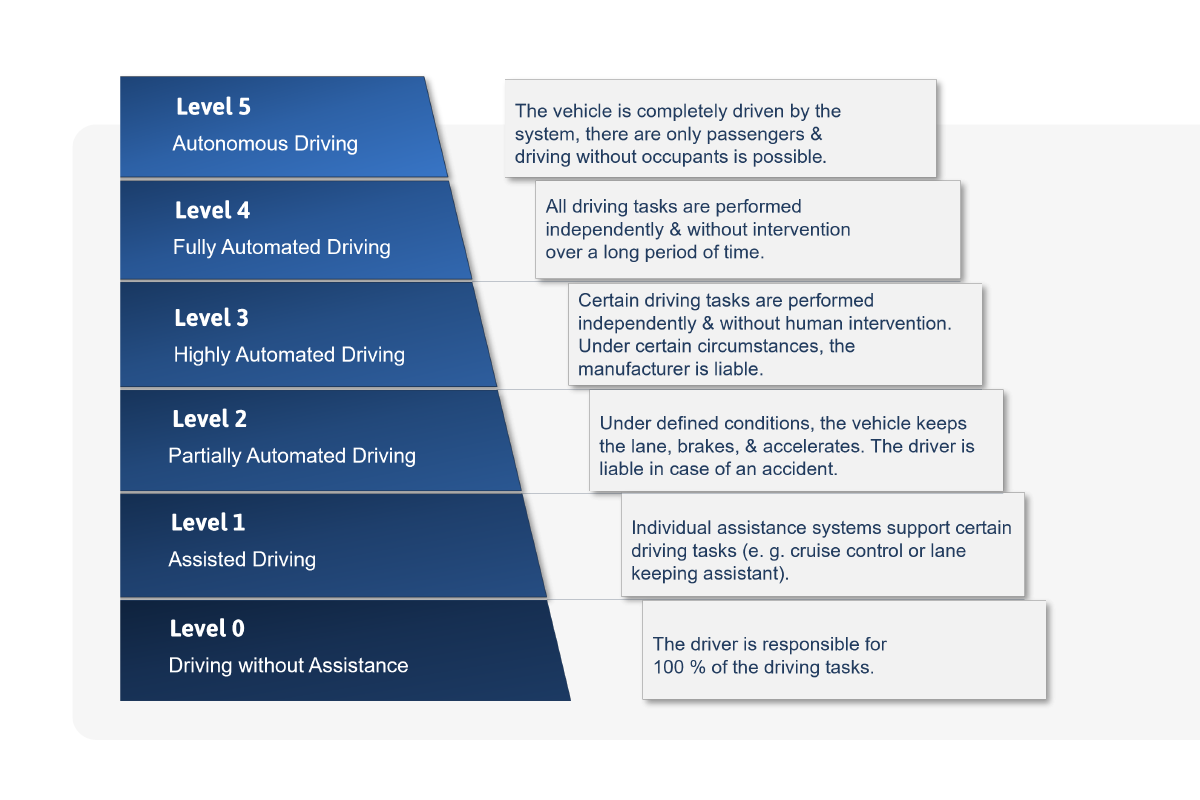
In future, the implementation of technical requirements will be a prerequisite for applying for type approval of vehicles equipped with an Automated Lane Keeping System (ALKS). The regulations apply to passenger cars and light commercial vehicles and specify that the ALKS can only be activated under certain circumstances:
- Driving on the highway (no pedestrians and cyclists, no oncoming traffic)
- Driving at a maximum speed of 130 km/h
National implementation of the regulation has so far taken place in more than 50 UNECE member states, including all countries of the European Union as well as in England, Australia, South Africa and Turkey.
Essentially, UNECE requires R157:
- redundant system and failure safety
- mechanisms for monitoring the human-machine interface
- sensors for object and event detection and
- the continuous recording of vehicle data
In addition, demonstrable compliance with the UNECE regulations on cyber security (R155) and software updates (R156) is a basic requirement for applying for a vehicle type approval in accordance with UNECE R157.
Effects and need for action
UNECE R157 therefore has a major impact on the existing development and testing processes for electrical and electronic components at automotive manufacturers and suppliers. In order to achieve compliance and the required software quality, the requirements must be taken into account from the outset.
The provision and interaction of appropriate processes, methods and IT tools within the organization is an essential basis for this. Processes include the definition and structuring of procedures for the efficient coordination and implementation of vehicle development projects. Methods include the application of specific techniques and approaches for the systematic analysis, design and optimization of components and systems. IT tools are used to facilitate data collection and processing, which improves planning and communication.
Only vehicles that meet these requirements may be fitted with a level 3 ALKS. The application for vehicle type approval is submitted to the national approval authority (e.g. Kraftfahrbundesamt in Germany).
The vehicle is then tested by an authority or a technical service. This test consists of a virtual simulation of various scenarios, the testing of critical scenarios on a test track and a driving test on public roads. If the test is completed successfully, the vehicle manufacturer receives type approval for the vehicle model applied for with the ALKS installed in it.
What needs to be done?
EFS Consulting provides support in identifying relevant UNECE R157 requirements and implementing them holistically. Automotive manufacturers and suppliers should carry out the following steps:
- Detailing technical requirements for a vehicle project
- Integrating the requirements into the development process
- Developing a testing concept based on the requirements in the annex to UNECE R157
- Compliance with the requirements in the development phase
- Accompanying the vehicle tests and documenting the fulfilled testing requirements
- Submitting the certification
By implementing the requirements at an early stage, car manufacturers and suppliers are laying the foundations for successful vehicle projects and creating a crucial basic requirement for future technological business and competitiveness.
Conclusion
UNECE R157 requires comprehensive safety and emergency strategies, continuous system monitoring and robust cyber security measures. For certification, vehicles with an ALKS must pass extensive tests covering various scenarios and real-life conditions.
The regulation therefore has far-reaching implications for the automotive industry, as the development of new technologies requires significant investment and expanded testing strategies. By implementing UNECE R157 early and effectively, companies can gain a competitive edge and strengthen their position in the market.