Environmental Product Declaration (EPD): Why Robust Environmental Data Are Indispensable Today
How environmentally friendly is a product really—and how can this be demonstrated objectively, comparably, and credibly? To communicate and compare the environmental impacts of products and services transparently, a consistent and broadly recognized format for data preparation is required. The aim is to make environmental data publicly accessible without disclosing sensitive product information. This insight focuses on the Environmental Product Declaration (EPD) as a globally recognized document for the concise presentation of verified environmental data. Learn how an EPD is structured, which steps must be completed during its preparation, and what specific value it provides for companies.
Table of contents
Key Takeaways
- An Environmental Product Declaration (EPD) is a standardized document that transparently presents externally verified environmental information on products or services.
- It enables companies to communicate environmental data credibly without having to disclose sensitive product information.
- EPDs enable participation in numerous public tenders and institutional procurements, which increasingly require environmental evidence.
- The methodological basis is a Life Cycle Assessment (LCA), the results of which are summarized, externally verified, and published.
- EPDs are based on recognized standards and regulations that enable the effective comparison if product in terms of their environmental impacts.
Environmental Product Declaration (EPD): Simply Explained
Terms such as “climate-neutral”, “sustainable”, or “environmentally friendly” are increasingly subject to legal and public scrutiny. Companies therefore face the challenge of substantiating environmental impacts objectively, transparently, and comparably—without disclosing sensitive product or process information. This is precisely where the Environmental Product Declaration (EPD) comes into play.
An Environmental Product Declaration (EPD) is a Type III environmental declaration that publicly provides quantitative and verified environmental information on a product or service in a standardized format. The underlying data are derived from a complete Life Cycle Assessment (LCA), which forms the basis of every EPD. The assessment results are summarized concisely, externally verified, and published. The format is aligned with data protection requirements, so that no sensitive information about the system under review must be disclosed.
EPDs are an instrument for the transparent and verified documentation of a product’s environmental impacts. As such, they enable credible substantiation of sustainability performance and the effective comparison of products with similar functions. In addition, EPDs often enable participation in public tenders and procurement processes of all kinds that require transparent environmental evidence as an eligibility criterion. This applies primarily to the construction sector, but also other industries are seeing rapidly increasing demand for EPDs.
Overview: Regulatory Framework for EPDs
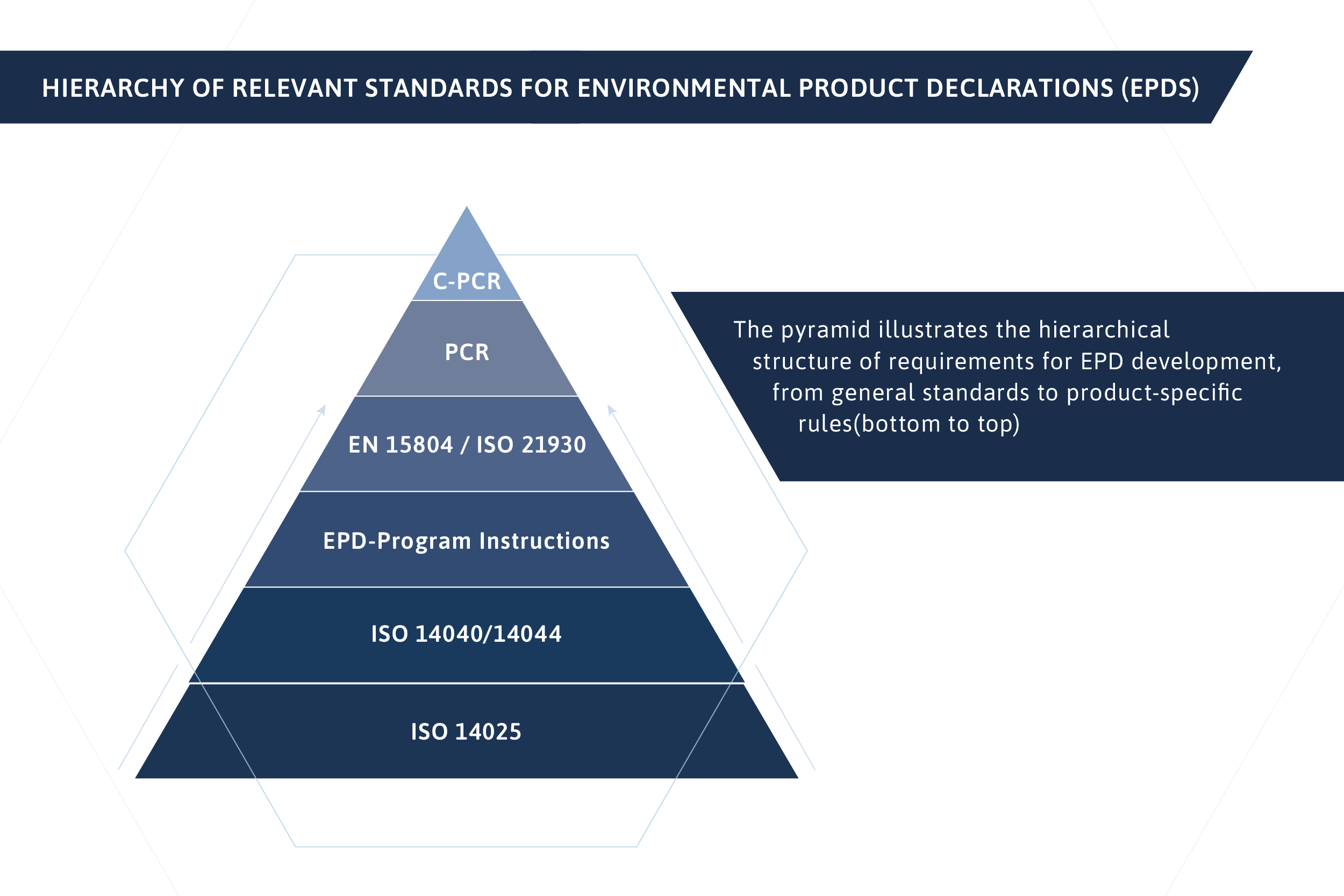
To be globally recognized and comparable, Environmental Product Declarations are based on internationally applicable standards and rule sets. The methodological foundation is provided by ISO 14025 for Type III environmental declarations. The underlying life cycle assessment must comply with the requirements of ISO 14040 and ISO 14044. In addition, so-called Product Category Rules (PCRs) specify how products within a given category must be assessed to ensure comparability.
Differences Between the Types of Environmental Declarations
As a Type III environmental declaration, an EPD differs fundamentally from other forms of environmental labeling. The various declaration types pursue different objectives and levels of evidential value:
- ISO Type I declarations are based on predefined catalogs of criteria and award environmental labels (e.g., classic eco-labels). The assessment is qualitative and typically takes the form of a yes/no decision.
- ISO Type II comprises voluntary environmental claims by manufacturers. These self-declarations are not necessarily subject to independent external verification and therefore have limited comparability and reliability.
- ISO Type III (EPDs), by contrast, provide product-specific and externally verified environmental metrics in the form of environmental product declarations. EPDs deliberately refrain from classification or evaluation and instead make verified data available in a standardized format.
Accordingly, Environmental Product Declarations are not used as a “quality seal” for marketing purposes; rather, they are data-driven and verified information instruments designed in particular for professional users, planners, tendering processes, and comparative assessments.
Distinction from EPIs: Why EPDs Are More Reliable
EPDs must be clearly distinguished from Environmental Product Informations (EPI). EPIs also provide environmental information, but they are subject to less stringent requirements than an EPD. EPIs are not standardized, do not have to be based on complete LCAs, and do not require external verification. The quality and evidential value of EPDs should therefore be regarded as significantly higher than that of EPIs.
More Than CO₂: The Holistic Environmental Profile of an EPD
EPDs are often equated with carbon footprint calculations or CO2 labels—however, this view is too narrow. First, as described above, an EPD is not a label that evaluates individual aspects of product quality; rather, it is a factual, scientifically grounded summary of the associated environmental impacts. Second, an EPD is not limited to the carbon footprint, but considers a range of additional impact categories (e.g., acidification, resource consumption, etc.). EPDs therefore provide a holistic environmental profile, including greenhouse gas emissions.
EPD Programs and Organizations: Who Verifies, Manages, and Publishes EPDs
To structure, verify, and publish EPDs, different EPD programs exist worldwide and are operated by various organizations. These program operators play a central role in the EPD system, as they ensure methodological and formal quality assurance.
They develop and manage Product Category Rules (PCRs), ensure conformity with the underlying standards (e.g., ISO 14025, EN 15804), organize independent third-party verification, and provide platforms for publishing verified EPDs.
Some of the most important EPD program operators include:
- International EPD System (Environdec): a globally recognized institution headquartered in Sweden; covers all product types and sectors.
- UL Solutions: an international program operator with a strong focus on North America.
- Institute for Construction and Environment e.V., Germany (IBU): a key program operator for construction products from Germany.
- Institute for Window Technology (ift Rosenheim): an example of a specialized program operator with a focus on windows and façade elements.
In addition to these programs, other national and sector-specific initiatives focus on particular markets or product groups.
Standards, Norms, and PCRs: How Comparability Is Truly Achieved
EPDs only fully realize their value when their contents are not only transparent but also systematically comparable. Decisive in this regard is the interaction of various standards, sector-specific norms, and product-specific rules that define the methodological framework of an EPD precisely and ensure consistent results.
The Formal Framework for EPDs
While the fundamental standards define the formal framework for EPDs, additional standards and rule sets ensure that environmental information within a product category is in fact comparable.
EPDs are specified by a range of standards and requirements intended to ensure standardization and comparability within product categories.
International Standards as a Basis
The ISO 14000 family of standards, which covers environmental management systems of all kinds, is regarded as the overarching regulatory basis. While ISO 14020 sets out general principles for environmental labels and declarations, ISO 14025 defines Type III environmental declarations in detail, specifying principles and content requirements for EPDs for all types of products. A complete life cycle assessment (LCA) in accordance with ISO 14044 always forms the foundation of an EPD. The standards provide significant flexibility for detailed implementation in order to address different requirements by product category and use case. Further rule sets are therefore necessary to guarantee consistent structures and comparability within product categories.
Sector-Specific Standards in the European and International Context
A key document in Europe is DIN EN 15804, which sets out basic rules for environmental declarations of construction products. In international and US studies, ISO 21930 is sometimes used as an alternative. The construction sector occupies a special position, as it was among the first to focus specifically on certification as a foundation for sustainable construction (green building). The majority of EPDs in existence today relate to construction products. However, other sectors are also seeing rapidly growing demand for transparent reporting of environmental impacts.
Product Category Rules (PCRs): Ensuring Comparability
Specific requirements for how LCAs and EPDs within a product category must be designed are defined through Product Category Rules (PCRs). These exist within the various EPD programs and are defined in an open, transparent, and verified process by stakeholders of the relevant product category. Broad “core PCRs” may, where appropriate, be supplemented by more detailed complementary PCRs (c-PCRs) for sub-groups of a product. Once reviewed and finalized, PCRs are publicly available and must be complied with when preparing an EPD.
Which EPD Is Suitable for Which Purpose: Different Types of EPDs
Depending on the scope of the assessment and the objective, different types of Environmental Product Declarations can be distinguished. Selecting the appropriate EPD type significantly influences the evidential value, effort required, and strategic benefit of the declaration.
1. Single-Product EPDs
Single-product EPDs relate to a specific product from a manufacturer and are currently the most common form of EPD. They enable a highly precise presentation of environmental impacts and are particularly suitable for products with clear delineation and a high degree of customization. Single-product EPDs are especially useful when products are positioned in tenders, compared, or used as part of building certification schemes.
2. Multi-Product EPDs
Multi-product EPDs cover several technically and functionally similar products of a company. Commonalities are consolidated and differences are reflected methodologically. Their advantage is that costs and effort can be reduced when certifying multiple products, without entirely foregoing product-specific evidential value. This form is particularly suitable for product families or series with comparable materials, production processes, or areas of application.
3. Industry-Wide EPDs
Industry-wide EPDs describe the average environmental footprint of a product within a market, based on data from multiple manufacturers. They are often initiated by associations or representative bodies. Industry-wide EPDs primarily serve as a reference or benchmark. They are less suitable for differentiating individual providers, but can provide valuable guidance, especially in early planning stages or where product-specific data is unavailable.
Contents of an EPD
A complete EPD consists of two key documents: a public EPD document and a non-public LCA report. The public EPD document serves to communicate LCA results and general product information transparently; however, internal background data are not disclosed and are deliberately protected. The structure of the document follows the regulations outlined above and includes the following sections:
- General information on the relevant EPD program, standards and regulations used, and the stakeholders involved (manufacturer, third-party verification, LCA preparation, etc.).
- Product description, including product name and delineation, function and composition, service life, and production conditions.
- LCA methodology, including key assumptions and parameters used in the LCA, system boundaries, and the life cycle stages considered.
- LCA results, presented in a standardized format, including interpretation and explanation of the results where necessary.
By contrast, the LCA report is intended solely for internal documentation and is not publicly accessible. It contains detailed information on the product, production conditions, and LCA calculations and serves as the central document for third-party verification of the life cycle assessment.
As the core element of an EPD, LCA results are captured across multiple impact categories. Requirements regarding which categories must be included are defined by EN 15805 or the respective PCRs. Among the mandatory impact categories are, for example:
- Greenhouse gas emissions (Global Warming Potential), subdivided into fossil, biogenic, and land-use-related emissions.
- Resource consumption, differentiated into fossil energy carriers as well as minerals and metals.
- Waste generation across the categories of non-hazardous, hazardous, and radioactive waste.
- Additional indicators such as acidification, ozone depletion, and water use.
Application and Benefits of EPDs
As a standardized, data-based information instrument, EPDs are the standard document for the transparent and objective disclosure of product-specific environmental information. As such, they can be used in a variety of ways and create tangible added value:
- The complete life cycle analysis underlying an EPD makes environmentally relevant hotspots transparent. This enables manufacturers to identify the life cycle stages in which the greatest environmental impacts occur. These insights support the optimization of materials, processes, and designs toward more sustainable product development.
- As a recognized, third-party verified proof of the environmental impacts of products, EPDs support fulfilling sustainability requirements and environmental certification. In particular, the construction sector uses EPDs extensively for sustainable building certification (LEED, BREEAM). Other industries are also seeing the growing importance of EPDs as a critical requirement in public tenders and procurement processes.
- An EPD enables credible communication of environmental performance to customers and stakeholders. As a transparent and verified data basis, it facilitates data-driven environmental management and strengthens trust among customers and stakeholders in products and processes.
- EPDs support sustainable marketing and sales strategies by enabling effective comparison of the environmental impacts of similar products. This allows companies to position themselves in the market and substantiate their claims through data-based certification.
Who Needs an EPD?
Due to their universal character and the standardized presentation of environmental data, Environmental Product Declarations are relevant for numerous stakeholders along the value chain. They serve equally as a decision-making, comparison, and evidence instrument:
Companies and Manufacturers
Companies can use EPDs for products or services in a targeted manner to analyze environmental impacts transparently, identify improvement potential, and communicate sustainability performance robustly. In addition, EPDs support data-based product positioning and transparent market communication as well as the fulfillment of regulatory and market requirements, particularly in tenders and supply chains.
Property Developer, Planners, and Architects
Especially in the construction sector, property developer, architects, and planning firms use EPDs as a basis for the selection of sustainable construction products and for building certifications (e.g., LEED, BREEAM). For manufacturers, this creates a concrete opportunity to position products and to be considered in relevant projects.
Public Sector and Authorities
Governments and public contracting authorities use EPDs to develop sound regulations, environmental standards, and award criteria. As a verified data basis, EPDs enable an objective assessment of environmental impacts in public procurement.
Consumers
EPDs also contribute to transparency for consumers: they make it possible to better understand the environmental aspects of products and to base purchasing decisions on an objective, verified data foundation—especially for complex or long-lived products.
Investors, Stakeholders, and Supply-Chain Partners
Stakeholders and investors benefit from EPDs as a reliable input for sustainability reporting, ESG assessments, and supply-chain analyses. Product-related environmental data increase the traceability of sustainability strategies and support well-founded investment and risk decisions.
Preparation and Verification of an EPD
Preparing an Environmental Product Declaration is more than merely collecting data. It starts with strategic decisions and proceeds through detailed analyses to independent verification. Each step builds on the previous one and ensures that a product’s environmental impacts are presented transparently and in a verifiable manner. The following phases illustrate how an initial concept becomes a verified and published EPD.
1. EPD Strategy and Concept Development
An EPD begins with fundamental decisions regarding the type of EPD, the scope of the products assessed, the platforms and tools to be used, and whether to engage external experts for support. The applicable standards and PCRs must also be identified and analysed.
2. Life Cycle Assessment (LCA)
Once the framework conditions for preparing the EPD have been clarified, the Life Cycle Assessment is conducted as the central data basis. External parties are often engaged to provide expertise and software tools. As described in the EFS Consulting Insight “What is Life Cycle Assessment?”, an LCA is structured into four distinct phases:
- Goal and scope definition
- Life cycle inventory (LCI)
- Life cycle impact assessment (LCIA)
- Interpretation
The approach and results of the LCA are documented in a comprehensive LCA report, which subsequently serves as the basis for the EPD document.
3. Third-Party Verification
The completed LCA report and the draft EPD document are then subjected to external review. Independent verification bodies examine the models and results provided and assess them for consistency, correctness, and compliance with the applicable standards and regulations. Together with those responsible for the LCA, potential improvements are identified and implemented where necessary. The final documents are then verified.
4. Publication
Once verification has been completed, the final EPD report can be published. To this end, the document is registered with the relevant program operator and listed in public EPD databases. After publication, an EPD is generally valid for five years, provided there are no significant changes in the product or its production.
EFS Consulting Experts Explain: Why EPDs are Becoming Increasingly Relevant from a Regulatory Perspective
Beyond voluntary sustainability communication, EPDs are also becoming increasingly important in a regulatory context. Their growing relevance primarily results from the EU’s continued overhaul of the legal framework toward a transparent, data-driven circular economy. Through initiatives such as the European Taxonomy Regulation, the revised EU Construction Products Regulation (CPR), and the Ecodesign for Sustainable Products Regulation (ESPR), environmental indicators are gradually shifting from voluntary information to mandatory market-access requirements. In addition, supplementary national legislation—such as Germany’s Quality Seal for Sustainable Buildings (QNG)—is further accelerating demand for EPDs.
For companies and investors alike, EPDs are therefore a key enabler of sustainable finance, green building certification, and compliance with the Digital Product Passport (DPP). They provide neutrality, comparability, and transparency, making them the instrument of choice for documenting product-related environmental impacts.
Conclusion
Preparing an EPD is a complex, data-driven process that provides objective and verified documentation on the sustainability performance of products. This enables companies involved to drive internal product optimization, report on sustainability effectively, and market their products credibly.
EFS Consulting supports you with technical expertise, many years of industry know-how, and comprehensive software tools—from concept development and LCA modeling through to external verification and publication of an EPD.
FAQs
What is the difference between an EPD and an eco-label?
While an eco-label provides a qualitative product assessment based on predefined criteria, an EPD is a quantitative document that presents detailed environmental impacts based on an individual LCA. An EPD is therefore significantly more comprehensive and in-depth than an eco-label.
How long is an EPD valid?
Following verification and publication, an EPD is generally valid for five years. If significant changes occur to the product or production process during this period, an update and a new application are required. After five years, the EPD must in any case be re-verified and, where necessary, adjusted in order to remain valid for a further five years.
Who can prepare an EPD?
Any company can prepare an EPD for products or services within its sphere of influence. In addition, industry-wide EPDs may be carried out by public authorities, associations, or other interest groups. In practice, this requires know-how to interpret and apply the relevant standards, a complete LCA, and subject-matter expertise to coordinate with the independent verification body.
How are EPD and LCA related?
The Life Cycle Assessment (LCA) forms the methodological basis of every EPD and provides the environmental data for the product under review. Within an EPD, these data are then condensed into a standardized format, externally verified, and published—without disclosing sensitive product information.

Authors