Supplier Management: Why Strategy and Structure Matter
In an increasingly globalized and interconnected world, supplier management is becoming ever more important as a strategic business function. Companies face growing demands for quality, sustainability, and resilience and require partner networks capable of meeting these challenges. Supplier management therefore encompasses far more than procurement alone: it forms the foundation for robust, innovation-driven, and sustainable external value creation. In this insight, you will learn how modern supplier management works, which roles, processes, and technologies are critical, and how companies can build long-term competitive advantages through proactive and strategic supplier management.
Table of contents
Key Takeaways
- Supplier management focuses on relationships with suppliers, whereas Supply Chain Management encompasses the entire value chain from raw materials to the end customer.
- Digitalization and data management create transparency, efficiency, and a sound basis for decision-making.
- Sustainability and compliance have become indispensable success factors that are required both by regulation and by society.
- Clearly defined roles, established KPIs, and standardized processes ensure operational excellence and effective governance.
- Procurement, materials planning, and quality management form the core functions of operational supplier management and jointly manage cost, delivery reliability, and quality.
What is Supplier Management?
Supplier management (or Vendor Management) describes the structured management of all relationships with external suppliers with the objective of ensuring quality, delivery reliability, innovation capability, and cost-effectiveness throughout the value chain.
It is not limited to operational procurement activities or maintaining supplier data. Rather, supplier management connects requirements for cost, quality, and supply security with the targeted selection, evaluation, development, and management of suppliers.
The central challenge is how companies manage increasingly complex supplier landscapes. Modern organizations frequently work with a large number of suppliers operating across national borders, complying with different regulatory standards, and providing a wide range of products and services, from raw materials and components to specialized services. Effectively managing this diversity requires a systematic and goal-oriented approach that closely integrates strategic direction with operational execution.
Effective supplier management begins with the strategic selection of suppliers and continues through qualification, ongoing performance evaluation, and supplier development. At the same time, suppliers must be integrated into internal processes, comply with standards such as ISO 9001 and IATF 16949, and contribute to continuous improvement in quality, cost, and sustainability. Particularly important in this context is the focus on establishing long-term and resilient partnerships.
Supplier Management vs. Supply Chain Management
Supplier Management and Supply Chain Management (SCM) are closely connected but have different areas of focus.
While supplier management concentrates on the selection, evaluation, development, and management of suppliers, Supply Chain Management considers the entire value chain from the sourcing of raw materials to the delivery of products to the end customer.
Supplier management therefore focuses primarily on relationships with suppliers, whereas Supply Chain Management encompasses the overarching coordination of all material, information, and process flows.
Strategic vs. Operational Supplier Management
Supplier management can be divided into strategic and operational responsibilities. Strategic supplier management focuses on the long-term development and governance of the supplier network, while operational supplier management covers the day-to-day management of cost, quality, and delivery performance. Both dimensions are closely interconnected and together form the foundation for holistic supplier management.
Why is Supplier Management Important?
In a globalized and increasingly complex business environment, supplier management plays a decisive role in the sustainable success of companies. The importance of supplier management becomes particularly evident where cost, quality, delivery reliability, resilience, and long-term supplier development must be managed together.
Effective supplier management is important for several reasons:
1. Ensuring Quality, Cost Efficiency, and Delivery Reliability
First, supplier management plays a critical role in ensuring quality, cost efficiency, and delivery performance. Only through close collaboration with the right suppliers can companies receive products and services at the required quality level, agreed cost, and expected delivery date. Supply disruptions or quality issues at a supplier can have significant consequences throughout the value chain, potentially resulting in production stoppages and financial losses.
These three performance dimensions are closely interconnected: A quality issue today can become a supply issue tomorrow and may ultimately lead to commercial disputes. For this reason, procurement, materials planning, and quality management must work together to evaluate and manage suppliers holistically.
2. Risk Management and Resilience
Second, professional supplier management helps organizations identify and mitigate risks at an early stage. Global supply chains are vulnerable to disruptions caused by geopolitical crises, natural disasters, and economic fluctuations. A transparent overview of the supplier landscape, combined with clearly defined communication and escalation processes, enables companies to respond quickly to unforeseen events and maintain supply security.
3. Driving Innovation
Another key aspect is innovation capability. Strategic suppliers are often development partners that contribute to the creation of new products and technologies. Companies that involve suppliers early in innovation processes can create competitive advantages and respond more quickly to changing market requirements.
4. Sustainability and Compliance
Furthermore, targeted supplier management enables a sustainable and ethical supply chain. Compliance with environmental standards, social requirements, and regulatory obligations can be ensured through contractual agreements, audits, and long-term partnerships.
5. Competitive Advantage Through Partnership
A structured and trust-based supplier management approach creates stable relationships and forms the basis for efficiency, flexibility, and growth.
Digitalization of Supplier Management
The growing complexity of global supplier networks requires modern digital solutions that provide transparency, automation, and real-time information. Companies are therefore increasingly implementing specialized supplier management software and integrated ERP systems to manage their processes efficiently. Effective supplier management tools enable organizations to centrally capture and analyze all relevant information, ranging from certifications and performance indicators to audit reports.
Digital dashboards visualize Key Performance Indicators (KPIs) such as on-time delivery performance, quality metrics, and sustainability indicators. These dashboards provide a reliable basis for strategic sourcing decisions. In practice, companies benefit not only from time savings and reduced error rates but also from the ability to proactively identify deviations and implement targeted corrective actions.
Sustainable Supplier Management
Sustainability is increasingly becoming a mandatory component of supplier management. Regulatory pressure is growing through EU initiatives such as the Corporate Sustainability Reporting Directive (CSRD) and the Corporate Sustainability Due Diligence Directive (CSDDD/CS3D). In many supply chains, these requirements are further reinforced by legislation such as Germany’s Supply Chain Due Diligence Act (LkSG). At the same time, societal expectations continue to rise, driven by ESG ratings and growing stakeholder demand for transparency and responsible supplier networks.
Sustainable supplier management therefore includes the systematic collection of environmental, social, and compliance-related criteria, the integration of this information into supplier evaluation processes, and the active development of suppliers toward more sustainable practices. Digital tools help organizations capture and transparently manage the relevant data.
Roles and Responsibilities in Supplier Management
Effective supplier management requires not only clear processes and appropriate tools but also a well-defined allocation of responsibilities within the organization. Different business functions contribute specialized expertise to manage supplier relationships in a structured manner, mitigate risks, and leverage opportunities throughout the external value chain.
At the center of supplier management are three core functions: (1) Procurement, (2) Disposition, and (3) Quality Management. Together, they manage the key performance dimensions of cost, delivery reliability, and quality, combining commercial, supply-focused, and quality-related perspectives on supplier performance. These core roles are complemented by support functions such as information management, project management, and methodology and quality assurance.
The interaction of these three core functions is critical, as cost, delivery reliability, and quality directly influence each other. For example, a supplier quality issue may initially appear as a quality deviation, subsequently affect delivery performance, and ultimately lead to commercial consequences. Holistic supplier management therefore requires close collaboration between Procurement, Materials Planning, and Quality Management.
The following illustration highlights this integrated approach and demonstrates how the three core functions jointly contribute to the primary objectives of supplier management.
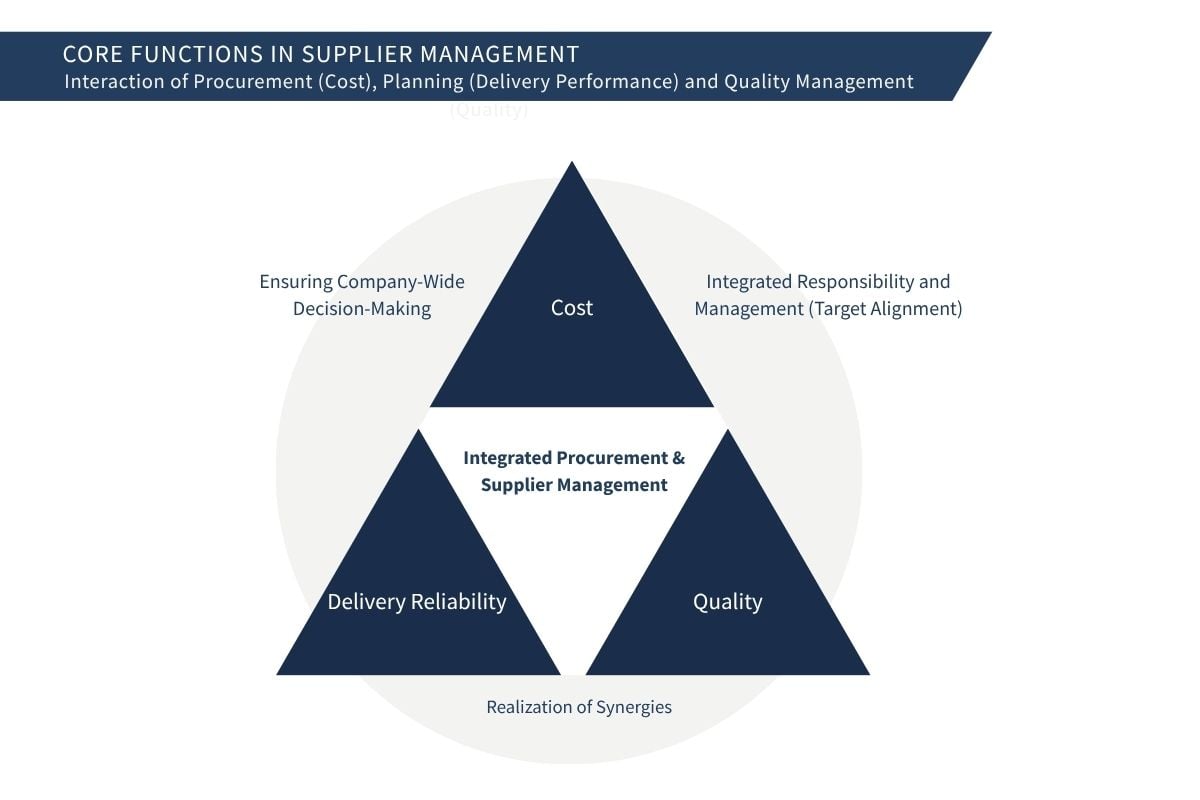
The graphic illustrates an important principle: Procurement, Materials Planning, and Quality Management each assess suppliers from different perspectives, but these perspectives must be combined into an integrated supplier management approach. As a result, cost, delivery reliability, and quality are not managed as isolated metrics but as interconnected performance dimensions.
Procurement
Procurement is responsible for the commercial management of supplier relationships. Key responsibilities include price negotiations, contract management, sourcing strategies, and the commercial evaluation of suppliers. In doing so, Procurement establishes the commercial framework conditions required for a sustainable and economically viable partnership.
Materials Planning
Materials Planning is responsible for ensuring supply continuity and monitoring compliance with agreed delivery schedules. The function identifies potential bottlenecks at an early stage and coordinates mitigation measures in response to delivery deviations. As a result, it directly contributes to delivery reliability and security of supply.
Quality Management
Quality Management, together with responsible quality engineers, ensures product and process quality at supplier sites. Typical responsibilities include complaint management, root cause analysis, audits, and the continuous improvement of supplier quality performance. This also includes evaluating quality KPIs, supporting corrective action processes, and driving supplier development initiatives in response to recurring or critical deviations.
The three core roles cannot be viewed in isolation. Cost, quality, and delivery reliability influence one another and must be managed jointly. A quality issue today can become a supply issue tomorrow and may ultimately result in significant commercial consequences. For this reason, Procurement, Materials Planning, and Quality Management work closely together within an effective supplier management framework to evaluate suppliers holistically.
Information Management
Information Management forms the backbone of every data-driven decision. The systematic collection, maintenance, and analysis of all supplier-related information, ranging from master data and certifications to performance metrics, is essential for resilient supplier evaluation. It enables transparency across the supplier portfolio, supports early risk identification, and provides the basis for targeted improvement measures. In combination with modern supplier management tools and ERP systems, this function is becoming increasingly important from a strategic perspective.
Project Management
Project Management focuses on the execution of specific initiatives, such as onboarding new suppliers, implementing technical changes, or managing escalations and task forces. Project managers coordinate internal alignment between Procurement, Quality, Logistics, and Engineering, ensure adherence to project timelines, and often serve as the primary interface to suppliers. This role requires not only a structured and methodical approach but also strong intercultural communication and problem-solving skills.
Methodology Development & Quality Assurance
The role of Methodology Development and Quality Assurance is to continuously enhance supplier management standards and processes while ensuring compliance with established requirements. Responsibilities include defining evaluation methodologies, classification frameworks, and audit procedures, initiating training programs, and translating regulatory requirements such as ISO 9001 or IATF 16949 into practical implementation measures. In addition, this function monitors compliance with quality requirements and systematically addresses deviations through corrective actions and supplier development initiatives.
The Typical Supplier Management Process: From Identification to Monitoring
A structured supplier management approach follows a multi-stage process that combines both operational and strategic aspects. The process begins with the identification of potential suppliers through market analyses, benchmarking activities, or recommendations, followed by an initial classification and potential assessment.
The next step is supplier qualification, during which evidence related to quality, sustainability, compliance, and overall suitability for collaboration is reviewed.
Based on this information, supplier selection and approval decisions are made. Only after approval does supplier onboarding begin. The qualified supplier is integrated into the company’s organizational structures, processes, and IT systems, enabling seamless collaboration.
Once suppliers have been successfully integrated into systems and processes, continuous supplier monitoring follows. This includes KPI analysis, feedback from internal functions, and, where applicable, external audits. Supplier controlling consolidates this information, creates transparency across the supplier portfolio, and manages supplier performance through defined thresholds, review processes, and escalation mechanisms.
Based on these insights, weaknesses are identified and supplier development activities are initiated, either through targeted support (active development) or through structured feedback, clear expectations, and a defined target state (passive development). The effectiveness of these measures is subsequently monitored through KPIs. Depending on the outcome, suppliers may undergo re-qualification or, if necessary, structured offboarding.
Overview Table of the Supplier Management Process
The detailed process is summarized in the table below:
| Step | Level | Purpose |
| 1. Supplier Identification | Operational | Research and pre-selection of potential suppliers through market analyses, benchmarking, or recommendations. |
| 2. Supplier Qualification | Operational | Assessment of quality, sustainability, compliance, and suitability for collaboration. |
| 3. Supplier Selection | Strategic | Decision regarding supplier approval and definition of the framework conditions for collaboration. |
| 4. Supplier Onboarding and Integration | Operational + Strategic | Integration of qualified suppliers into systems, processes, and the organization to ensure smooth collaboration. |
| 5. Supplier Evaluation and Controlling | Operational (with strategic relevance) | Continuous performance monitoring based on KPIs, including supplier portfolio management, risk transparency, and escalation management. |
| 6. Supplier Development | Strategic | Definition and implementation of improvement measures through both active development (support/measures) and passive development (feedback/target state). |
| 7. Re-qualification or Offboarding | Strategic | Re-assessment following changes or deviations, or a structured exit in the event of persistent risks or performance issues. |
EFS SC Experts’ Insights: Success Factors in Supplier Management
Successful supplier management is built on several fundamental pillars. First and foremost, it requires a clear understanding of roles and responsibilities, a structured organizational setup, and established processes. Without clear ownership and interfaces, misunderstandings can arise that may lead to delays or quality issues in day-to-day operations. Especially in industrial organizations with complex value networks, strong organizational anchoring is critical.
Particularly important is the close organizational alignment of procurement, disposition, and quality management. These three functions bring together different perspectives and enable the integrated management of cost, delivery reliability, and quality.
Another key success factor is the systematic use of modern technologies. Digital tools provide not only transparency but also the ability to actively manage and develop supplier networks. Digitalization thereby creates the foundation for responsive, scalable, and resilient processes.
Communication among all stakeholders involved is another critical success factor. Open and structured communication with suppliers helps identify potential issues early and develop solutions collaboratively. Trust and partnership form the basis of resilient supplier relationships, particularly during periods of uncertainty or supply constraints.
Ultimately, KPI-driven management determines the effectiveness of supplier management. Without objective criteria and measurable targets, success remains difficult to assess. Organizations must define relevant performance indicators, regularly analyze them, and use them as a basis for decisions and actions ranging from supplier development to escalation management.
Conclusion
Supplier management is far more than an organizational necessity. It is a strategic lever for growth, resilience, and innovation. Companies that actively shape their supplier relationships create the foundation for stable supply chains, higher quality, and sustainable competitive advantages. In a world where external value creation has become the norm, modern supplier management is indispensable.
EFS Consulting supports leading industrial companies in building and optimizing their supplier management capabilities. Professional supplier management begins with a well-designed strategy and does not end with operational implementation. It must be digitally enabled, firmly embedded within the organization, and continuously developed. Furthermore, sustainability is no longer an add-on topic but an integral component of every modern supplier strategy.
“Only those who view their suppliers as strategic partners can fully unlock their potential.”
EFS Consulting supports organizations in analyzing, optimizing, and digitalizing their supplier management operations. From concept development to implementation, EFS Consulting combines proven methodologies, industry expertise, and technological excellence. Take your supplier management to the next level and contact us for a personal consultation.
FAQs
What is Supplier Management?
Supplier management governs and optimizes all relationships with external suppliers to ensure quality, cost efficiency, delivery reliability, innovation capability, sustainability, and compliance throughout the procurement process.
What are the phases of Supplier Management?
Typical phases include supplier identification, qualification, selection and approval, onboarding and supplier integration, ongoing supplier evaluation and controlling, and supplier development. Depending on the outcome, suppliers may subsequently undergo re-qualification or a structured offboarding process.
What is Strategic Supplier Management?
Strategic supplier management focuses on building long-term partnerships, segmenting and managing the supplier portfolio, and aligning the supplier strategy with overall business objectives. It ensures that supplier relationships contribute sustainably to competitiveness, resilience, innovation, and long-term value creation.

Authors