AI Tender Tools: How AI is Transforming Tender Management
The public procurement market has reached a turning point. In Austria, more than €30 billion is awarded each year through thousands of tenders; across Europe, the figure exceeds €2 trillion¹—a market that, until recently, relied almost entirely on manual processes: reading tender documents, searching platforms one by one, and compiling bids in Word documents. This is now undergoing fundamental change.
In Austria and Germany, more than 30 percent of companies were already using AI technologies in 2025.² In Austria, this share nearly tripled in just two years³—a pace exceeding even optimistic forecasts. Artificial intelligence is therefore no longer a future prospect for tender management, but part of the transformation already under way. This article explains what the tools can actually do today, how the market is structured, and where specialised solutions deliver genuine added value.
Table of contents
Key Takeaways
- The market for AI tender tools is growing rapidly and has developed into five application categories: monitoring, analysis, bid writing, tender creation, and bid evaluation. Most providers cover only one of these categories.
- AI tender tools already deliver measurable results: automated monitoring, structured document analysis, completeness checks, and AI-assisted drafting of tender documents. Fully automating the procurement process, however, is not yet a realistic promise.
- In a procurement context, specialised solutions deliver considerably greater value than general-purpose AI tools such as ChatGPT because of document volumes, procurement-law expertise, and EU sovereignty requirements.
- Tendalyzer—developed by EFS Consulting—is one of the few platforms that covers both sides of the procurement process: contracting authorities and bidders, from monitoring through bid evaluation, with EU sovereignty and a design tailored specifically to the DACH market.
What are AI tender tools?
AI tender tools are AI-enabled software solutions that support tendering and procurement procedures through automated document analysis, semantic search, and structured information extraction. Their key advantage over conventional procurement software is that AI tools understand content rather than merely managing structures.
This qualitative leap was made possible by large language models (LLMs). Unlike rule-based systems, LLMs can read complex documents in context, identify contradictions between document sections, extract evaluation criteria from lengthy specifications, and respond to requirements in natural language. These capabilities make the procurement process—highly text-based, document-intensive, and prone to error—particularly well suited to AI applications.
Structurally, the market can be divided into five categories:
1. Monitoring and discovery tools (for bidders)
Their core purpose is to identify relevant tenders automatically before opportunities are missed. They offer automated searches based on individual search profiles, real-time alerts, and initial document summaries. This is the most accessible entry point into AI-supported procurement.
2. Analysis and compliance tools (for contracting authorities & bidders)
Their core purpose is to understand procurement documents in depth and check them for weaknesses—on both sides of the process. For contracting authorities, this means analysing tender documents for inconsistencies, ambiguities, and risks before they are published. For bidders, the focus is on extracting requirements, analysing gaps between the tender requirements and their own bid, and ensuring the bid documents comply with formal requirements.
3. Bid-writing tools (for bidders)
Their core purpose is to draft bid content and systematically reuse proven content. This category is particularly widespread in English-speaking markets and has so far remained less prominent in German-speaking countries.
4. Tender-creation tools (for contracting authorities)
Their core purpose is to use AI to formulate and structure tender documents and specifications based on existing procurement documents and market data. This is the newest and least developed segment, but it is becoming increasingly relevant.
5. Bid-evaluation tools (for contracting authorities)
Their core purpose is to systematically review and compare submitted bids and document award decisions in an fully auditable manner. This area places particular demands on traceability and knowledge of procurement law.
In practice, this market structure means that most providers solve exactly one problem—either for bidders or for contracting authorities, and either monitoring or analysis. End-to-end process support for both sides of the procurement process is the exception.
What are the Biggest Challenges in Tender Management?
Whether for a public contracting authority or a bidder, the underlying problems are structurally similar, although they manifest themselves differently:
|
Contracting authorities |
Bidders |
| Substantial manual effort involved in drafting and reviewing tender documents | Time-consuming analysis of lengthy, complex tender documents |
| Ambiguous wording generates bidder questions, corrections, and deadline extensions | Evaluation criteria and evidence distributed across numerous documents |
| Bid evaluation is time-consuming, especially with complex evaluation matrices | Risk of exclusion due to formal non-compliance—regardless of the technical quality of the bid |
| Shortage of skilled staff while tender volumes are rising | Limited resources and tight bid deadlines |
| Growing complexity due to the best-value principle and sustainability criteria | Lack of transparency regarding market potential, competitors, and benchmarks |
| High liability risk in the event of procedural errors and review proceedings | Manual searches across numerous national and EU-wide platforms |
What can AI Tender Tools Actually do Today—and What can’t they do?
What AI tender tools can reliably do today
Document analysis and information extraction are the strongest application areas. Modern language models can read hundreds of pages of procurement documents in seconds, extract award criteria, identify inconsistencies between document sections, and produce a structured summary of the key data. What takes an experienced procurement specialist several hours can be completed by AI in minutes—with equal or greater thoroughness.
Formal review and completeness checks also work reliably. Checking whether a bid includes all required evidence, whether deadlines are stated correctly and whether wording is contradictory involves structured tasks for which AI-supported checks deliver robust results.
Automated monitoring removes the need for companies to conduct time-consuming manual searches. Relevant tenders are identified at an early stage—even on platforms that could hardly be searched regularly without automated support.
AI-assisted drafting of tender documents is becoming an increasingly mature use case. Based on existing procurement documents and market data, specifications can be drafted in a structured format and adapted to current requirements—as a working basis, not as a finished product.
What AI tender tools cannot yet do—and where caution is required
AI cannot and should not make the final award decision. Assessments require professional judgment beyond formal criteria; this remains a human responsibility. Likewise, the fully automated creation of tender documents that comply with procurement law, without human review, is not yet a mature use case: support with drafting, yes; complete automation, no.
Traceability is another critical issue: under procurement law, decisions must be documented and defensible in the event of a challenge. AI outputs without sources or explanations are problematic in a procurement context, regardless of how plausible they sound. The quality of an AI tender tool is therefore reflected not only in what it analyses, but also in how transparent and verifiable its results are.
Tendalyzer: Next-Level Tendering through AI
With Tendalyzer, EFS Consulting has developed an AI-native platform that covers both sides of the procurement process—contracting authorities and bidders—and supports the tender lifecycle from monitoring through structured bid evaluation. It combines AI technology with many years of consulting experience in procurement, supply chain management, and tender management, underpinned by robust EU data sovereignty—still far from standard in the market.
| Module | Target group | Core function |
| Tendalyzer for contracting authorities | Public contracting authorities and procurement bodies | Review tenders and evaluate bids in a structured, fully auditable manner |
| Tendalyzer for contractors | Bidders | Analyse tender documents and ensure bids comply with formal requirements |
| Tendalyzer Monitor | Bidders | Automatically identify, analyse and prioritise relevant tenders |
1. Tendalyzer for contracting authorities
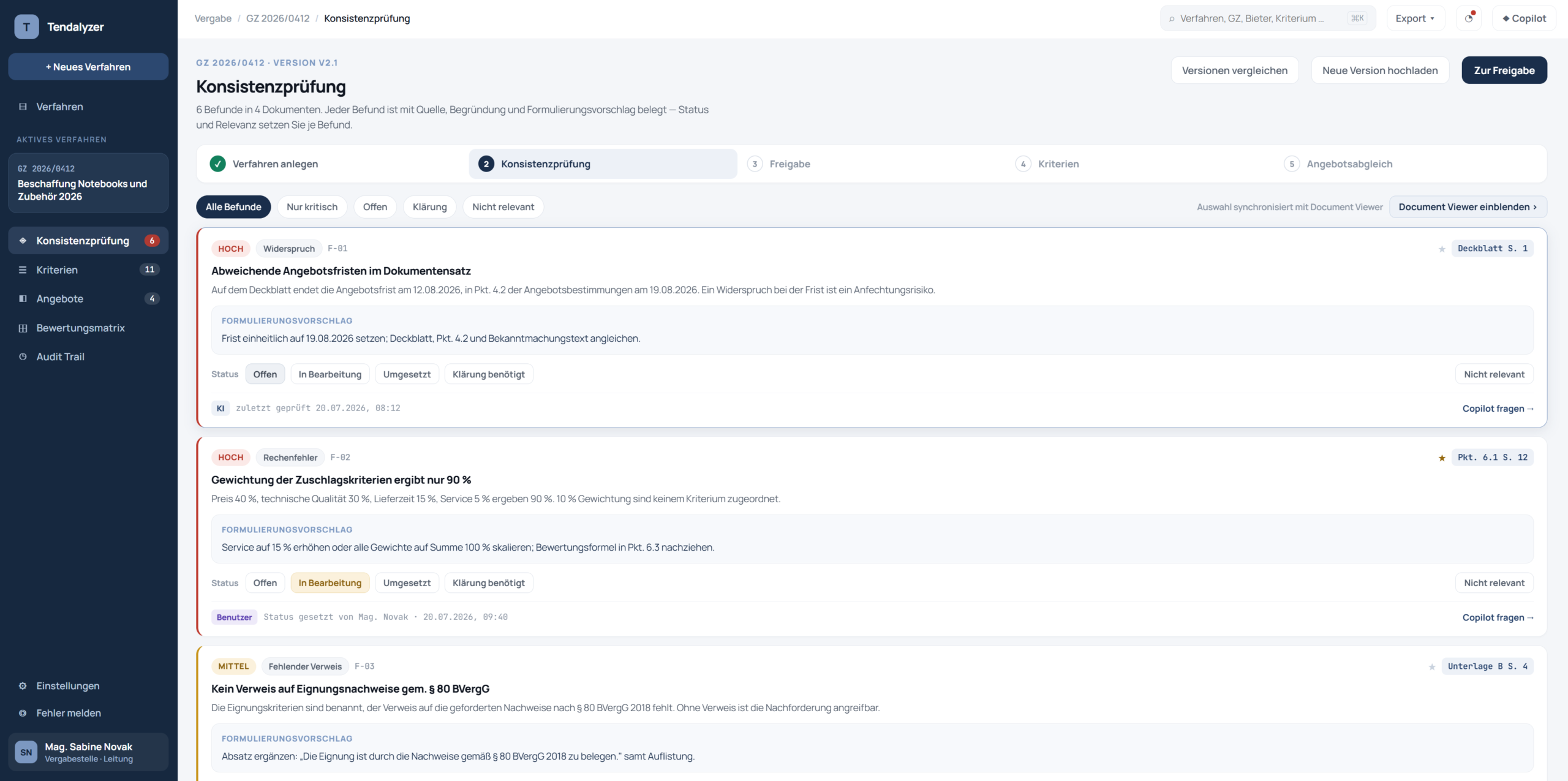
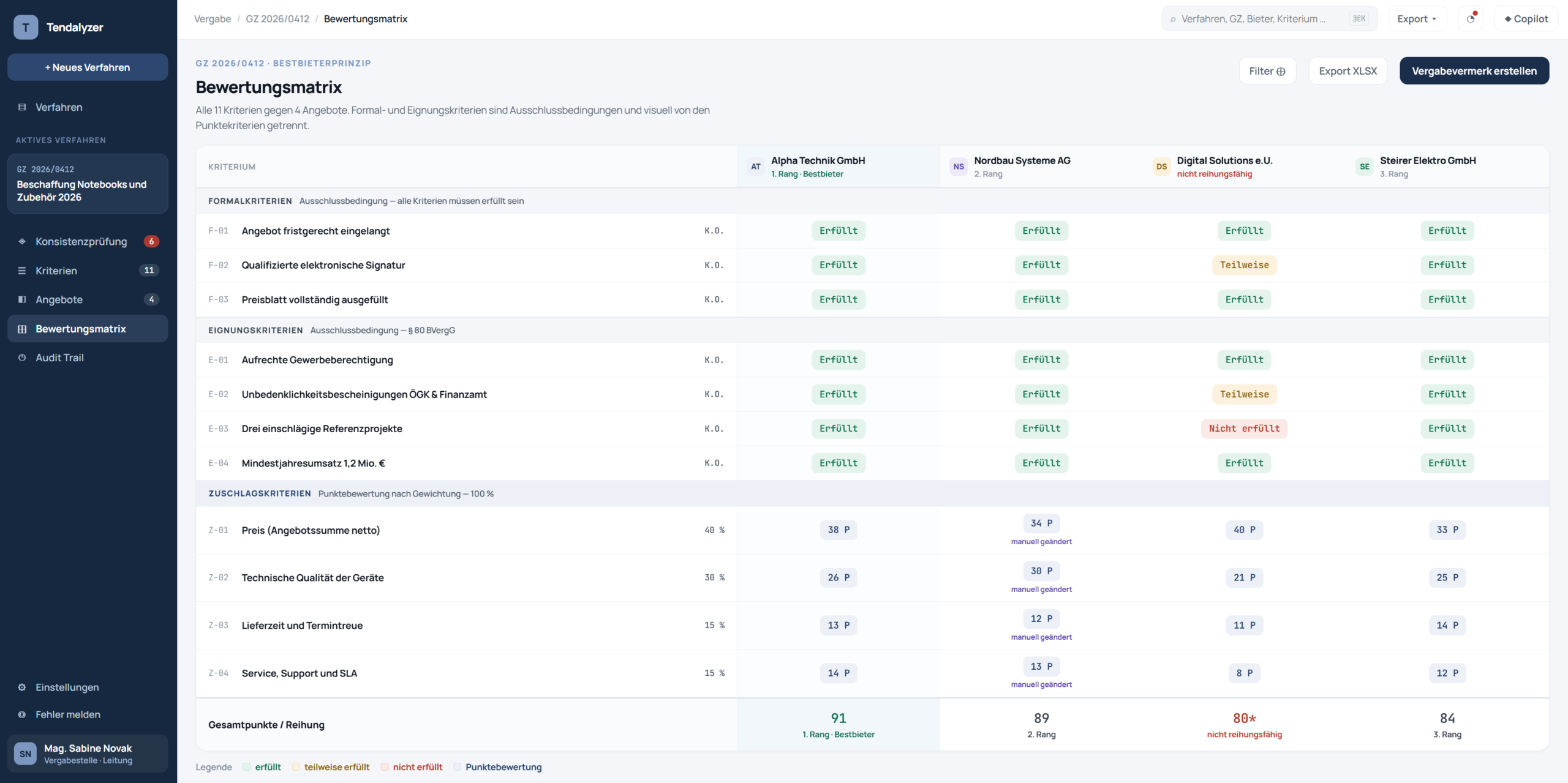
Tendalyzer automatically checks tender documents for formal completeness, consistency and risk before the tender is published. Errors and ambiguities that would otherwise emerge only through bidder questions or review proceedings are identified early.
For bid evaluation, Tendalyzer provides structured completeness checks, automated price comparisons and traceable documentation of compliance with criteria—as a robust basis for procurement committees and audit bodies. The Tendalyzer Agent also enables targeted chat queries and the creation of reports at the touch of a button.
Tendalyzer customers report up to 75% less time spent on bid evaluation and a noticeable reduction in the number of bidder questions as a result of clearer tender documents.
All functions and details here
2. Tendalyzer for Bidders
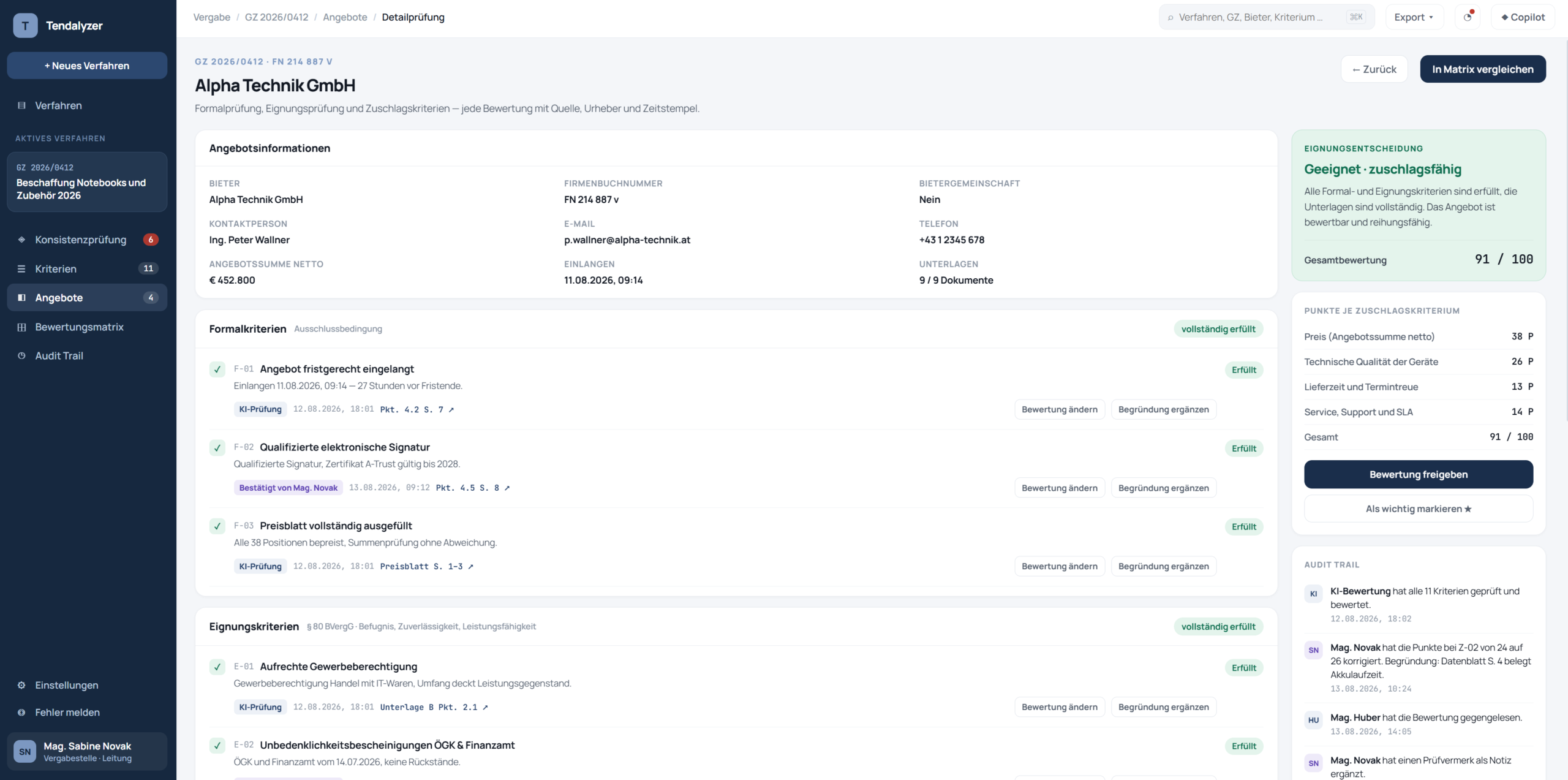
Tendalyzer analysiert Ausschreibungsunterlagen KI-gestützt und liefert strukturiert: eine prägnante Management-Summary, eine vollständige Liste aller Angebots-, Eignungs- und Zuschlagskriterien sowie klare Hinweise auf kritische Anforderungen und potenzielle Ausschlussrisiken.
Tendalyzer uses AI to analyse tender documents and provides a structured, concise management summary, a complete list of all bid, eligibility and award criteria, together with clear indications of critical requirements and potential exclusion risks.
Before submission, Tendalyzer checks the company’s own bid for completeness, formal compliance, and consistency with tender requirements—reducing the risk of formal exclusion that would render all work on the bid futile.
All functions and details here
3. Tendalyzer Monitor—Automatically identify relevant tenders
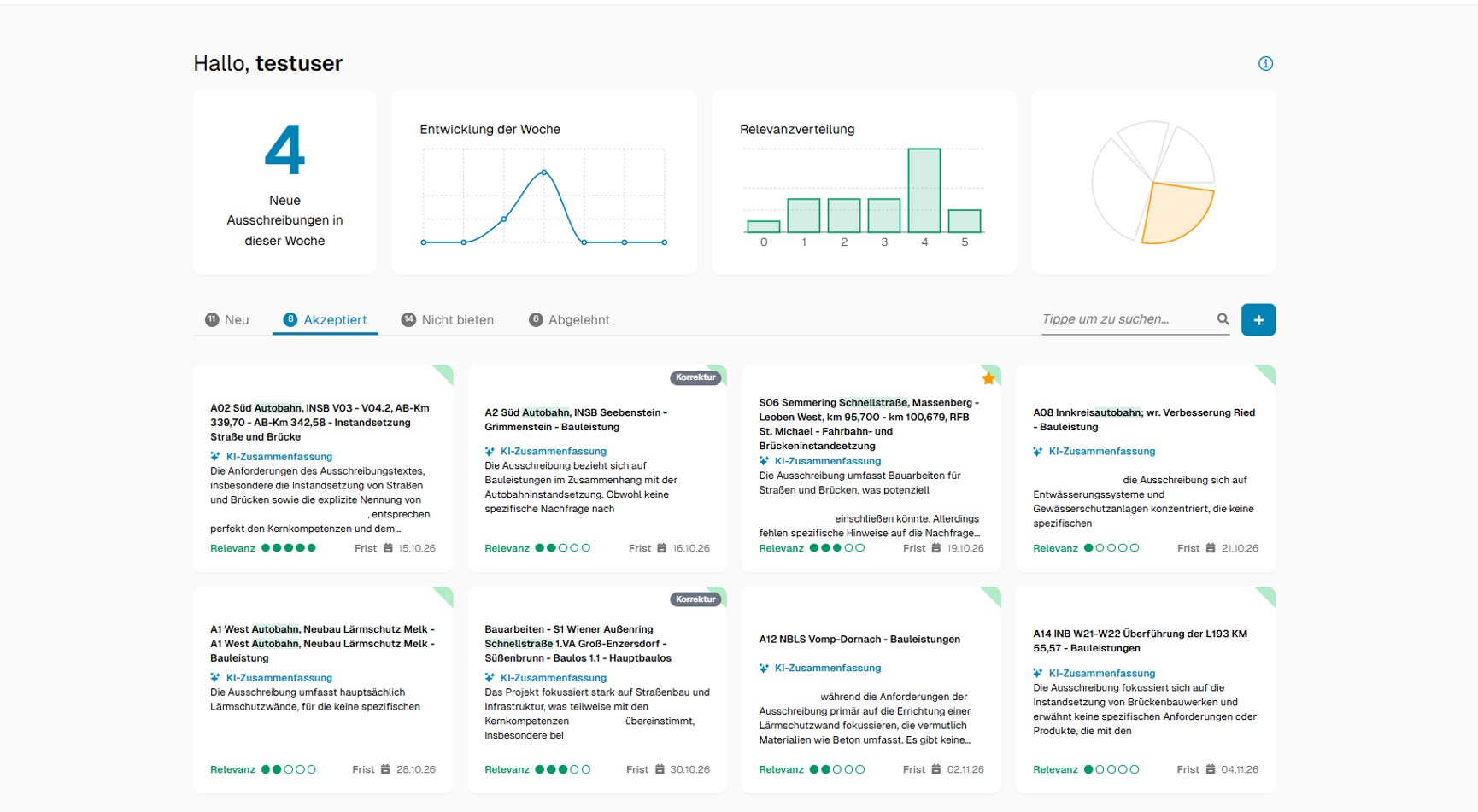
Austria alone has around 7,850 contracting authorities subject to procurement rules⁴—their tenders are spread across national platforms (ANKÖ, Auftrag.at), EU-wide databases (TED/Tenders Electronic Daily), and numerous sector-specific and international portals. It has long been impossible to maintain a comprehensive manual overview of this market.
Tendalyzer Monitor automatically searches these platforms based on individual search profiles—not merely through simple keyword matching, but through AI-powered semantic analysis. Relevant tenders are identified even when they do not use the exact search terms. The result is a set of structured reports with a management summary, participation assessment, checklists, and direct links—enabling companies to devote their time to tenders where they have a genuine chance of success.
Why Specialised AI Tender Tools Deliver More than General-Purpose AI Tools
General-purpose AI tools such as ChatGPT or Microsoft Copilot are powerful for many tasks—and their rapid adoption in tender management is understandable: they are immediately available, cost-effective and provide useful answers to straightforward questions. In a professional procurement context, however, they have clear limitations.
Document volume and depth of context A public tender may consist of dozens of documents spanning hundreds of pages. General-purpose AI tools cannot consistently connect information across such large document sets, systematically identify contradictions between different sections, or perform cross-document completeness checks.
Public procurement expertise Tendalyzer distinguishes between eligibility criteria and award criteria, understands the requirements of the best-value principle, and understands the logic of European and, in particular, Austrian procurement procedures. A generic language model knows these concepts in theory but cannot apply them reliably to specific procurement documents.
Traceability and auditability Under procurement law, decisions must be documented, justified, and, if necessary, defended before a review authority. Tendalyzer is designed to produce transparent, traceable outputs—structured results with clear source references rather than opaque answers. This distinction is crucial when an award decision can be challenged.
EU data sovereignty and data protection Tender documents may contain sensitive content. Many general-purpose AI tools process data outside the EU—often an unacceptable scenario for public contracting authorities. Tendalyzer uses only EU-based technologies and providers and complies with the requirements of the EU AI Act—an aspect that is increasingly becoming a selection criterion in the market.
Process integration rather than isolated queries Tendalyzer is not an application to which users simply pose questions. It is a platform with defined workflows, structured output formats, and the ability to integrate into existing procurement processes. The difference between a powerful general-purpose tool and a specialised instrument becomes relevant when reliability matters: for an award decision that may be challenged, for a bid with potential exclusion consequences, or for a decision that must be documented.
Conclusion
The market for AI tender tools has achieved remarkable maturity in a short period of time—and it continues to become more specialised. Monitoring, compliance analysis, bid writing, tender creation, and bid evaluation are evolving into distinct categories with specialised providers. The question is no longer whether AI should be used in tender management, but which tools are suited to which tasks.
One thing is clear: specialisation is more effective than a generalist approach. General-purpose AI tools can complement procurement work, but they cannot replace what specialised platforms deliver in terms of document processing, domain knowledge, auditability, and data sovereignty.
This is particularly true of the Austrian and German-speaking markets: specific procurement-law requirements, platform-specific demands, and data-protection concerns make locally specialised, EU-sovereign solutions a strategically sound choice—for contracting authorities and bidders alike.
When is it Worth Speaking to EFS Consulting?
A Tendalyzer demo is particularly worthwhile if you:
- regularly conduct or participate in tenders,
- want to significantly reduce manual effort in the procurement process,
- face shortages of skilled staff or resource bottlenecks,
- want to improve the quality of tenders or bids,
- want to increase transparency and auditability in evaluation processes,
- or want to use AI with EU data sovereignty and in compliance with procurement law.
Arrange a no-obligation consultation and explore Tendalyzer using your specific use cases.
Frequently asked questions about AI tender tools and Tendalyzer
What distinguishes Tendalyzer from general-purpose AI tools such as ChatGPT?
ChatGPT is a general-purpose language model—useful for many tasks, but not optimised for professional procurement processes. Tendalyzer understands procurement-law logic, processes large volumes of documents consistently, provides traceable results with source references, and processes data exclusively on EU infrastructure. The difference becomes critical when decisions must be documented and defensible.
What distinguishes Tendalyzer from other monitoring tools?
Dedicated monitoring tools identify relevant tenders—Tendalyzer Monitor does this as well, but goes further: specific competitive advantages/USPs are identified and highlighted based on your product portfolio. Tendalyzer automatically analyses the tenders, creates a management summary with a participation assessment, and supports formal bid preparation.
Who is Tendalyzer suitable for?
Public contracting authorities and procurement bodies that want to improve the quality of tenders and make bid evaluations more efficient, as well as companies that regularly participate in tenders and want to professionalise their processes.
Where is the data processed?
Tendalyzer consistently relies on EU-based technologies and providers. Data is processed in accordance with European data protection and security standards, without being transferred to US cloud services. EFS Consulting thereby complies with the requirements of the EU AI Act.
Can Tendalyzer replace existing procurement software?
Tendalyzer complements existing procurement and document management systems with AI-supported analysis and review functions. The platform can be used independently or integrated into existing systems.
How can I test Tendalyzer?
As part of a no-obligation demo, you receive access to Tendalyzer and test it with your own tenders—not a generic product presentation, but practical testing using your documents.
Sources
¹ Bröthaler, J./Plank, L. (2017): Public Procurement in Austria. Study commissioned by ANKÖ – Auftraggeber Kooperationsnetzwerk Österreich. TU Wien. Available at: https://www.ankoe.at/wp-content/uploads/2023/07/ANKOE_Oeffentliche-Vergaben-in-Oesterreich_Studie_TU-Wien.pdf [reference year: 2017]; European Court of Auditors (2023): Special Report No 28/2023: Public Procurement in the EU. Luxembourg: Publications Office of the European Union. Available at: https://www.eca.europa.eu/en/publications/SR-2023-28
² Statistics Austria (2026): ICT Use in Enterprises 2025. Press release, 24 June 2026. Based on the Eurostat Community Survey on ICT usage in enterprises 2025. Vienna: Statistics Austria. Available at: https://www.statistik.at; Bitkom Research (2025): Artificial Intelligence in Germany 2025. Berlin: Bitkom e.V.
³ Statistics Austria (2024): Use of Artificial Intelligence in Enterprises Almost Doubled Within One Year. Press release, 16 October 2024. Vienna: Statistics Austria. Available at: https://www.statistik.at/fileadmin/announcement/2024/10/20241016IKTU2024.pdf; Statistics Austria (2026), see footnote 2.
⁴ Bröthaler, J./Plank, L. (2017), see footnote 1.

Authors