
Circular Economy
Circular Economy as a Lever for Economic Success
Rising raw material prices, regulatory requirements, and unstable supply chains are changing industrial value creation and presenting companies with new challenges. At the same time, the circular economy opens up targeted opportunities to rethink value creation.
Circular approaches enable more efficient resource management, reduce dependencies on primary raw materials, and strengthen resilience to external risks. Companies benefit not only ecologically, but also economically through cost savings, innovation, and new business models.
EFS Consulting supports companies in systematically developing circular strategies – from the analysis of the material footprint and carbon footprint to the implementation of scalable solutions along the entire product life cycle.
What is the Circular Economy?
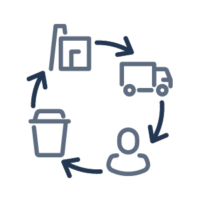
The circular economy (CE) is a sustainable economic model that aims to keep products, materials and resources in the cycle of use for as long as possible and to reduce waste to a minimum.
In contrast to the traditional linear “take-make-dispose” logic, recyclable materials are used continuously through reuse, repair, remanufacturing and recycling.
Product design is a key lever here: Already in the development phase, products are designed in such a way that they are durable, repairable and recyclable.
Core Principles of the Circular Economy
The circular economy is based on several strategic principles:
- R strategies: Refuse, Rethink, Reduce, Reuse, Repair, Recycle – they form the basis for circular value creation
- Design for durability: Products are designed to be modular, repairable and recyclable
- Reduction of primary raw materials: Reduction of dependence on finite resources
- Separation of biological and technical cycles: Materials are kept in the system in a targeted manner or degraded naturally
- Avoidance of planned obsolescence: Products are deliberately designed to maximize their lifespan, facilitate repair and reuse
General Advantages and Practical Implementation
The transformation to a circular economy offers a wide range of added value:
- Economic benefits: New business models, additional value creation and long-term cost reduction
- Ecological effects: Reduction of greenhouse gas emissions, protection of ecosystems as well as mitigation of climate change and species extinction and more sustainable use of resources
- Strategic resilience: Reduced dependence on global supply chains and volatile markets
The implementation is particularly relevant in sectors such as construction, electronics or packaging, where material flows and waste management play a central role.
How is the EU Driving the Circular Economy?
The European Union is pursuing the goal of establishing a climate-neutral and circular economy by 2050.
The circular economy is (1) a central component of the EU Green Deal and (2) one of the six environmental goals of the EU taxonomy.
Key regulatory initiatives include:
- Clean Industrial Deal (CID) & Circular Economy Act (in planning): Linking decarbonisation and circular business models
- Ecodesign Regulation (ESPR): requirements for durability, repairability, resource efficiency and introduction of the digital product passport
- EU Packaging Regulation (PPWR): Reduction of packaging waste and promotion of recycling
- End-of-Life Vehicle Regulation: Promoting circularity in the automotive sector through stricter requirements on recycling, reuse and material use
- Extended Producer Responsibility (EPR): Manufacturers are responsible for the entire life cycle of their products
These regulatory developments increase the pressure on companies to act and at the same time offer clear guardrails for innovation and transformation.
Why is the Circular Economy Crucial for Companies?
Companies are increasingly faced with the challenge of meeting sustainability, profitability and regulatory compliance at the same time.
Circular strategies make it possible to:
- Reduce material risks and increase security of supply
- Reduce dependencies on raw material imports
- Reduce the CO₂ footprint and material footprint in a targeted manner
- Unlock new revenue potential through innovative business models
Especially for companies in Austria and Europe, the circular economy is becoming a decisive competitive factor.
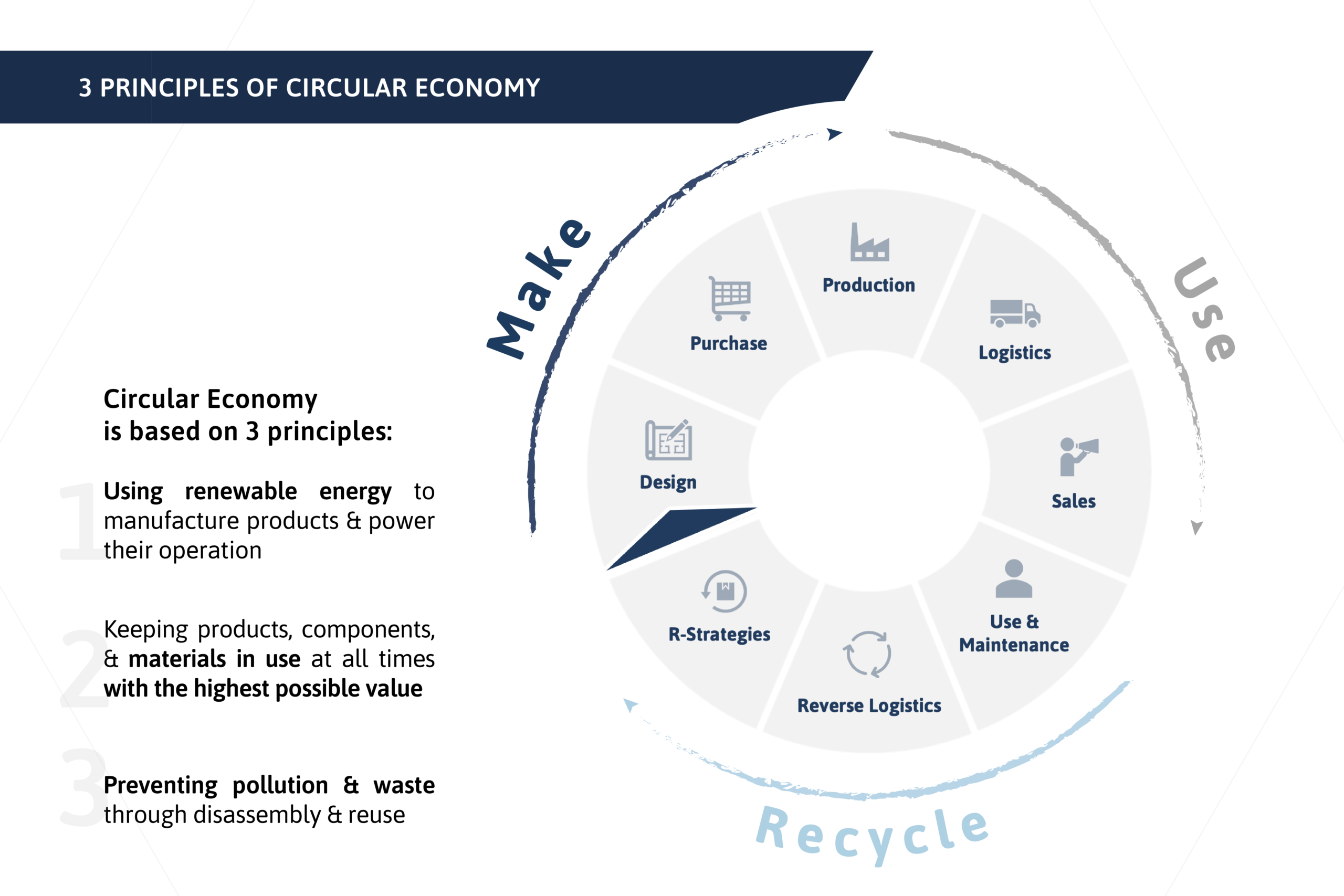
Principles of Circular Economy
How Do Companies Successfully Transition to a Circular Economy?
The focus is on an economic model in which products, components, and materials remain in the usage system for as long as possible. The aim is to maintain the economic value of resources over several product life cycles .
Successful companies rely on:
- Integration of R strategies such as reuse, repair, remanufacturing and recycling enable additional value creation and more efficient use of materials
- Circular business models along the entire product life cycle – from product development to use and service to the return of components and materials. (e.g. product-as-a-service, take-back systems)
- Design-to-Circularity in Product Development
- Transparency about material flows and emissions
These approaches not only promote environmental improvements, but also create measurable economic benefits, as the impact of circular measures is made comprehensible through the systematic measurement of the circular economy.
EFS Consulting Services in the Context of the Circular Economy
EFS Consulting supports companies with a structured consulting approach in the transformation to a circular economy. The EFS Consulting consulting approach combines strategic expertise, practical implementation and data-based analysis to help companies identify the potential of the circular economy, make processes more efficient and secure long-term competitive advantages.
EFS Consulting Specializations Include
Highlights
Circular Business
Development and evaluation of circular business models along the product life cycle. From the identification of economic potentials to the evaluation of R-strategies to the development of viable business cases.
Circular Product Design
Integrating circular economy principles into product development. Focus on design for disassembly, material optimization, modularity and the integration of circular strategies into development processes.
Lifecycle Data
Building transparency about material structures, CO₂ emissions and environmental impacts along the entire product life cycle. From life cycle assessments to the implementation of data structures for digital product passports.
Your Added Value with EFS Consulting
With EFS Consulting, you gain a partner who combines strategic foresight with operational implementation expertise. We support you in not viewing the circular economy in isolation as a sustainability initiative, but in anchoring it in your corporate strategy as an economic lever.
The EFS Consulting approach combines in-depth analysis, field-tested methods and data-based decision-making bases to realize concrete added value: from reducing material and CO₂ costs to developing new business models and strengthening your resilience to volatile markets and regulatory requirements.
Through the close integration of circular business, circular product design and lifecycle data, we create holistic solutions along the entire product life cycle. This makes the circular economy measurable, scalable and economically successful for your company.
Contact us and let’s analyze together how you can create sustainable value through circular strategies!
Contact EFS Consulting now
Free and personalized initial consultation!
Insights