What is Life Cycle Assessment (LCA)?
The sustainability of products, services, and organizations is becoming increasingly important for companies of all kinds. To comply with regulations, develop new business areas, and reduce their ecological footprint, holistic methods for assessing environmental impacts are needed. This insight highlights Life Cycle Assessment (LCA) as one of the most widely used and recognized tools. You will learn what LCA is, what is required to implement it, and what benefits can be drawn from it.
Key Takeaways
- Life Cycle Assessment (LCA) is a method for estimating the environmental impact of all types of products or services.
- The method is based on ISO standards 14040 & 14044 and is therefore standardized and recognized worldwide.
- System boundaries, environmental effects examined, and other study parameters can be individually adapted to fit the specific application.
- LCA studies enable companies to identify environmental hotspots in their product life cycle and form the basis for environmental certifications.
What is Life Cycle Assessment (LCA)?
Life Cycle Assessment is a standardized method for calculating the environmental impact of products and services. To enable a holistic view, the entire product life cycle is considered – from production and use to disposal and possible recycling. A variety of impact categories describing different environmental phenomena (e.g., greenhouse effect, acidification, resource depletion) can be used to determine the results.
LCA creates objective and data-based transparency in the assessment of product-related environmental impacts. The results enable the precise localization of key factors influencing the environmental impact within the product life cycle. The identification of these environmental hotspots can then be used to optimize product design, logistics, and end-of-life concepts. In addition, LCA helps in the development of sustainability strategies and serves as a basis for decision-making for companies and consumers alike.
Standardization according to ISO 14040/14044
Among the multitude of available environmental assessment methods, LCA stands out as a standardized and therefore widely recognized approach. This enables a globally uniform structure and the comparability of different studies.
The basic structure is based on two standards:
- ISO 14040 (Life cycle assessment – Principles and framework) defines the fundamental rules and structure of an LCA study.
- ISO 14044 (Life cycle assessment – Requirements and guidelines) describes more detailed specifications and provides instructions for the implementation of a life cycle assessment. These documents are supplemented by product-specific Product Category Rules and additional frameworks for special applications.
LCA variations and definitions
Within the field of environmental accounting, several terms and methods covering different processes and approaches can be found. The following section explains the definition and meaning of the most important terms in the context of LCA.
- Material flow analysis vs. complete LCA: A material flow analysis records the quantities and paths of all material and energy flows within a system. This is also done in an LCA (see later: Phase 2 – Life Cycle Inventory). However, an LCA also includes the assessment and interpretation of environmental impacts connected to these flows. A life cycle assessment is therefore more comprehensive than a mere material flow analysis.
- Product-related vs. company LCA: Here, a distinction is made between the objects of investigation of a study. A product-related life cycle assessment examines a physical object, while a company LCA considers the entire organization. Also services can be analyzed within an LCA.
- Comparative vs. non-comparative LCA: In a comparative life cycle assessment, the environmental impact of two or more objects under investigation is compared to enable a more elaborate evaluation. This requires stricter guidelines to be followed when conducting the study. Non-comparative LCA, on the other hand, only includes the ecological evaluation of a single system.
- Carbon footprint vs. holistic LCA (Environmental Footprint): A carbon footprint calculation describes the holistic assessment of the CO2 footprint of a product system. In contrast, holistic LCA covers several impact categories within which the environmental impact is determined. Depending on the use of the study, the selection of these categories is either prescribed or left to the authors of the study.
- Environmental certification (EPD) vs. LCA:The certification of products, for example through Environmental Product Declaration (EPD), is a multi-stage and externally audited process that requires an LCA as a basis. Additional process steps are necessary in the approval process, that go beyond the scope of a mere LCA study.
Why is Life Cycle Assessment important?
Life Cycle Assessment creates transparency regarding the environmental impact of products, services, and organizations. The resulting insights can be used in a variety of ways by companies and organizations of all kinds, thereby contributing significantly to future success.
On the one hand, numerous European and global regulations require companies to pay increasing attention to sustainability. Examples include the Corporate Sustainability Reporting Directive (CSRD) and the Digital Product Passport (DPP). Life Cycle Assessment provides valuable input for sustainability reports and CSR-measures. On the other hand, data-based insights into environmental hotspots can form the basis for optimizing internal processes. Based on LCA, resource efficiency can be improved, environmental liabilities reduced, and sound product development in terms of Ecodesign promoted. In addition, companies can utilize LCA to effectively optimize supply chains and identify environmental risks at an early stage.
The sales sector also benefits from LCA accounting. The objective assessment of environmental impacts enables credible marketing and communication of sustainable products, thereby strengthening customer loyalty. In addition, environmental certification based on Life Cycle Assessment is increasingly becoming a criterium for participating in tenders and is therefore crucial for developing and maintaining business areas in the public sector.
Expanding the perspective to encompass NGOs, governments, and other institutions highlights LCA’s function as a foundational element for strategic planning, effective policy-making, and ensuring long-term institutional robustness
Who needs LCA?
Due to its inherent flexibility and versatile applicability, Life Cycle Assessment is employed by a wide range of organizations to evaluate environmental impacts.
- Corporations leverage LCA to optimize or certify products, assess the sustainability of services, and quantify comprehensive organizational environmental footprints.
- Governments utilize quantitative LCA data to design targeted regulations and subsidies, thereby facilitating the implementation of more effective environmental policies.
- Consumers benefit from the transparency provided by LCA, which empowers them to make informed purchasing decisions based on environmental performance.
- Stakeholders and Investors, much like consumers, derive value from the rigorous reporting that LCA offers. It enables them to conduct data-driven assessments of corporate sustainability, refine investment strategies, and implement more effective optimization measures.
Four Phases of Life Cycle Assessment
An LCA study comprises four distinct phases, as rigorously defined within international ISO-standards:
1. Goal and Scope Definition
In this initial phase, the central objectives and parameters of the study are established. This includes the rationale for the study, the product system under consideration and the selected impact categories. The significant methodological flexibility permitted by the standards allows for the LCA to be tailored to specific client requirements and unique use cases.
2. Life Cycle Inventory (LCI)
The second phase involves the comprehensive collection of all material and energy flows occurring within the defined system boundaries. Similar to a material flow analysis, this stage constructs a highly detailed representation of the various process steps throughout the product life cycle.
3. Life Cycle Impact Assessment (LCIA)
Building upon the inventory data, potential environmental impacts of all recorded flows are identified and evaluated. This process incorporates all impact categories selected during the scoping phase. The LCIA relies on the latest scientific data and characterization models.
4. Interpretation
In the final phase, the findings of the study are synthesized, verified, and evaluated. In the case of a comparative LCA, the environmental performances of different systems are contrasted. The results must be presented with clarity and aligned with the study’s initial objectives.
LCA Approaches
The international standards governing Life Cycle Assessment provide a fundamental framework for execution while allowing significant latitude in specific orientation. This flexibility enables the strategic definition of central study parameters based on the intended application. The following section provides an overview of various specification options.
The Basis: Product Life Cycle
As a holistic methodology, LCA aims to capture not merely a single stage of a product’s existence but rather the entire product life cycle. In addition to the use phase (e.g., the fuel consumption of a vehicle), this encompasses manufacturing, logistics, raw material extraction, as well as potential second-life applications and end-of-life disposal or recycling. This comprehensive approach is equally applicable to LCAs of services and organizations.
Consequently, the product life cycle describes all processes occurring throughout the product’s lifespan that are considered within the assessment. To maintain a realistic scope and level of detail, life cycle stages and processes with negligible impact are often intentionally excluded. For instance, the infrastructure required for manufacturing facilities is frequently omitted in a vehicle LCA. The decision regarding which modules to include or exclude is determined by the selection of system boundaries, tailored to the specific use case.
System Boundaries and Life Cycle Perspectives
A comprehensive Life Cycle Assessment that captures the entire product life cycle is commonly referred to as a “Cradle-to-Grave” study. Depending on the specific application and objectives, the scope may be narrowed or expanded using the following systemic perspectives:
- Cradle-to-Gate: An assessment covering the life cycle from raw material extraction up to a specific point of exit, typically the factory gate, before the product is transported to the consumer.
- Cradle-to-Cradle: This perspective extends the “Cradle-to-Grave” analysis by incorporating recycling and the subsequent utilization of materials in new products, thereby aligning with the principles of a circular economy.
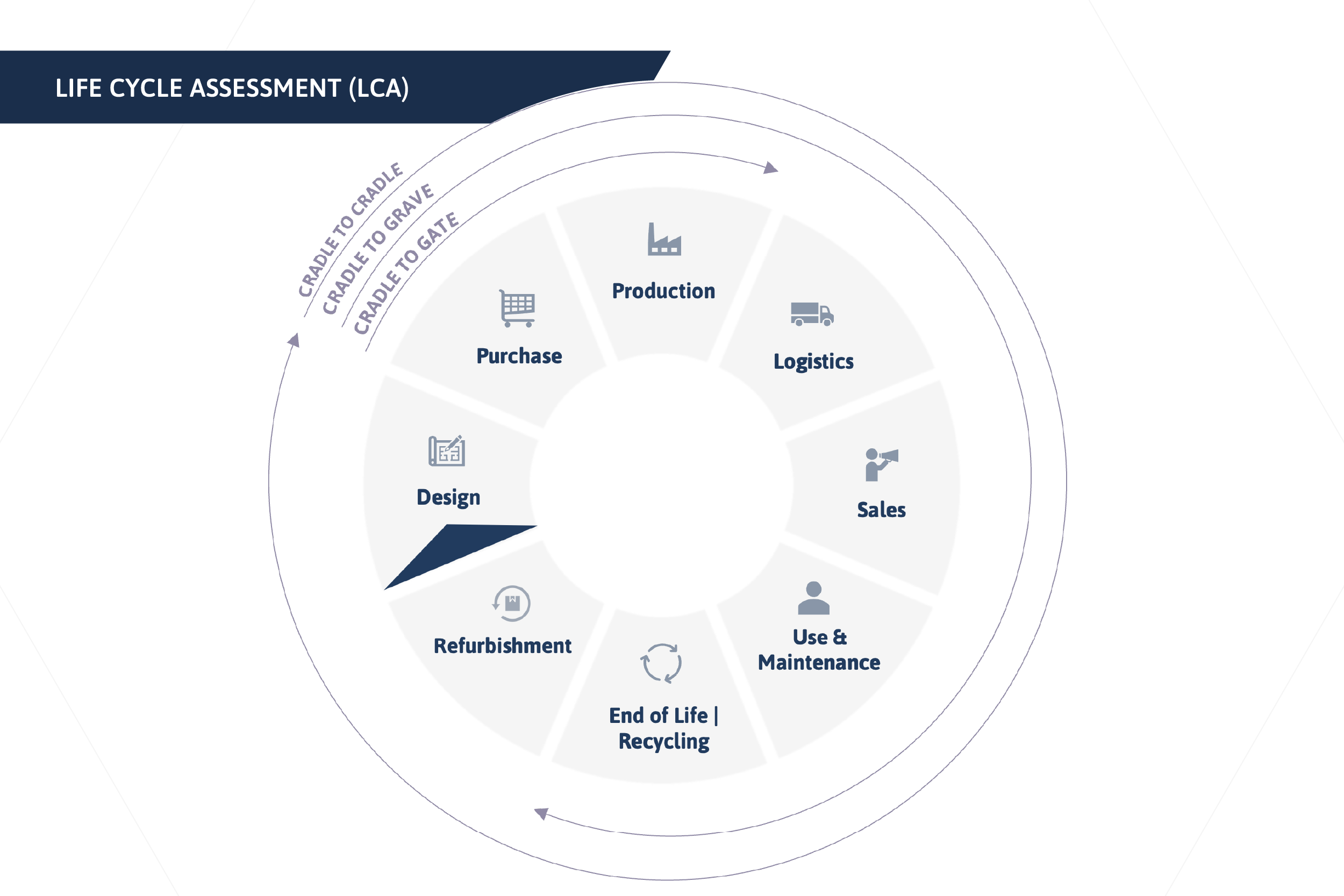
- Gate-to-Grave: The system boundaries encompass the life cycle from a specific point of entry (usually the manufacturing plant’s gate) through to the end-of-life stage.
- Gate-to-Gate: This approach focuses exclusively on the processes occurring between two defined points in the life cycle, such as the interval between production and disassembly.
- Well-to-Wheel (WTW): A specialized term utilized in automotive LCAs. It accounts for all processes involved in fuel production (Well-to-Tank) as well as those associated with vehicle operation (Tank-to-Wheel).
LCA Application
Case Study: Industry Benchmark
To illustrate the strategic utility of LCA, the following case study highlights a project conducted for a prominent manufacturer in the renewable energy sector:
- Client: A European manufacturer of high-performance heat pumps.
- Objective: To achieve product certification through an Environmental Product Declaration (EPD), enabling eligibility for public infrastructure projects with stringent sustainability requirements.
- EFS-Consulting Services: Data collection, conceptualization and execution of the underlying LCA study, managing the documentation process, external auditing, and support in the final EPD certification.
- Project Duration: 12 weeks (Phase 1: data acquisition – 2 weeks; Phase 2: LCA modelling – 4 weeks; Phase 3: external audit, refinements, and EPD submission – 6 weeks).
- Outcome: Successful LCA quantification of a heat pump unit, resulting in a verified EPD. This transparent documentation of environmental performance significantly bolstered the product’s market position and competitive advantage.
LCA Tools and Databases
The execution of a rigorous, data-intensive LCA requires the integration of specialized databases and software solutions. As outlined in the four phases of an LCA, all material and energy flows within the product system are assessed during the Life Cycle Inventory (LCI) and subsequently modeled using LCA software. In the succeeding Life Cycle Impact Assessment (LCIA), the environmental burden for each of these flows is determined across all relevant impact categories. This process relies on databases that provide a comprehensive selection of materials and processing steps with integrated environmental datasets.
In the domain of proprietary software, LCA for Experts (formerly GaBi), SimaPro, and Umberto are the best kown solutions. All three are widely adopted and offer extensive capabilities for data modeling and analysis. A viable free-of-charge alternative is Open-LCA, which is available as open-source software and encompasses all essential core functions.
LCA databases are indispensable for impact assessment and are frequently provided in combination with software packages. An example is the LCA for Experts database, which is integrated into the respective software. Furthermore, the Ecoinvent database offers a comprehensive dataset that can be utilized in combination with various software programs. Both databases are fee-based. Within the spectrum of free solutions, databases such as Idemat, GREET, or Ökobaudat are available, though they typically contain a reduced number of datasets and are often focused on specific technical fields.
Corporate Integration
Due to its versatile applicability, LCA can be integrated into various corporate processes, providing substantial added value across multiple functional areas:
- Product Development: Insights derived from LCA facilitate the implementation of eco-design measures, enable the early-stage and iterative evaluation of prototype concepts, and assist in establishing a sustainable brand identity.
- Supply Chain Management: In the realm of logistics and procurement, LCA enables a focus on sustainable sourcing, the optimization of transport routes, and serves as a foundational element for strategic supply chain management.
- Regulatory Compliance and Reporting: LCA assists organizations in meeting increasing disclosure requirements under the CSRD, EU Taxonomy, and other regulatory frameworks. The transparent presentation of environmental metrics allows for effective steering, credible stakeholder engagement, and enhanced data quality within corporate reporting.
- Sales and Market Positioning: LCA provides the empirical data required for sustainable product certifications, such as Environmental Product Declarations (EPDs), which are increasingly mandated across all industries. This facilitates participation in public tenders and large-scale procurement processes, thereby expanding sales opportunities.
Conclusion
Life Cycle Assessment (LCA) serves as a pivotal methodology for quantifying the environmental impacts of products, services, and organizations. As a strategic instrument integrated across diverse corporate functions, it facilitates sustainable product development, comprehensive regulatory reporting, and robust certification processes. These applications ultimately strengthen customer loyalty, drive product innovation, and enable entry into emerging markets.
EFS Consulting provides end-to-end support throughout the entire LCA lifecycle – ranging from primary data processing and full-scale LCA studies to EPD certifications and the implementation of specific organizational optimization measures. By synthesizing deep LCA technical expertise with extensive industrial experience, we ensure that even the most complex product systems are modeled with high fidelity. EFS Consulting further enriches the optimization process by integrating domain-specific knowledge into strategic decision-making. To ensure maximum flexibility and analytical precision, EFS Consulting utilizes professional licenses for LCA for Experts (formerly GaBi), providing our clients with direct access to industry-leading environmental databases for efficient and effective Life Cycle Assessment.
FAQs
What are the benefits of LCA?
LCA establishes transparency regarding the environmental performance of products, services, and organizations across their entire life cycle. This data-driven approach assists organizations in meeting regulatory requirements, implementing internal sustainability initiatives, and increasing competitiveness in public tenders and customer engagement.
What is EPD certification?
An Environmental Product Declaration (EPD) is a standardized European certification that provides an objective and holistic assessment of various environmental impacts. Built upon the foundation of an LCA, it enables an evidence-based comparison between various products. Furthermore, EPDs are increasingly becoming a mandatory prerequisite for participating in public tenders and large-scale procurement processes.
How does EFS Consulting support?
EFS Consulting provides comprehensive support throughout every phase of the LCA process—from initial data collection and system modeling to full-scale study execution, final EPD certification and the implementation of optimization measures. Our methodology is designed to identify and implement tailored solutions for specific organizational challenges.
Which LCA software and database are used?
EFS Consulting utilizes LCA for Experts (formerly GaBi), including its integrated professional database, for system modeling and performance evaluation. This industry-leading solution offers a vast array of datasets and advanced analytical options, ensuring both high efficiency and granular detail in every assessment.