Private Label: The Ultimate Guide to Profitable Brand Management in Retail
Private labels are no longer “no-name” products – they have become one of the strongest growth drivers in retail and are now a central strategic tool for differentiation, customer loyalty, and sustainable margin improvement. In this insight, you will learn how to successfully manage your private labels: from selecting the right type of brand to strategies for premiumization, and benchmarking against best practices.
Key Takeaways
- Private labels continue to gain market share: The private label market is growing rapidly, especially in Western Europe. According to NielsenIQ, more than half of European consumers are purchasing private labels more than ever before.
- Perception ≠ Cheap: Most Consumers perceive private labels as equivalent in quality to branded goods, not as a downgrade.
- Premiumization pays off: Premium private labels grow disproportionately and improve margins through higher selling prices.
- Operational excellence matters: Smart sourcing, data-driven product development, partnership management, and cost transparency are critical to success.
Private Label, Store Brand, or Private Brand: What’s the Difference?
The terms private label, store brand, house brand, and private brand are often used interchangeably in practice. They refer to brands owned by a retailer and sold exclusively through its stores and online channels.
Private Brand is a modern term building on private labels. It emphasizes strategic brand management with an independent identity, often separate from the retailer’s name, with clear positioning. Private brands focus on building a portfolio of category-specific private labels with distinct value propositions against manufacturer brands.
White Label vs. Private Label
White-label products are generic, pre-made goods sold under multiple retailers’ brands. They enable fast market entry with low cost, and differentiation is primarily through packaging or branding.
Private-label products are customized, exclusive items made specifically for a retailer. They allow control over formulation, design, and quality and enable higher margins.
Difference: Store Brands vs. Manufacturer Brands (Branded Goods)
Store brands are developed, controlled, and sold exclusively by retailers. They mainly serve differentiation, customer loyalty, and margin optimization. Marketing and sales are conducted through the retailer, reducing costs and allowing flexible price-performance positioning. Examples include: ja! (Rewe), Balea (dm), S-Budget (Spar).
Manufacturer brands are built and managed by producers. They invest heavily in brand communication, innovation, and advertising to create recognition and loyalty. Their products (branded goods) are usually available across retailers. Examples include Nike, Snickers, Coca-Cola, Perrier, Sony.
Overview of Brands
Brands guide consumers and strategically manage competitive advantages for businesses. Below, we present fundamental brand functions and the specific functions of store brands.
Brand Functions
- Identification Function: A brand ensures clear recognition and distinguishes products from competitors, reducing search and decision effort for consumers and providing market orientation.
- Origin Function: A brand acts as the “business card” of the owner, signalling the origin of a product. This conveys responsibility, competence, and trust in the provider.
- Support Function: Brands carry image and communication messages, bundling marketing efforts, increasing efficiency, and embedding emotional and functional value propositions in consumer awareness.
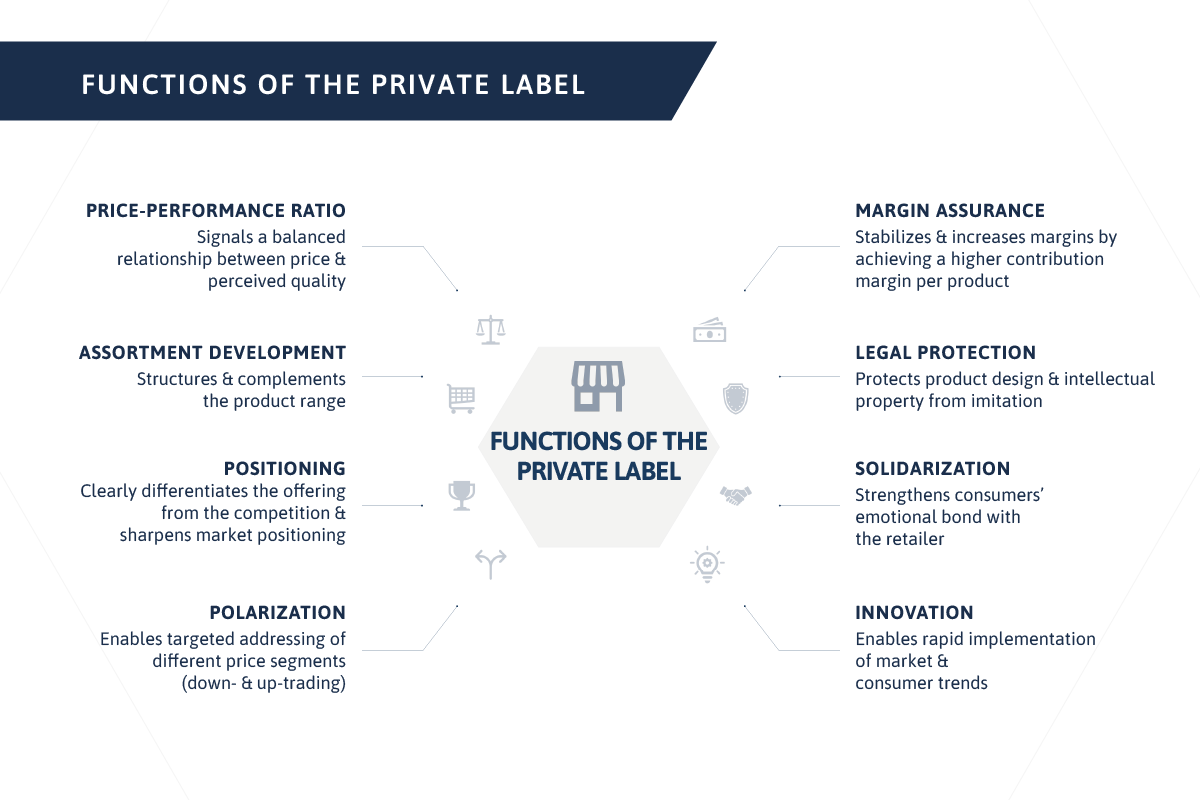
Functions of Store Brands
Private Labels as a Strategic Tool
Private labels are no longer just a margin lever; they are a strategic marketing tool allowing retailers to manage brand image, price differentiation, and customer loyalty. Their relevance is reflected in consumer popularity.
According to ÖGVS, category popularity varies in Austria: household cleaners and hygiene products are among the top private label purchases (market share ~69%), while baby food (~13.5%) and confectionery (~28.3%) are mainly dominated by manufacturer brands.
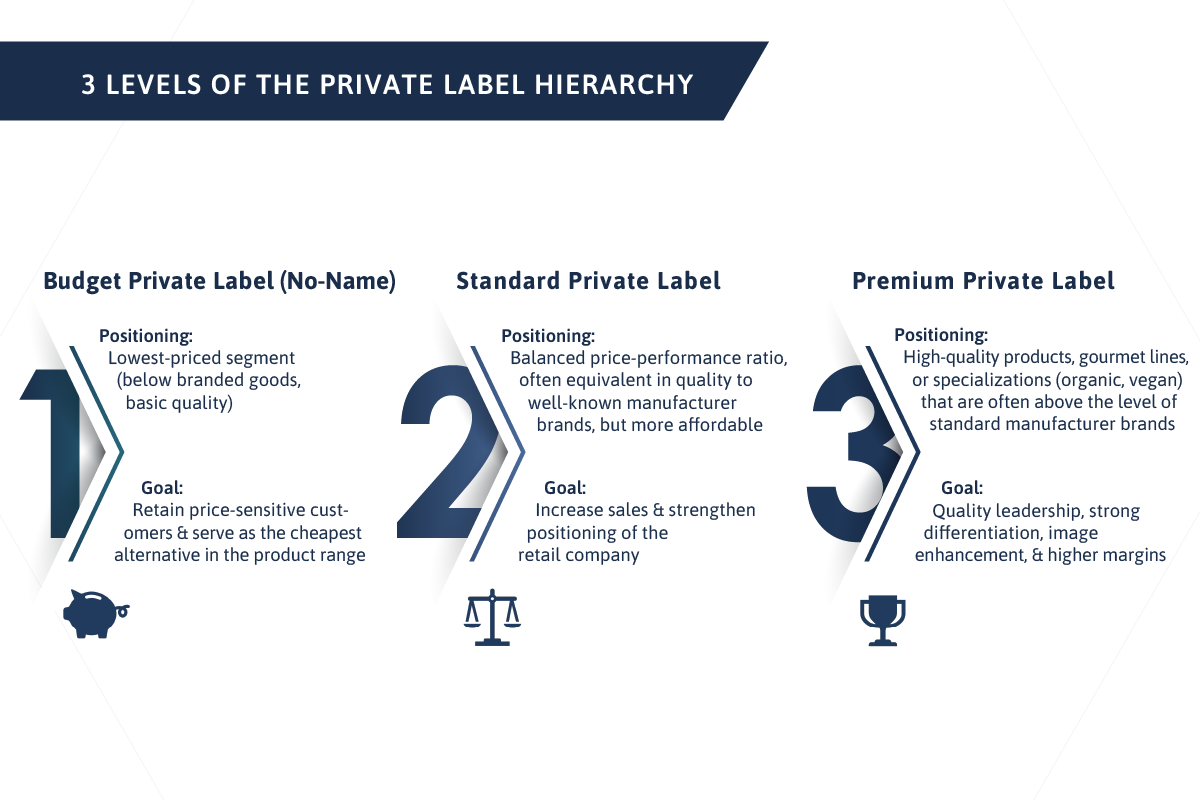
The Three Tiers of the Private Label Hierarchy
Private labels can be structured by price and quality levels, forming a three-tier hierarchy that allows retailers to control price perception, assortment depth, and positioning.
1. Generic Brands (No-Name)
Generic brands target the lowest price segment with basic quality and no brand premium. Their main goal is to attract price-sensitive customers, retain them long-term, and serve as the reliably cheapest option in the assortment.
2. Classic Store Brands
Classic store brands offer a balanced price-performance ratio and quality comparable to well-known manufacturer brands at a better price. Their primary goal is to drive sales growth while strengthening and profiling the retailer’s brand.
3. Premium Store Brands
Premium store brands represent high-quality lines, gourmet selections, and specialized offerings such as organic or vegan products, often exceeding the quality of standard manufacturer brands. They aim for market differentiation, strong brand image, and attractive margins through added value.
Features of Private Labels
One of the key characteristics of private labels is that they are exclusively available from the respective retailer. Since assortment and price control lie with the retailers, they are able to manage quality and pricing. For this reason, private labels typically offer an attractive price-performance ratio. Private label products are often developed by third-party manufacturers according to retailer specifications and produced in their manufacturing facilities. Another characteristic is that retailers assume responsibility for marketing, distribution, and legal compliance.
Private Label Development
Successful retailers think like consumer goods manufacturers. Private label development is now systematic and data-driven to achieve price-performance and differentiation goals. Brands and positioning are defined based on retailer objectives and data to clearly differentiate from competitors. Retailers increasingly structure portfolios under defined umbrella brands, providing strategic guidance, quality promises, and pricing logic.
Custom product development is driven by consumer feedback, online reviews, and digital analytics, enabling rapid market launches or product optimization. White-label products can also be sourced if in-house development is not done, with strict quality control in both cases. Marketing and sales then ensure effective market introduction and brand management.
Why Retailers Use Private Labels
Retailers use private labels to manage assortment breadth and depth, close gaps, and improve margins by cutting intermediaries and controlling pricing and costs. Exclusive products create competitive advantage and strengthen customer loyalty, as many consumers choose retailers based on private labels. Tailored products allow differentiation and greater consumer identification with the retailer brand. Overall, private labels are a top driver for growth and market position.
Management Challenges
Managing private labels requires balancing price and quality to build trust and loyalty, developing tailored products with fast innovation cycles, and managing assortment breadth, depth, and differentiation from manufacturer brands. Responsibilities include marketing, distribution, placement, supplier selection, cost control, production capacity, and legal compliance. These interconnected challenges make professional retail management essential, integrating strategic procurement, category management, supply chain, and brand management.
Sustainability Trend in Store Brands
Growing private label popularity reflects changing consumer behavior: consumers increasingly prioritize price-performance, quality, and sustainability. While quality and sustainability matter, price remains the primary factor for German consumers, who are most price-sensitive.
Private labels address these needs with high-quality, sustainable products, emphasizing responsible sourcing, fair production, regional ingredients, organic quality, or innovative/recyclable packaging. Leading examples include ja! Natürlich (REWE/Billa), Zurück zum Ursprung and Rettenswert (Hofer), dmBio/Alverde Naturkosmetik (dm), and SPAR Natur*pur (Spar).
The “Luxury Strategy” for Private Labels: Premiumization as a Margin Lever
Private labels are no longer only associated with low prices: most consumers view them as equal to branded goods, eliminating the old stigma. Many consumers even rate private labels better than branded goods, especially when positioned as sustainable or premium. Retailers have widely introduced premium private labels, focusing not just on price-performance but also on the consumption experience. Premium private labels attract new customer segments, allow products to compete with branded goods, and rely on storytelling around quality, origin, exclusivity, and enjoyment. Premiumization increases margins while strengthening brand loyalty and communication.
EFS Consulting Analysis: Private Label Examples & Best Practices
Spar is a best practice example, with clear positioning and coverage of all three private label tiers: S-Budget (budget), Spar (classic store brand), and Premium lines (Spar Premium, Natur pur, Spar Free From, Spar Veggie).
Balea is a best practice in drugstore retail, with dm scaling a clearly positioned, versatile private label across key care categories, combining strong price-performance with high perceived quality. Sub-lines (Balea Med, Balea Men, Balea Baby) allow targeted differentiation without complicating brand architecture.
However, the use of private labels is no longer limited to grocery retail or drugstores. For example, the online retailer Amazon also operates a private label. AmazonBasics offers a wide range of everyday products such as electronics, household goods, and office supplies. The private label combines simple, functional products with competitive prices and high availability, which makes it particularly trustworthy for consumers. AmazonBasics demonstrates that private labels can effectively compete with manufacturer brands. Many products are produced by established manufacturers—the same producers that also supply A-brands and B-brands. Amazon is responsible for the brand, assortment, and distribution, while the specialized manufacturer provides the technical expertise.
EFS Consulting Tips: Key Factors in Managing Store Brands
-
A clear positioning within the assortment ensures that private labels can be clearly categorized and compared by consumers. Retailers should follow the three levels of the private label hierarchy and structure different price and quality levels accordingly. This clear hierarchy defines the brand’s place between private labels, manufacturer brands, and discount products, and communicates the value customers can expect.
-
It is essential to develop a coherent brand and communication strategy in which all elements of the private label—such as name, design, values, messages, and more—merge into a consistent and credible overall appearance. Only when these components are harmonized across all channels can a strong and sustainable brand presence be established. Equally important is the targeted use of push or pull methods in private label management: while push approaches such as promotions, shelf strategies, or retail media drive short-term sales, pull methods such as brand building, social content, and community effects strengthen long-term demand and brand loyalty.
-
Companies should design the product development of their private labels in a data-driven manner by leveraging consumer insights, for example from online reviews, social media feedback, and market research. Based on these insights, innovative private label products can be introduced more quickly (“first-to-market”), and existing products can be optimized or repositioned. This enables private labels to effectively achieve price, quality, and differentiation objectives.
-
Strategic procurement is another key success factor in private label management. Through direct collaboration with manufacturers, retailers can secure cost and quality control along the supply chain. At the same time, bundling volumes and actively managing supplier relationships strengthens negotiating power with brand manufacturers. In addition, modern sourcing in the private label environment increasingly relies on centralized sourcing teams (Centers of Excellence), real-time cost transparency, and increased supplier competition enabled by digital tools. The resulting flexibility in procurement, production, and logistics allows for faster responses to market trends.
-
To build a financially strong private label portfolio, comprehensive cost optimization is required that goes beyond the optimization of direct costs. Retailers should therefore also systematically review their overhead costs, prioritize expenditures, and identify efficiency potential across supporting functions (e.g., logistics and marketing). In addition, the use of Zero-Based Budgeting is recommended to align budgets more strategically.
Conclusion
Private labels are now a central strategic success factor in retail. They secure attractive margins, strengthen differentiation, build customer loyalty, and sharpen brand identity. Managing a private label portfolio effectively provides sustainable competitive advantage. In a balanced mix of branded and private label products, high-volume items are typically offered as private labels, while niche needs are covered by branded goods, which are usually not exclusive, limiting market differentiation.
EFS Consulting supports you with deep market knowledge and proven methods for private label development and procurement. We analyse your assortment and competitors’ offerings to identify gaps, define product specifications, test or taste samples to finalize products, conduct tenders and supplier comparisons, select partners, and negotiate contracts, prices, and service-level agreements to ensure smooth implementation.
FAQs
What is a private label?
Private labels are brands owned by a retailer and sold exclusively in its stores.
What are examples of private labels?
S-Budget (Spar), Balea (dm), Vemondo (Lidl), Graceland (Deichmann), Billa Corso (Rewe)—covering generic, classic, and premium private label tiers.
What benefits do private labels offer to retailers?
Higher margins, control over assortment and pricing, differentiation from competitors (including discounters), and stronger customer loyalty.
How do private labels affect customer loyalty?
Private labels positively influence retailer choice and can increase loyalty, especially with consistent quality, clear design, and credible sustainability.