Offer Management & Promotion Management: Generating Revenue Instead of Cutting Costs
Today’s competitive landscape in the FMCG and retail sectors is defined by value propositions, customer experience, and the ability to design offers tailored to specific target groups and activate them with tactical precision. This is precisely where the difference lies between a purely product-centric mindset and effective, strategically driven offer management. The following insight shows how companies can achieve more sustainable improvements in earnings through integrated offer and promotion management than through pure cost-cutting measures.
Key Takeaways
- Strategic offer management is a lever for sustainable growth because it designs offers that add value, are segment-specific, and economically viable.
- Promotion management has a short-term impact and stimulates demand, but it only achieves its full effect if the underlying offer is clearly positioned, differentiated, and designed to be appropriate for the channel.
- Overall, offer management also conveys the positioning of the brand and its values in a sustainable manner. Ideally, the overarching corporate strategy is clearly reflected in the products and services offered.
The Synergy of Strategy and Activation: Why the Separation Makes All the Difference
Many companies compensate for a vague or undifferentiated product portfolio by running more frequent or more aggressive promotions. Yet a curated product range aligned with market positioning is the very foundation of effective promotional planning. Strategically designed offerings increase the value contribution of each individual promotion, as the base offering is already customer-relevant, channel-specific, and economically viable.
Product Management
Product management involves the planning, development, steering, and control of a product throughout its entire lifecycle. The focus is on the physical/digital product with its features and specifications.
Offer Management
Offer or offering management involves the market- and results-oriented design, bundling, and management of integrated service offerings. The focus is not on the product itself, but on the market, customer needs, and the pricing structure of the offer, plus a clear positioning in terms of service and quality promises.
Promotion Management
Finally, Promotion Management is responsible for tactical customer activation, i.e., for creating targeted incentives or purchase stimuli to increase sales. Offer and Product Management strategically contribute to how customers perceive the retailer’s positioning.
Comparison Table
| Dimension | Product Management | Offer Management | Promotion Management |
| Time Horizon | Medium-term (product lifecycle) | Medium- to long-term (portfolio steering, monetization, offering architecture) | Short-term / event-driven (weeks, campaigns, seasonal impulses) |
| Focus | Product (functionality, quality, technical development) | Offering (value proposition, segmentation, business model) | Purchase incentives (mechanics, timing, shopper activation) |
| Primary Goal | Develop market-fit products and ensure product quality | Design value-creating, differentiated, and economically viable offerings | Increase short-term sales, generate incremental revenue, and drive traffic |
| Control Logic | Roadmaps, product requirements, development processes | Market analyses, pricing and pack logic, portfolio architectures | Promotion calendars, promotion ROI analysis, sales uplift measurement |
EFS Consulting Explains: Why This Distinction Is Important for Companies in the FMCG/Retail Sector
Companies seeking to drive sustainable growth must clearly distinguish between strategic offer management and tactical promotion management. It is precisely in the revenue boost generated by offers that a significant—and often underestimated—lever lies. Offer management lays the foundation for value creation: a differentiated, segment-specific, and economically viable offering that ensures long-term brand relevance and enables margin protection. Promotion management, on the other hand, has a short-term impact, creates purchase incentives, and drives market share. In practice, however, companies often try to compensate for a vague or mispositioned offering with increasingly frequent promotions.
The EFS POV: Only when the offering is right—with a clear value proposition, the right segmentation, and genuine innovations—do promotions become a lever rather than a margin-eater and a driver of “panic buying.” A clearly defined offering creates the conditions under which promotions do not have to compensate for the product’s lack of added value, but instead actively generate targeted additional demand.
Offering Management: The Strategic Design of the Market Presence in Detail
The central task of Offering Management is to ensure that the offering meets the needs of the target market segment, maximizes customer value, and simultaneously optimizes value capture for the company. This includes, among other things, ensuring marketability through appropriate channels, the operational feasibility and scalability of the offering, as well as its long-term competitiveness and profitability.
Key aspects of offering management
- Value Proposition: Clear customer benefits for a specific market segment
- Market Positioning: Aligning the offering with clearly defined customer groups
- Portfolio Innovation: Continuous expansion through new formats, bundles, or services
- Price-Pack Architecture (PPA): Pricing, packaging, and bundling of products
- Channel Specificity: Different offer logics per sales channel
Key Offer Strategies
1. Bundling Strategies
Bundling strategies combine multiple products or services into a single comprehensive offer (e.g., pure, mixed, cross-category, or solution bundles) to increase perceived customer value, boost basket size, and achieve differentiation based on total value rather than individual prices.
2. Modular Strategy
Modular strategies are based on standardized, flexibly combinable product modules that enable efficient adaptation to different sales channels, target groups, or promotions.
3. Pricing & Monetization Strategies
Pricing & monetization strategies define how an offering is monetized, for example through subscription models, value-based pricing, pay-per-use, or freemium approaches, in order to optimally leverage different willingness-to-pay levels and account for price elasticities. In addition to pricing strategies, revenue per customer can be systematically increased using monetization models such as up-selling and cross-selling.
4. Segmentation Strategies
Segmentation strategies help create targeted offerings. Based on target audience segmentation in retail, offerings are precisely tailored to shoppers’ needs—such as “Value Shoppers,” “Quick Trips,” or “Stock-Ups”—thereby significantly increasing their relevance and the likelihood of purchase.
5. Differentiation Strategies
Differentiation strategies aim to clearly position the offering against competitors and price segments by highlighting unique value propositions, quality features, or additional services.
6. Lifecycle Strategies
Lifecycle strategies guide the development of an offering throughout its entire lifecycle, from market launch through growth and maturity phases to repositioning or discontinuation.
7. Platform & Ecosystem Strategies
Platform and ecosystem strategies expand the core offering with complementary products, services, or digital components (from third-party providers) to create integrated solutions and network effects.
Process Steps
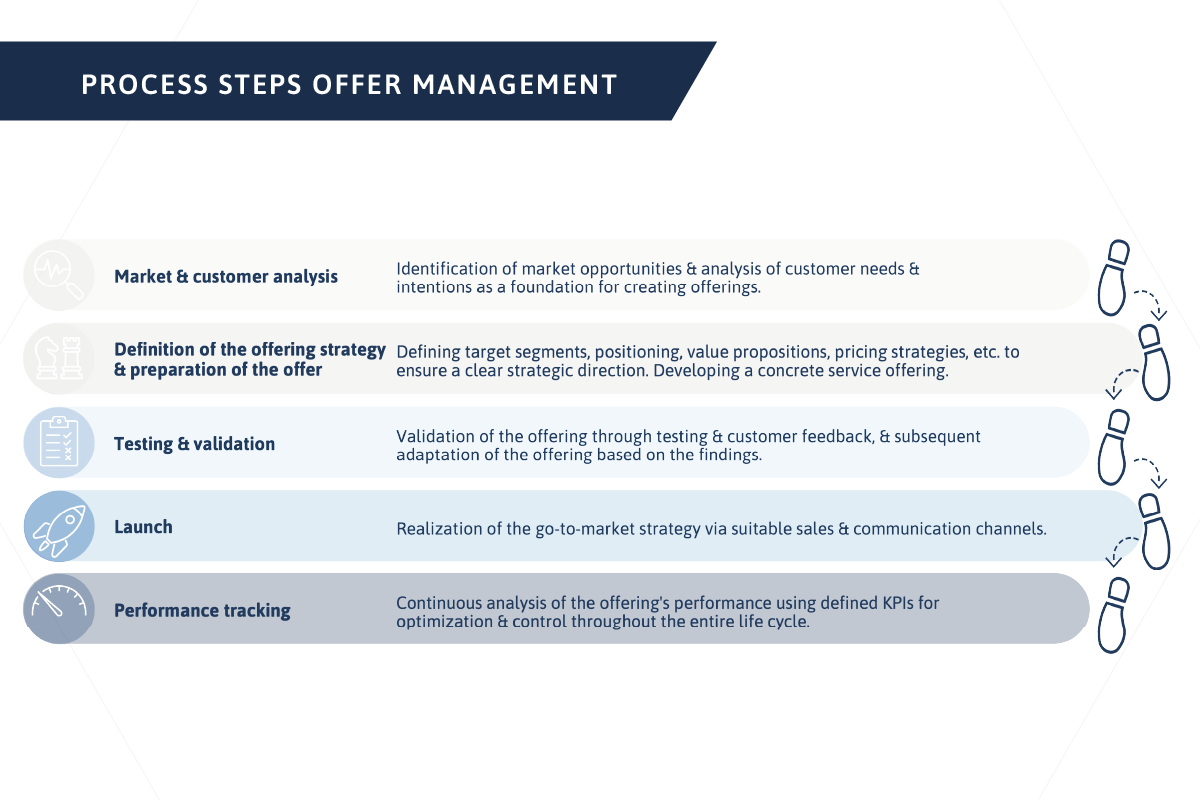
Effective offer management is based on clearly structured processes that range from the initial market analysis to ongoing performance measurement. These processes ensure that offers are developed in a targeted manner, successfully launched in the market, and continuously optimized.
- Market and Customer Analysis: Identifying market opportunities and analyzing customer needs and intentions as the basis for designing the offering.
- Defining the Offering Strategy and Developing the Offering: Defining target segments, positioning, value propositions, pricing strategies, etc., to ensure a clear strategic direction. Developing the specific service offering.
- Testing and validation: Validating the offering through testing and customer feedback, and adapting the offering based on these results.
- Launch: Implementing the go-to-market strategy through appropriate sales and communication channels.
- Tracking and performance measurement: Continuous analysis of the offering’s performance using defined metrics for optimization and management throughout the entire lifecycle.
KPIs & Metrics in Offer Management
The success of strategic offer design can be measured using the following KPIs.
| Metric | Objective | Calculation |
| Conversion Rate per Offer | Measurement of offer effectiveness (purchase completion) | (Number of purchases of an offer ÷ Number of offer interactions or store visitors) × 100 |
| Revenue per Offer | Economic contribution of a single offer | Total revenue generated by the offer within the defined period |
| Margin per Offer | Profitability assessment of the offer | (Offer revenue − variable costs) ÷ Revenue × 100 |
| Incrementality of New Variants/Bundles | Additional incremental revenue from new offer structures | (Revenue with new offer − Revenue without new offer) |
| Cross-Sell Rate | Success of complementary additional sales | (Number of additional purchased products related to the offer ÷ Number of offer purchases) × 100 |
| Up-sell Rate | Share of upgrades to higher-value variants | (Number of upgrades ÷ Total number of offer purchases) × 100 |
| Customer Lifetime Value (CLV) | Long-term value contribution of an offer per customer | (Average revenue per customer × Customer retention period) − Acquisition costs |
| Net Promoter Score (NPS) | Customers’ willingness to recommend | Rating (e.g., scale from 0 to 10) |
| Share of Promotion Revenue within Total Category Revenue | Portion of revenue generated through promotional purchases compared to total category revenue | (Promotion revenue) ÷ (Total category revenue) |
Promotion Management: Tactically Stimulating Demand
Promotions encompass all targeted measures companies use to reach their target audiences and encourage them to take a specific action. They increase product visibility, boost demand through limited-time incentives, and help clearly position an offering against the competition. Overall, promotions make offers better known, more relevant, and more attractive, thereby directly contributing to building demand and differentiation.
Well-designed promotions justify their costs because they not only bring additional customers into the store but also lead to larger shopping baskets and thus to measurable economic value. Tools include discounts, volume-based incentives, retail media networks, couponing, POS placements, and omnichannel promotions.
Online and offline marketing each have their own strengths, but they are only truly effective when used in combination. Online marketing enables personalized offers, data-driven optimization, and clear measurability across digital campaigns. With the help of hyper-personalization, offers and promotions can be delivered with significantly greater precision based on individual behavioral data. Promotion performance tracking helps optimize advertising measures in a targeted manner, reduce unprofitable campaigns, and focus the budget on measures with a demonstrable ROI. Offline marketing, on the other hand, creates tactile, trust-building touchpoints—such as package inserts, coupons, or printed offers—and reaches people even outside of digital channels.
Core Components of Promotion Management
Promotion management encompasses the systematic planning and management of various campaign formats, such as classic discounts (“20% off everything”), volume offers (“3 for 2”), freebies (GWP – Gift with Purchase), or sweepstakes.
This involves precisely defining the mechanics and timing, such as duration, frequency, or thresholds (“free shipping on orders over €50”). Effective cross-channel promotion planning consistently coordinates channel-specific promotions across flyers, social media, retail media, and the point of sale (PoS). One of the key promotion KPIs is promotion ROI—that is, the data-driven analysis of whether a campaign actually generates incremental revenue or merely creates pull effects.
KPIs & Metrics in Promotion Management
Promotion KPIs provide the foundation for data-driven promotion optimization, enabling companies to manage their initiatives more precisely:
| Metric | Objective | Calculation |
| Promotion ROI | Profitability of the promotion | (Incremental contribution margin − promotion costs) ÷ promotion costs × 100 |
| Conversion Rate | Measurement of promotion effectiveness with the goal of conversion rate optimization | (Number of purchases ÷ Number of promotion interactions or store visitors) × 100 |
| Promotion Revenue Increase | Actual additional revenue generated (adjusted for cannibalization effects) | Revenue with promotion − expected revenue without promotion |
| Customer Acquisition Cost | Evaluation of promotion efficiency for acquiring new customers
|
Marketing and sales costs ÷ Number of new customers |
| Reactivation Rate | Recovery of inactive customers | (Number of reactivated customers ÷ Number of targeted inactive customers) × 100 |
| Pull-Forward Effect Rate | Share of purchases brought forward (no real incrementality) | (Sales decline after promotion ÷ Sales increase during promotion) |
EFS Consulting Experts: Why Offer Management Is Essential for Driving Revenue Growth Today
To continue reaching consumers in highly competitive categories, retailers and brands must not only rely on attractive price promotions but, above all, develop value-added offers. To achieve this, a deep understanding of customers, clear customer segmentation, and innovative approaches to the product range are crucial—such as targeted bundle offers or reimagined product and service concepts. Efficiency programs from strategic procurement, such as cost optimization of direct and indirect spend—for example, through zero-based budgeting—create a necessary economic foundation—but they do not replace strategic offer development, which ultimately determines growth. In summary, targeted offer management actively taps into revenue potential and thus acts as a strategic growth driver.
Conclusion
Sustainable revenue growth management emerges when companies conceptually distinguish between strategic offer management and tactical promotion management while effectively coordinating them. A precisely designed offering forms the foundation for profitable promotions that generate real added value rather than merely shifting volume in the short term. Companies that master this logic secure their long-term margins, strengthen their brand positioning, and stimulate demand exactly where it arises.
EFS Consulting helps you analyze the current state of your offer and promotion management, identify growth drivers, and develop a clear offer architecture. We are happy to guide you through the process, from potential analysis to results-oriented implementation.
FAQs
What is Offer Management?
Offer management encompasses the strategic design and bundling of an offer with the goal of providing an economically viable and customer-relevant offering.
What is the most common mistake in offer management?
The most common mistake is to compensate for a vague or mispositioned offer with excessive promotions, rather than making the offer itself clearer, more relevant, and more value-adding.
What are the key components of offer management?
Key components include a clear value proposition, channel- and segment-specific offer logic, portfolio innovation, and continuous economic evaluation of the offer.